Retail & venues / WORKED EXAMPLE
Apparel replenishment
Bring stock from a mezzanine to a sales-floor display.
Free to open, edit and save a file. Pro to run your changes. Opening a project asks before replacing your current space.
Can a shorter replenishment route handle the work before we add a person?
- Who uses it
- Store managers and stockroom leads
- How it can create value
- Compare moving the drop zone with adding a stock assistant. Fewer walking minutes can free staff for other work; payroll only falls if paid hours or overtime actually fall. The published pair tests staffing, not a changed layout.
- Bring your site data
- Replenishment requests, actual pick/place times, walking speed, routes, lift constraints and paid hours. This sample does not model stockouts or inventory demand.
01 / SETUP
A model you can inspect.
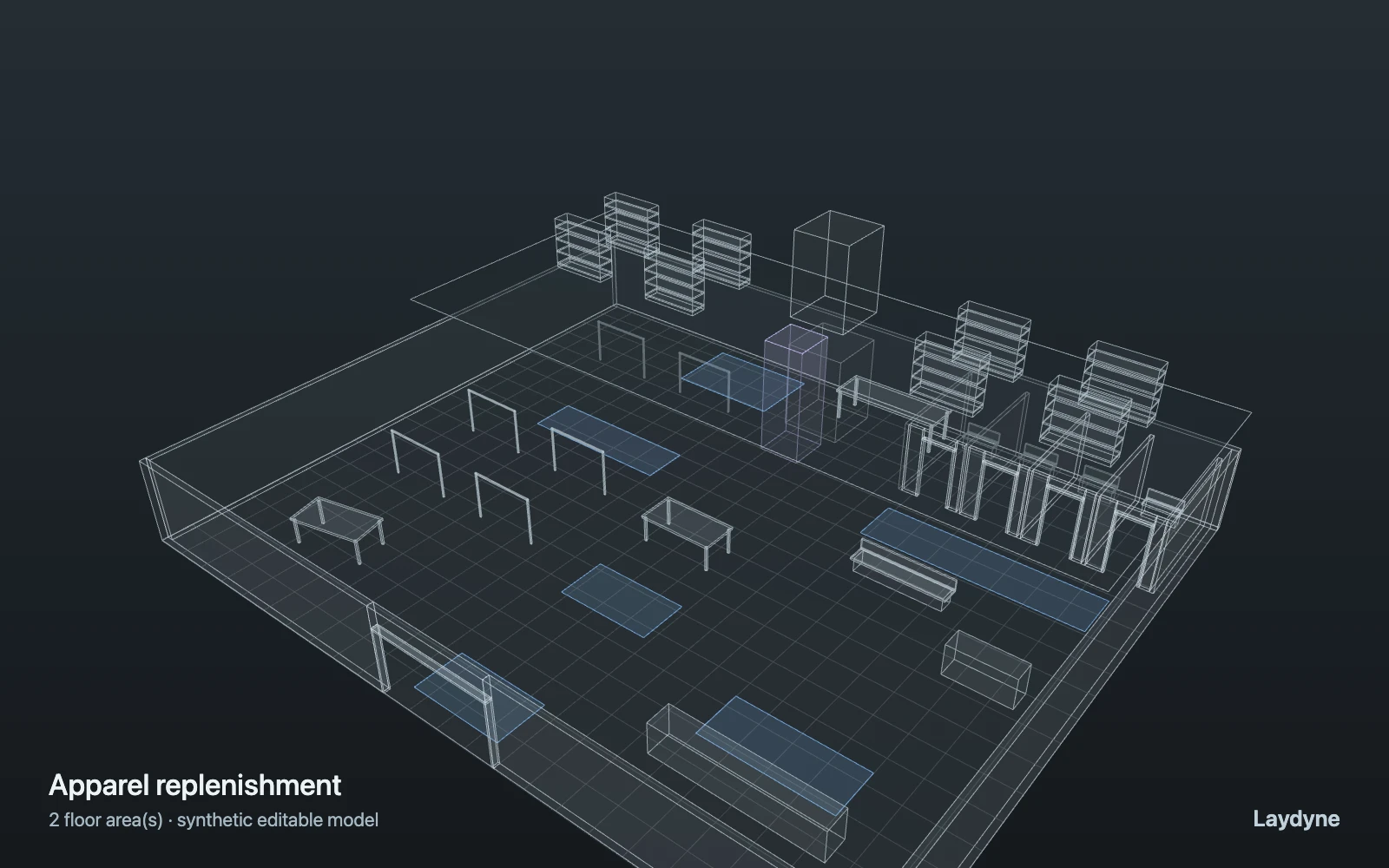
Staff carry 18 replenishment batches from a mezzanine stockroom to a sales-floor drop zone, using a capacity-one lift. Compare one and two staff with the same requests; staff stay occupied on the return. Geometry affects walking distance. This models transfer jobs, not inventory depletion, SKU demand, staff schedules or customer interference. The lift is travel and capacity only, not car dispatch.
Change one thing
Compare 1 and 2 stock assistants, or move the drop zone with demand unchanged.
Read the consequence
Batch wait, walking distance and lift use. Inventory, shifts and customer interference are outside this example.
View the starting inputs
- Replenishment batches
- 18
- Request interval (s)
- 45
- Pick and prepare (s)
- 35
- Place stock (s)
- 45
Agent counts, routes and resource definitions are also saved in the project JSON.
02 / ACTUAL ENGINE OUTPUT
The same demand. A different capacity.
One run, seed 0. Observation window 120 minutes. Arrivals, geometry and the seed set stay the same in every option.
| Scenario | Completed | Mean wait | Mean cycle | Blocked |
|---|---|---|---|---|
| 1 stock assistant | 18 | 9m 45s | 11m 21s | 0 |
| 2 stock assistants | 18 | 1m 37s | 3m 14s | 0 |
Waiting averages cover arrived jobs, including unfinished waits; cycle averages cover completed jobs only. These are synthetic calculations, not measured store performance, revenue or a safety assessment.
Engine, status and output notes
process-des-2.2.0. Status: 1 stock assistant: completed; 2 stock assistants: completed. “Completed” is the engine run status; check the blocked column for unreachable jobs.
- No engine warnings.
Engine inputs and saved comparisons stay with the downloaded project. Any limited trace affects playback details, not aggregate metrics.
03 / MAKE IT YOURS
Plan in 2D. Inspect in 3D. Keep the whole project.
- Open and adjust. Switch between 2D and 3D; edit a part, a floor or an input. Both views describe the same model.
- Connect your agent for free. Sign in, choose Connect AI and connect Codex or Claude Code. Ask it to inspect the example, edit the layout and check a route.
- Save a checkpoint. Export → Project JSON, or ask the agent to export the complete project. Import it later to restore floors, scenarios, saved comparisons and the selected view.
- Compare with Pro. Run an edited scenario or compare frozen options under the same demand. Pro also adds built-in AI and manual cloud saving.