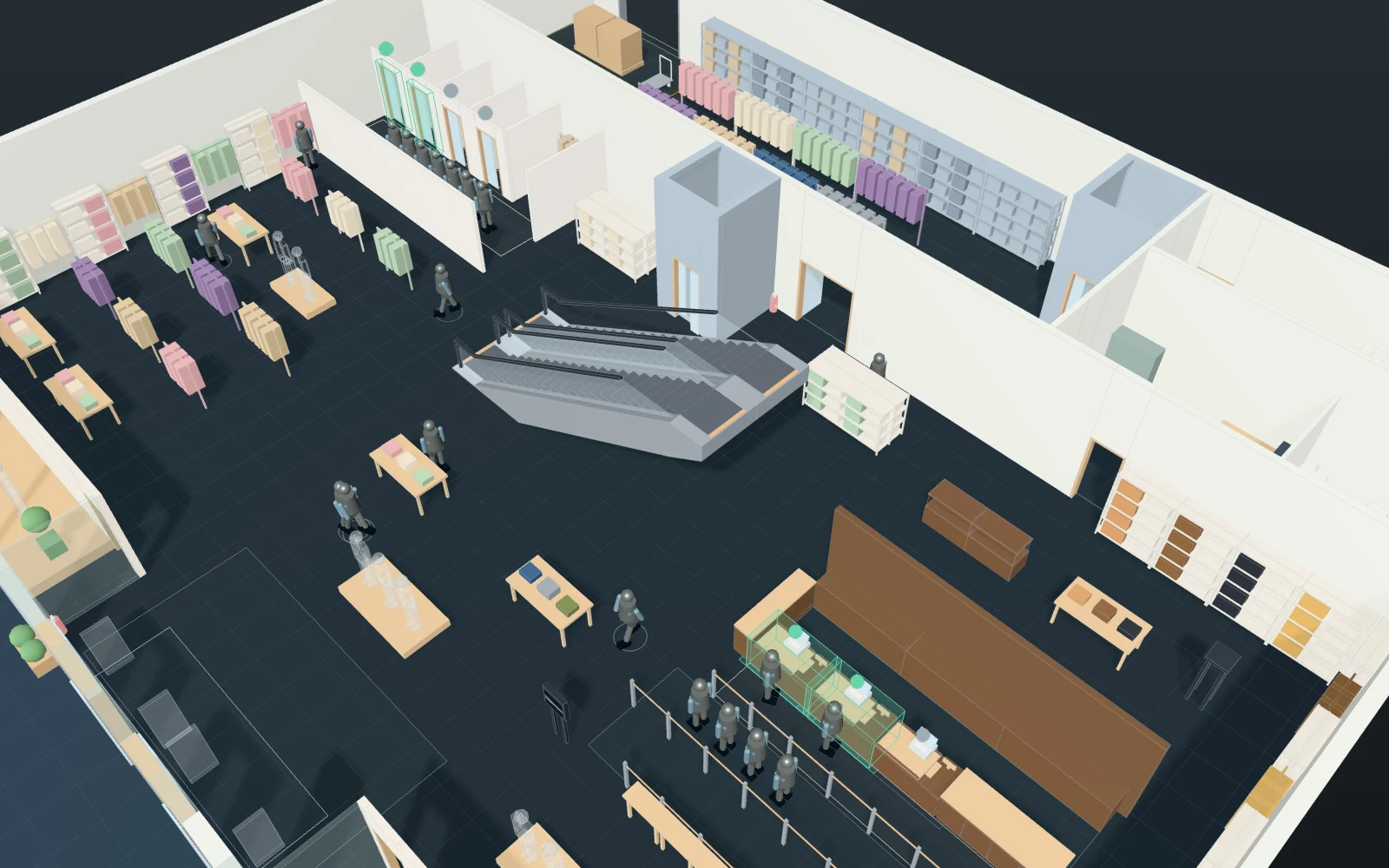
Open the apparel store model (no account needed; running the simulation needs Pro). Which rack or table should carry the new arrivals or the items you want to push? In this article, on a simulated two-storey apparel store, the AI runs the saved Saturday scenario as it is and, assuming each shopper looks where it walks, counts how long every side of the racks, shelves and display tables was in the shoppers’ view. It used the same tools an AI calls over MCP; every figure and picture below is their result.
1. What was counted
The apparel store’s saved Saturday: for the first hour shoppers come in from the street at a rate of 170 an hour, browse, some try clothes on in the fitting rooms, and queue to pay. In this one run of the three hours until all have left, 168 shoppers came, and 86 of them also went up to the first floor.
The AI ran the scenario (run_process_scenario) and counted each floor with get_visibility’s attention:
- It read the fixtures (clothes racks, shelves and display tables) with
get_spaceand named them as parts (66 on the ground floor, 83 on the first). Racks are shopped from all round, so every side is counted. - The points on each side are at 0.7 m: the display tables stand 0.8 m high, so this height is on every fixture (at the default 1.2 m, named display tables are refused).
- Every 3 seconds (the tool widens the step so the three hours take 3,600 samples), each shopper stands where playback draws it and is assumed to look where it walks (60° either side, 60° up or down, within 6 m). Standing still, it keeps the direction it last walked.
- When a point is in that view, the side faces the shopper and no shelf or wall stands between, those 3 seconds are added to the side. Per side: shopper-seconds and how many shoppers had it in view at least once.
2. The ground floor’s sides in view the longest
| Rank | Fixture | Side | Shopper-seconds | Shoppers (of the 168 on the ground floor) |
|---|---|---|---|---|
| 1 | New-in table | East | 10,422 | 110 (65.5%) |
| 2 | Basics gondola (tees and socks) | South | 8,970 | 87 (51.8%) |
| 3 | Socks and small gifts table | North | 5,703 | 105 (62.5%) |
| 4 | Socks and small gifts table | North | 3,495 | 98 (58.3%) |
| 5 | Women’s wall bay, shelving | East | 2,640 | 54 (32.1%) |
- The east side of the new-in table (the eastern one) is 2 m from the west end of the till queue: it is in front of the shoppers waiting in the queue.
- The south side of the basics gondola is 1.1 m from the east end of the ground floor’s fitting-room lobby: it is in front of the shoppers waiting for a free fitting room.
- The socks and small gifts tables stand beside the till queue.
3. The first floor’s sides in view the longest
| Rank | Fixture | Side | Shopper-seconds | Shoppers (of the 86 on the first floor) |
|---|---|---|---|---|
| 1 | Caps and wallets table | East | 15,771 | 79 (91.9%) |
| 2 | Caps and wallets table | South | 11,820 | 84 (97.7%) |
| 3 | Men’s wall bay, hanging | West | 2,757 | 52 (60.5%) |
| 4 | Men’s wall bay, shelving | West | 2,367 | 49 (57%) |
| 5 | Double rail (trousers) | North | 2,334 | 60 (69.8%) |
- The caps and wallets table on the first floor is 3.2 m from the west end of the first floor’s fitting-room lobby. Its east side is in front of the shoppers waiting for a free fitting room (about 200 seconds each on average). Its south side faces the escalator landing, about 4 m away.
On both floors, the longest in view were fixtures beside where shoppers wait, the till queue and the fitting-room lobbies: while they wait, shoppers stand facing the same way.
4. Fixtures never in view
Of the 66 fixtures on the ground floor, 14 had no side ever in a shopper’s view, and 7 of the 83 on the first floor. All of them are the stock racks and shelving in the back of house and the fitting rooms’ return rail, where shoppers do not go. No fixture on the sales floor was left out of view.
5. When the assumption changes
The same run, counted again with another assumed view:
- With a 60° view, the first stays the same on both floors (the new-in table on the ground floor, the caps and wallets table on the first). Of the first five sides, 3 stay among the first five on each floor.
- With 3 m instead of 6 m, the first changes: on the ground floor the socks and small gifts table (beside the till queue), on the first floor the double rail of trousers. Of the first five, 3 stay on the ground floor and 2 on the first. The caps and wallets table is a little over 3 m from where shoppers wait.
- Counted with shoppers hiding fixtures from each other (
crowd: the other shoppers stand in the way as upright prisms of their size), every side added up falls by 10% on the ground floor and 12% on the first. The sides in front of where shoppers wait fall the most: the new-in table’s east side on the ground floor from 10,422 to 4,083, the caps and wallets table’s east side on the first from 15,771 to 6,390, as other waiting shoppers stand in front of those waiting. The ground floor’s first becomes the socks and small gifts table (5,304); the first floor’s first is the caps and wallets table’s south side (6,639). The first five are the same five sides on both floors.
The order changes with the assumption, above all with how far shoppers are assumed to see. Compare plans under the same assumption, and check that a few assumptions lead to the same conclusion.
6. The plans
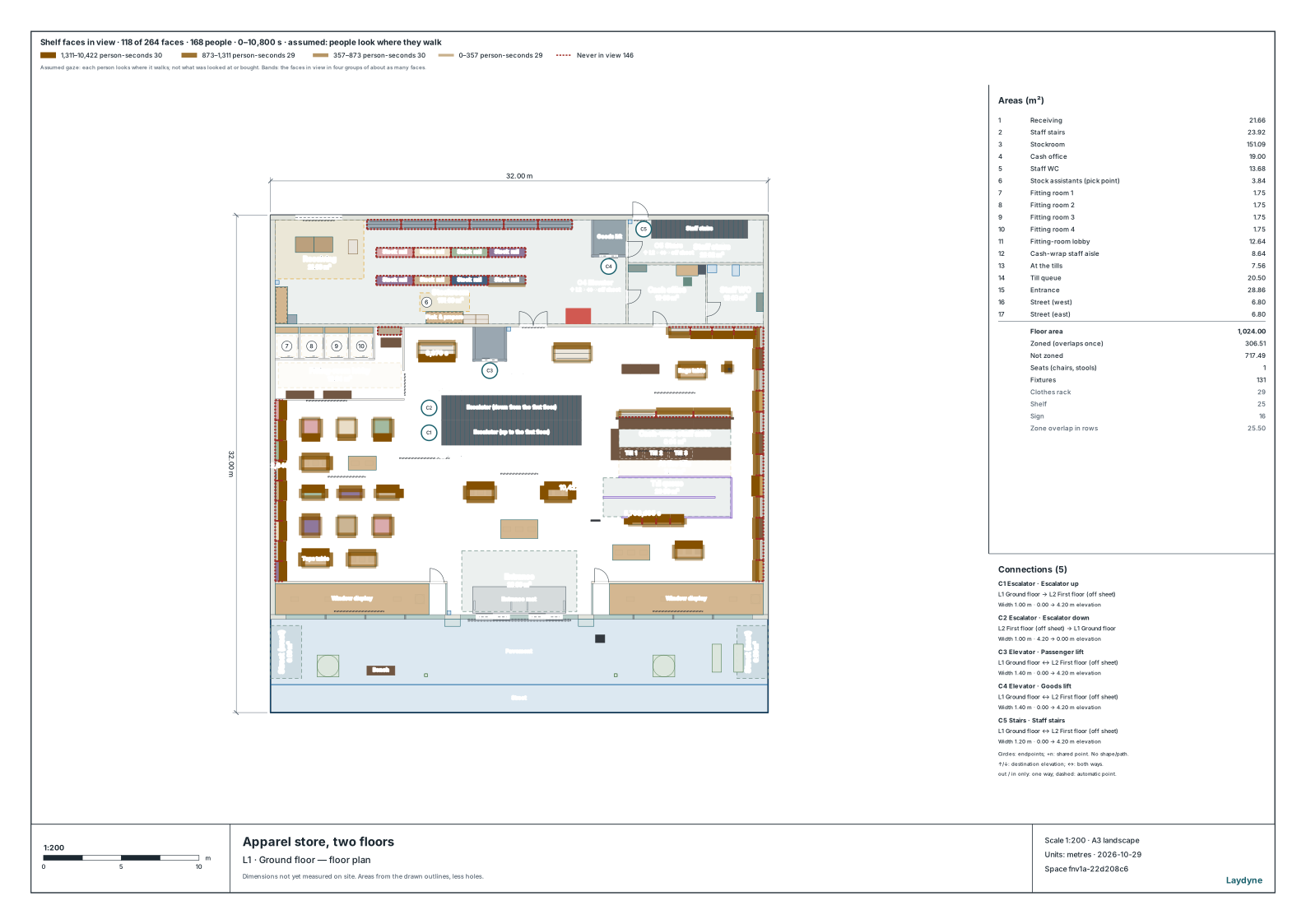
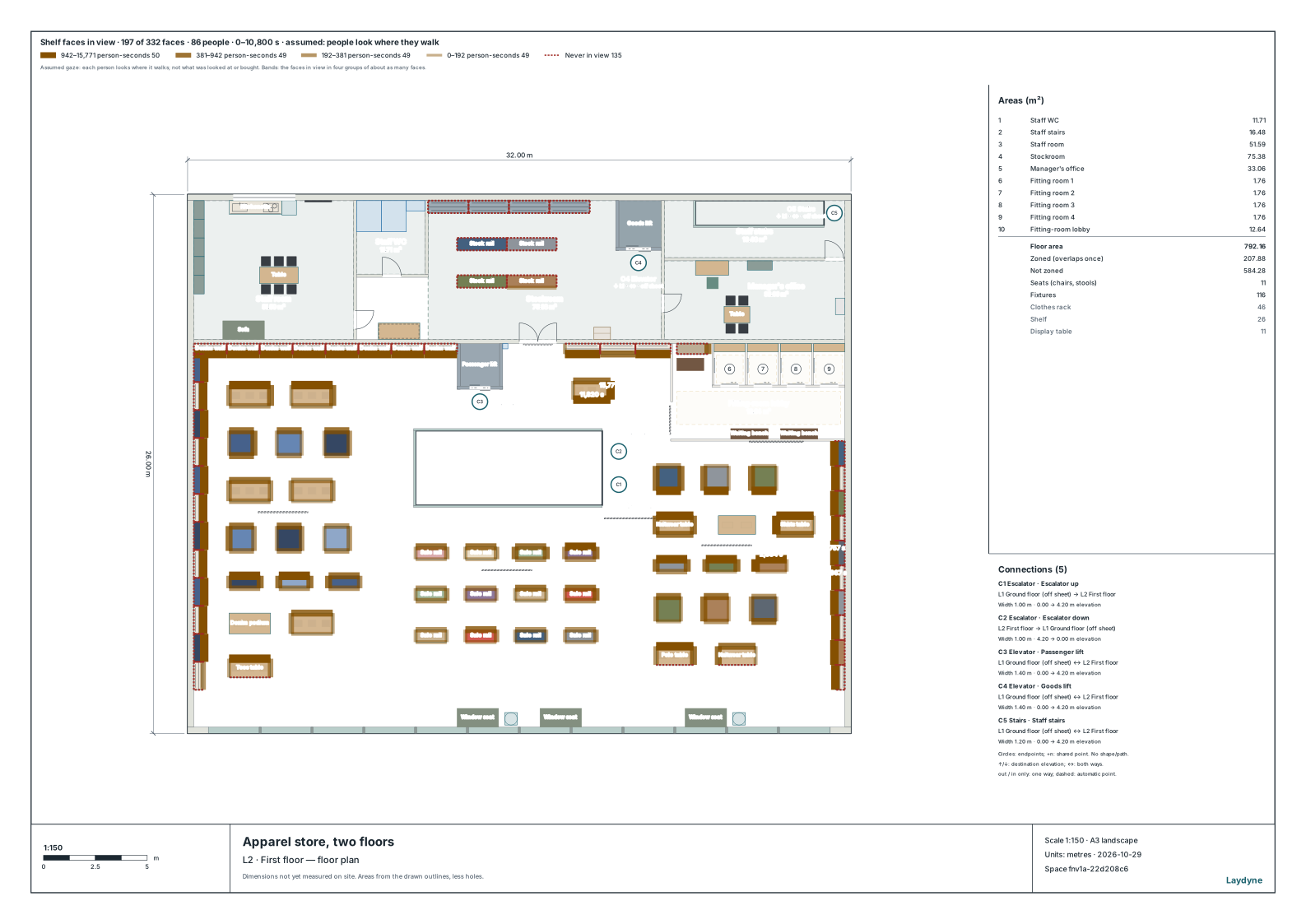
get_view_image’s attention draws the same figures on each floor’s plan: the sides in view in four groups of about as many sides, thicker and darker the longer, the sides never in view dashed, and the five longest with their figures.
7. How to use it, and what it does not tell
- Sell where shoppers wait. The sides beside the till queue and the fitting-room lobby are in front of shoppers all the while they wait: candidates for small items and new arrivals.
- Compare layouts. Run the same scenario on a plan with tables or racks moved and count under the same assumption, to compare which sides come into view for longer.
What it does not tell:
- It counts the time a side was in view, not whether shoppers looked at it, picked something up or bought it.
- Shoppers are assumed to look where they walk, without turning their heads.
- Shoppers hiding fixtures from each other are counted only in the last count of section 5 (prisms of their size); the tables and the plans leave them out. Racks and tables are counted as boxes that hide what is behind them up to their height (seeing between the clothes is not counted).
- It is one run (a fixed random seed).
Tools used
run_process_scenario: runs the saved Saturday scenario as it isget_space: reads each floor’s fixtures (clothes racks, shelves, display tables)get_visibility(attention): counts, for each side of the fixtures, how long and by how many shoppers it was in viewget_view_image(attention): draws the same on each floor’s plan