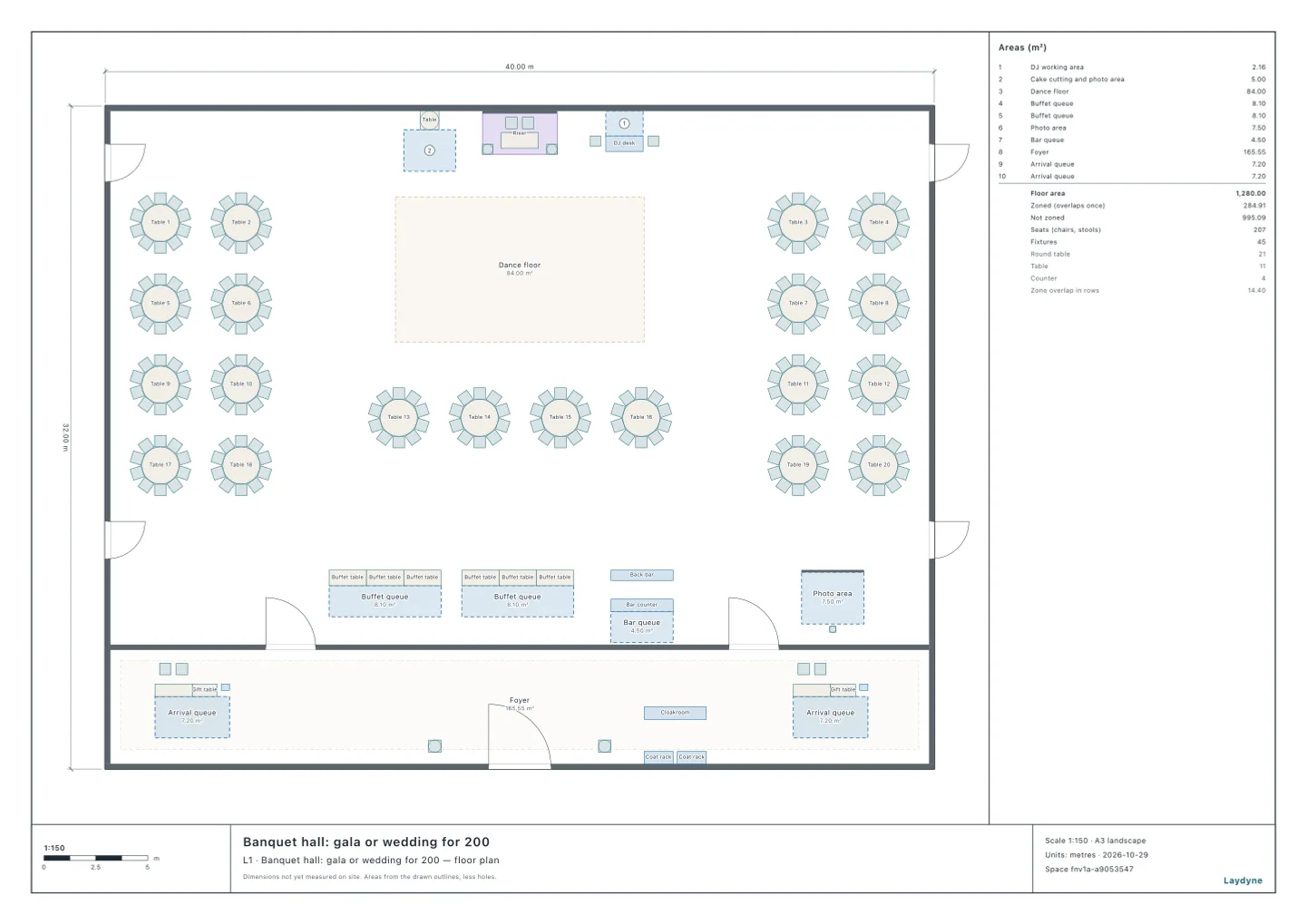
Start from the banquet hall model (free sign-up; running a simulation is Pro). When a party ends, the guests leave the hall in ten minutes or so, and those who left a coat queue at the cloakroom. In this article, in the members’ banquet hall for 200, your AI puts a cloakroom in the foyer and simulates the end of the party. It ran the same tools an AI calls over MCP. Every figure and number below comes from that run.
1. The hall and the end of the party
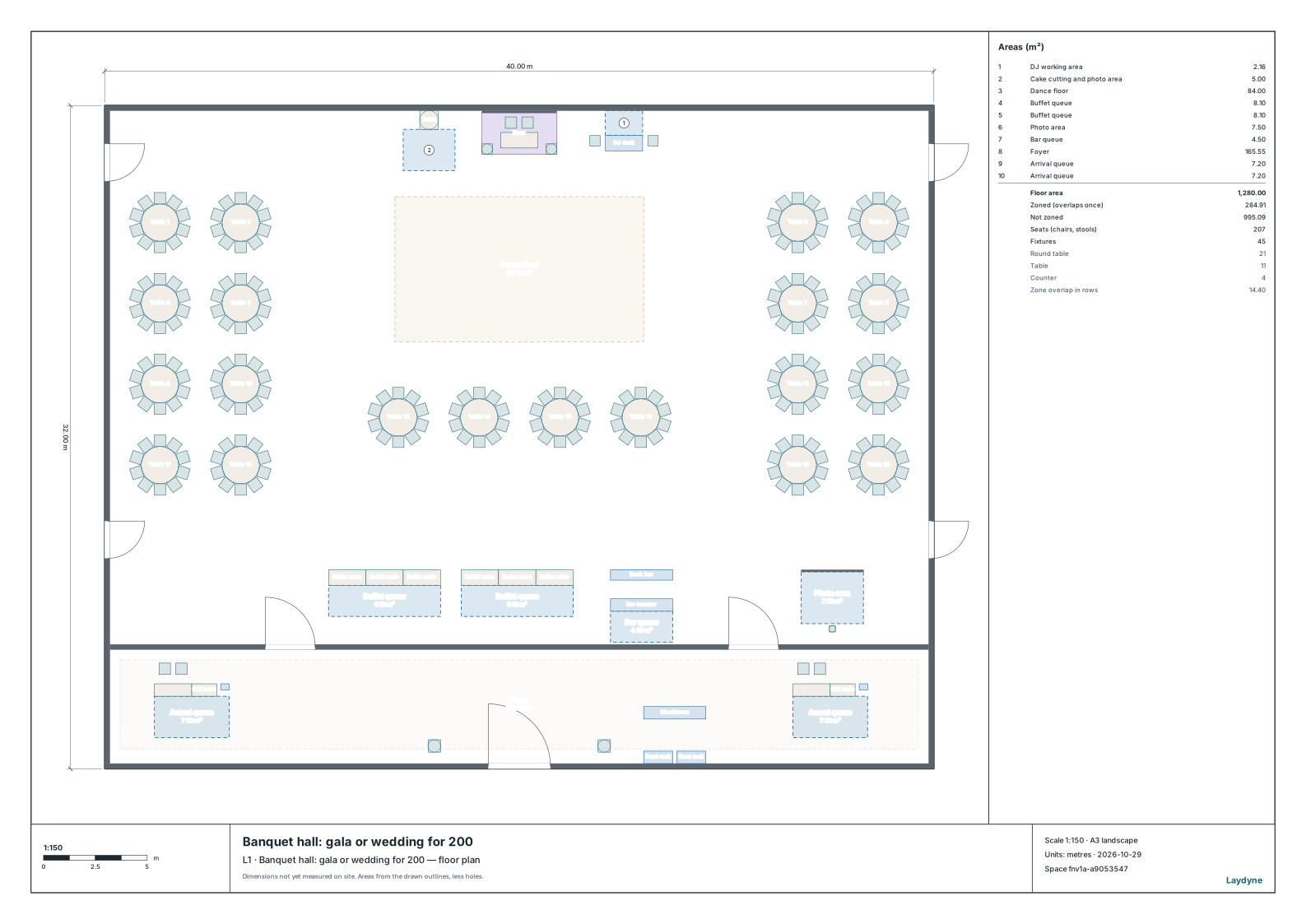
- A hall with 20 round tables of 10, and two doors (west and east) to the foyer to the south. In one change (
edit_space), your AI puts a cloakroom counter (3 m wide) east of the foyer’s entrance, with two coat racks behind it.check_spacefinds nothing.
The AI wrote this flow as a scenario (put_process_scenario).
- Over the ten minutes after the party ends, the 200 guests come out by the hall’s two doors, 100 by each, evenly.
- Those who left a coat or a bag (40, 60 or 80 %) queue in front of the cloakroom counter and hand in their ticket. Finding the coat and handing it over takes the staff 20 seconds to 1.5 minutes (most often 40 seconds, 50 on average).
- With their coat, or straight away without one, the guests leave by the entrance.
- Every number and time is an assumption. Put in your own venue’s records.
2. The cloakroom staff, and the guests who left a coat
The AI changed the cloakroom staff (2, 3, 4) and the share of guests who left a coat (40, 60, 80 %) (sweep_process_parameters), 20 runs each. The wait is the mean for a guest who left a coat, the longest wait the mean over the 20 runs, and the last guest out is the time from the end of the party.
| Left a coat | Cloakroom staff | Wait (mean) | Longest wait | Last guest out |
|---|---|---|---|---|
| 40 % | 2 | 11.3 min | 22.7 min | 33.8 min |
| 40 % | 3 | 5.9 min | 11.9 min | 22.9 min |
| 40 % | 4 | 3.2 min | 6.5 min | 17.5 min |
| 60 % | 2 | 19.1 min | 38.4 min | 49.5 min |
| 60 % | 3 | 11.0 min | 22.2 min | 33.3 min |
| 60 % | 4 | 7.0 min | 14.1 min | 25.2 min |
| 80 % | 2 | 27.5 min | 55.2 min | 66.4 min |
| 80 % | 3 | 16.6 min | 33.3 min | 44.5 min |
| 80 % | 4 | 11.1 min | 22.5 min | 33.7 min |
- With 60 % leaving a coat and two staff, the wait is 19.1 minutes on average, and the last guest leaves 49.5 minutes after the end of the party. At the most 92.7 guests wait at once: a queue across the foyer.
- The last guest leaves at about the coats left, times 50 seconds a coat, divided by the staff. At 60 % that is 120 coats times 50 seconds, 100 minutes of work: 50 minutes with two, 33 with three, 25 with four (49.5, 33.3 and 25.2 in the simulation). The guests come out in ten minutes, so with few staff almost everyone queues.
- In winter, with 80 % leaving a coat, four staff take 33.7 minutes: about the same as two at 40 % (33.8 minutes).
3. Bringing a coat out quicker
With 60 % of the guests leaving a coat, the AI compared finding a coat in 60 % of the time, say by hanging the coats in the order of their tickets when they are left.
| Cloakroom staff | Bringing a coat out | Wait (mean) | Longest wait | Last guest out |
|---|---|---|---|---|
| 2 | As now | 19.1 min | 38.4 min | 49.5 min |
| 3 | As now | 11.0 min | 22.2 min | 33.3 min |
| 2 | Down to 60 % | 9.5 min | 19.1 min | 29.8 min |
| 3 | Down to 60 % | 4.7 min | 9.4 min | 20.2 min |
- Bringing a coat out in 60 % of the time, even two staff get the last guest out in 29.8 minutes: sooner than three at the time as now (33.3 minutes).
4. How to use this check
- Draw your own venue (from a PDF of the drawings or photos too), and tell your AI the guests, how long they take to come out after the party, the share who leave a coat, the time to bring one out and the cloakroom staff. Your AI also puts a moved cloakroom or a wider counter on the drawing and checks them.
- Not checked: leaving the coats before the party, large luggage and gift bags, guests who stay talking in the foyer, guests hurrying to an after-party, how the queue in front of the cloakroom forms and a crowded foyer, and the lifts and the car park.