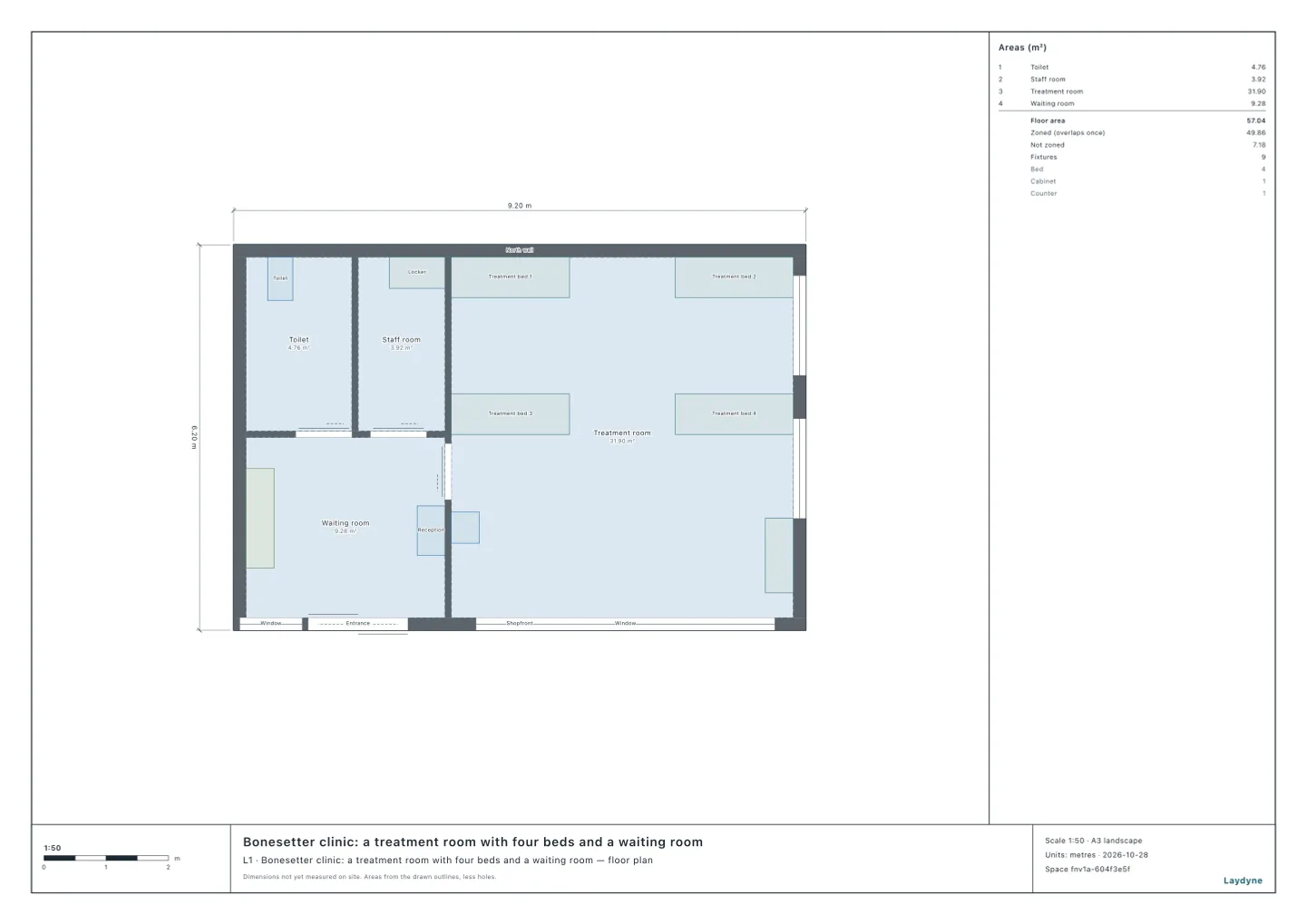
Start from the bonesetter clinic model (free sign-up; running a simulation is Pro). A bonesetter clinic fills up in the evening, as patients come from work and school. Whether it is short of therapists or of beds changes what to do. In this article, in the members’ bonesetter clinic, your AI simulates a weekday evening. It ran the same tools an AI calls over MCP. Every figure and number below comes from that run.
1. The clinic and the evening
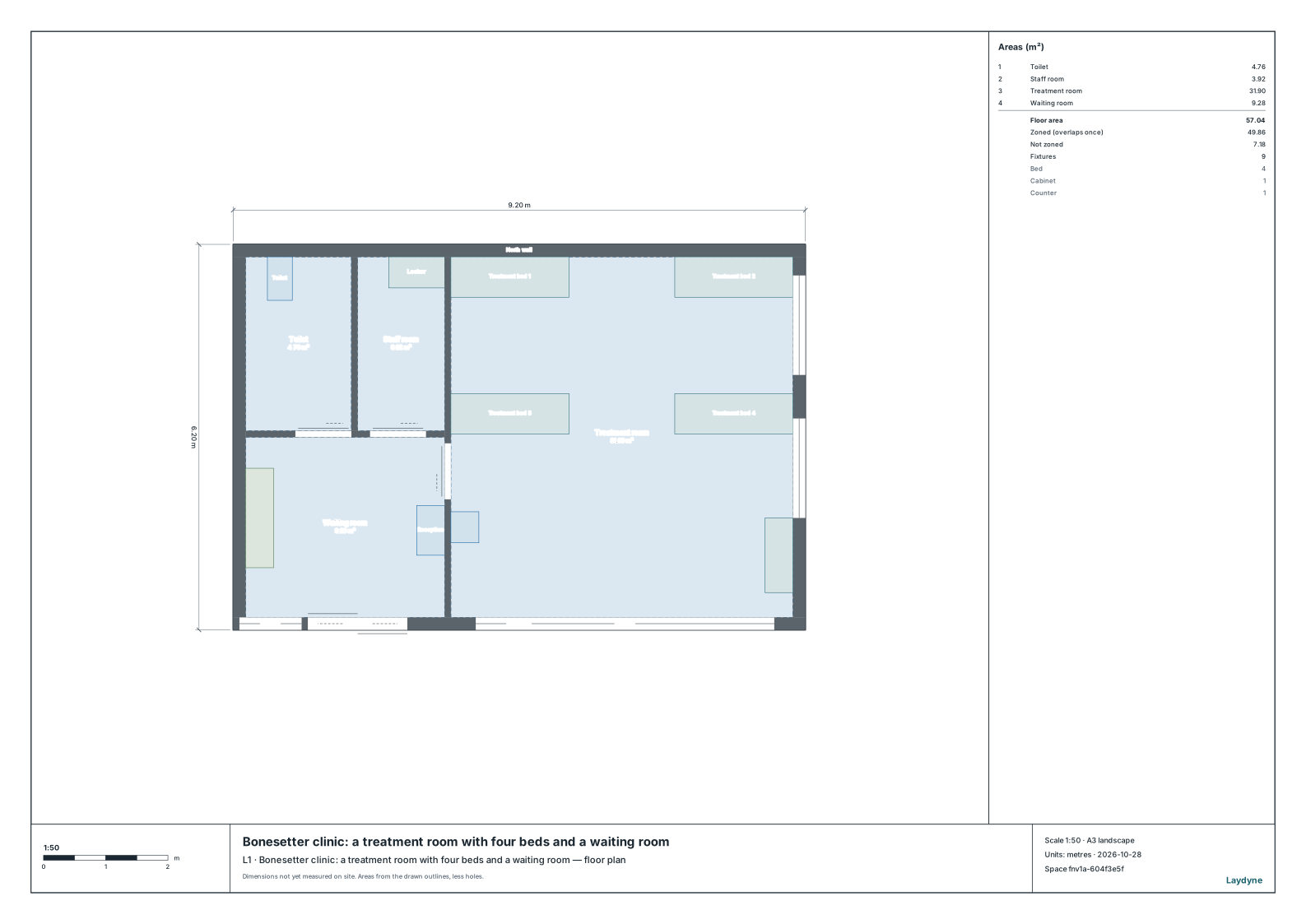
In one change (edit_space) your AI tags the four treatment beds, so each patient takes one of their own. check_space finds nothing. Your AI writes the evening as a scenario (put_process_scenario).
- From 16:00 to 20:00 patients come in at random: half an hour at a time from 16:00, 40, 50, 70, 90, 100, 100, 70 and 40 % of the patients from 18:00 to 19:00, the busiest hour.
- After the reception (30 to 90 seconds) a patient waits in the waiting room for a free bed up to 30 minutes, then leaves.
- On the bed, the patient waits for a therapist and has the manual treatment (8 to 15 minutes, most often 10).
- Those who have electrotherapy (70 % to begin with) then have 10 minutes of it on the bed, with no therapist.
- The patient pays at the reception (30 to 60 seconds) and leaves. Every time is an assumption, to swap for your own.
2. The therapists and the patients that come
Your AI sweeps the therapists (1, 2, 3) and the patients from 18:00 to 19:00 (6, 9, 12) with sweep_process_parameters, 20 runs each. The wait for a bed is over every patient, the wait for a therapist over those treated.
| 18:00 to 19:00 | Therapists | Patients | Left untreated | Wait for a bed (waiting room) | Wait for a therapist (on the bed) | From coming in to leaving |
|---|---|---|---|---|---|---|
| 6 | 1 | 16.1 | 0.8 | 3.6 min | 10.7 min | 33.5 min |
| 6 | 2 | 16.1 | 0.0 | 0.6 min | 0.8 min | 22.0 min |
| 6 | 3 | 16.1 | 0.0 | 0.4 min | 0.1 min | 21.1 min |
| 9 | 1 | 25.6 | 4.7 | 12.1 min | 17.2 min | 43.3 min |
| 9 | 2 | 25.6 | 0.1 | 2.9 min | 1.9 min | 25.2 min |
| 9 | 3 | 25.6 | 0.0 | 1.7 min | 0.2 min | 22.2 min |
| 12 | 1 | 33.6 | 10.7 | 17.9 min | 19.9 min | 46.7 min |
| 12 | 2 | 33.6 | 1.4 | 7.1 min | 2.6 min | 29.6 min |
| 12 | 3 | 33.6 | 0.7 | 4.9 min | 0.3 min | 25.5 min |
- With 9 patients from 18:00, one therapist leaves 4.7 of 25.6 patients going home untreated, and from coming in to leaving takes 43.3 minutes. Two make it 0.1 and 25.2 minutes.
- With 12 patients from 18:00, even three leave a wait of 4.9 minutes for a bed in the waiting room. The wait for a therapist is 0.3 minutes: it is the beds that run short.
3. The share who have electrotherapy
With 12 patients from 18:00, your AI changes the share who have electrotherapy (0, 50, 70, 100 %) and the therapists (2, 3). During electrotherapy the bed stays taken, but the therapist can move on to the next patient.
| Electrotherapy | Therapists | Left untreated | Wait for a bed (waiting room) | Wait for a therapist (on the bed) | From coming in to leaving |
|---|---|---|---|---|---|
| 0 % | 2 | 1.1 | 4.6 min | 5.7 min | 23.1 min |
| 50 % | 2 | 1.3 | 6.5 min | 3.5 min | 28.0 min |
| 70 % | 2 | 1.4 | 7.1 min | 2.6 min | 29.6 min |
| 100 % | 2 | 1.8 | 8.3 min | 1.2 min | 31.8 min |
| 0 % | 3 | 0.0 | 1.2 min | 1.0 min | 15.6 min |
| 50 % | 3 | 0.4 | 3.3 min | 0.4 min | 22.2 min |
| 70 % | 3 | 0.7 | 4.9 min | 0.3 min | 25.5 min |
| 100 % | 3 | 1.5 | 7.0 min | 0.1 min | 29.7 min |
- The more have electrotherapy, the more the wait moves from the therapists to the beds. With two therapists, the wait for a therapist falls from 5.7 minutes at 0 % to 1.2 at 100 %, and the wait for a bed grows from 4.6 to 8.3 minutes.
- With three therapists, from coming in to leaving takes 15.6 minutes at 0 % and 29.7 at 100 %.
4. Using the check
- Draw your clinic (from a PDF drawing or photos as well), and tell your AI the patients in the evening, the times of the treatment and of electrotherapy, and the therapists.
- Not checked: how bookings are taken, insured and private treatment, takings, the reception staff, and the chairs in the waiting room.