Start from the trade show hall (free sign-up), or draw your own venue. Allocating booths means going down the exhibitor list, giving each a booth that keeps the organiser’s rules (where sponsors go, competitors not side by side), and drawing it as a booth plan. In this article your AI allocates a show of 24 booths. It runs on a synthetic venue with the same tools your AI calls over MCP; every company is made up. Every number and drawing below comes from that run.
1. The hall and the exhibitors
The synthetic venue is a trade show hall 36 × 26 m.
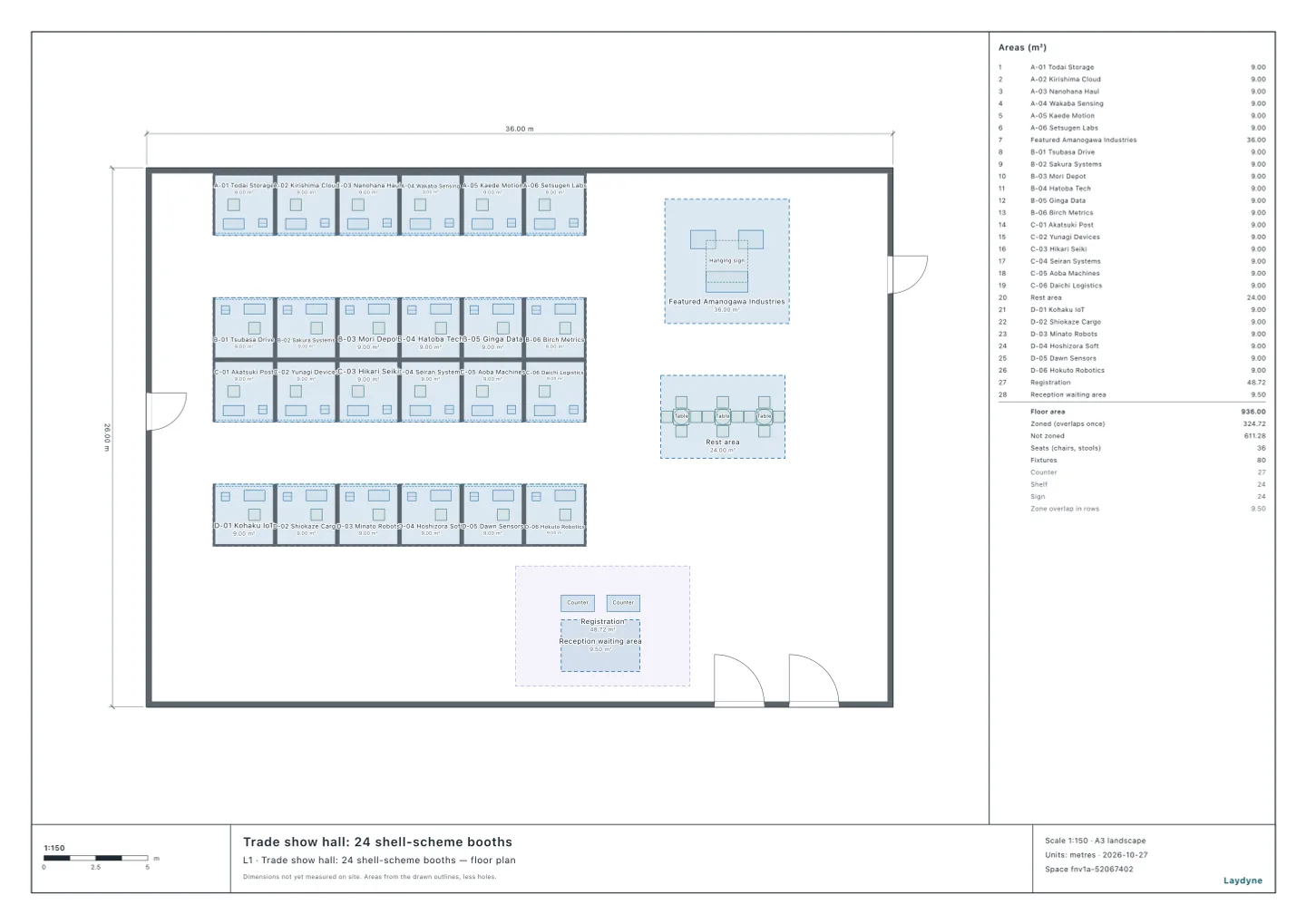
- There are 24 shell-scheme booths of 3 × 3 m in four rows of six, A to D: A along the north wall, B and C back to back, D to the south, with 3 m aisles. An island booth (6 × 6 m) to the north-east, a rest area to the east, and registration and two entrances to the south.
- Each booth’s fascia carries its number (A-01 to D-06), and your AI reads the booths, their fascias and carpets with
get_space. - There are 25 exhibitors: four gold sponsors, 20 others in order of application, and one featured exhibitor, in four fields: robots, sensors & IoT, software and logistics services.
2. The rules
Your AI allocated in this order.
- The four gold sponsors take the booths nearest the entrances (in a straight line from the middle of the nearer entrance door to the middle of the booth).
- The other 20, in order of application, take the nearest free booth that has no company of the same field beside it, left or right, in its row.
- The featured exhibitor takes the island.
The booths nearest the entrances are D-06 (12.7 m), D-05 (15.0 m), D-04 (17.5 m), C-06 (17.5 m) and C-05 (19.2 m). Once allocated, no two companies of a field sit side by side in a row.
3. The allocation
| Booth | Exhibitor | Field | How |
|---|---|---|---|
| A-01 | Todai Storage | Logistics services | Application 20 |
| A-02 | Kirishima Cloud | Software | Application 19 |
| A-03 | Nanohana Haul | Logistics services | Application 18 |
| A-04 | Wakaba Sensing | Sensors & IoT | Application 17 |
| A-05 | Kaede Motion | Robots | Application 12 |
| A-06 | Setsugen Labs | Software | Application 11 |
| B-01 | Tsubasa Drive | Robots | Application 16 |
| B-02 | Sakura Systems | Software | Application 15 |
| B-03 | Mori Depot | Logistics services | Application 10 |
| B-04 | Hatoba Tech | Sensors & IoT | Application 8 |
| B-05 | Ginga Data | Software | Application 5 |
| B-06 | Birch Metrics | Sensors & IoT | Application 3 |
| C-01 | Akatsuki Post | Logistics services | Application 14 |
| C-02 | Yunagi Devices | Sensors & IoT | Application 13 |
| C-03 | Hikari Seiki | Robots | Application 7 |
| C-04 | Seiran Systems | Software | Application 4 |
| C-05 | Aoba Machines | Robots | Application 1 |
| C-06 | Daichi Logistics | Logistics services | Gold sponsor |
| D-01 | Kohaku IoT | Sensors & IoT | Application 9 |
| D-02 | Shiokaze Cargo | Logistics services | Application 6 |
| D-03 | Minato Robots | Robots | Application 2 |
| D-04 | Hoshizora Soft | Software | Gold sponsor |
| D-05 | Dawn Sensors | Sensors & IoT | Gold sponsor |
| D-06 | Hokuto Robotics | Robots | Gold sponsor |
The island goes to the featured exhibitor, Amanogawa Industries.
4. The booth plan
In one change with edit_space, your AI wrote “booth number and name” on each booth’s fascia (what visitors see in 3D) and the same name on each booth’s carpet, a floor area (what the plan shows), and named the island’s carpet “Featured Amanogawa Industries” (49 places). Only names changed, so check_space finds nothing.
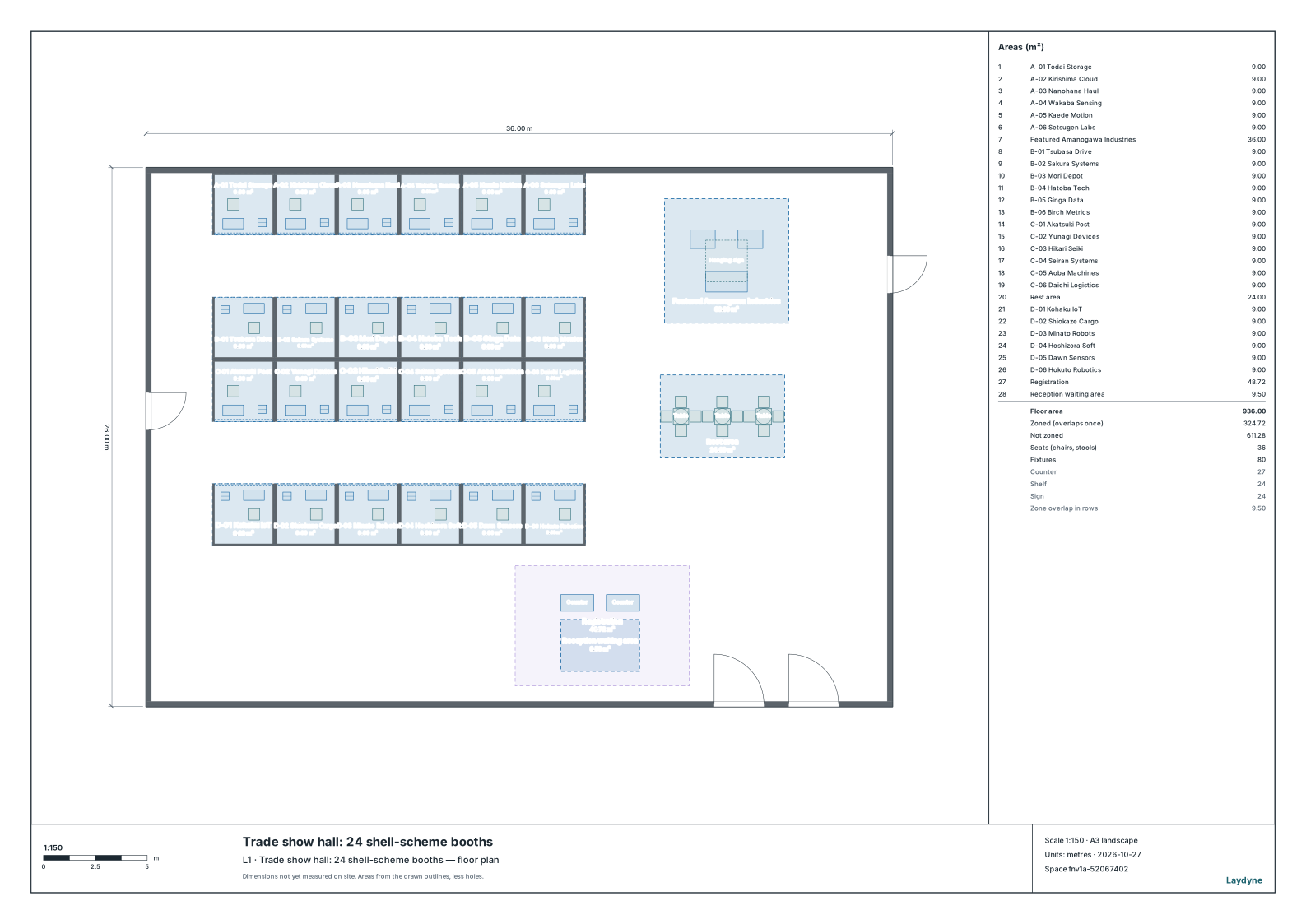
- The list of areas on the right of the plan gives the exhibitors in booth order (with the island, the rest area and registration).
- A long company name may not fit inside its booth. Give your AI the short form for the plan.
5. How to use these numbers
- Give your AI the exhibitor list (field, order of application, sponsor level) and the rules (competitors apart, where sponsors go, booths near power or the loading door). When exhibitors change, it can allocate again by the same rules.
- Booth sizes, aisle widths and exhibit heights follow the venue’s rules and what the fire authority requires. The distances here are straight lines, not the way visitors walk.