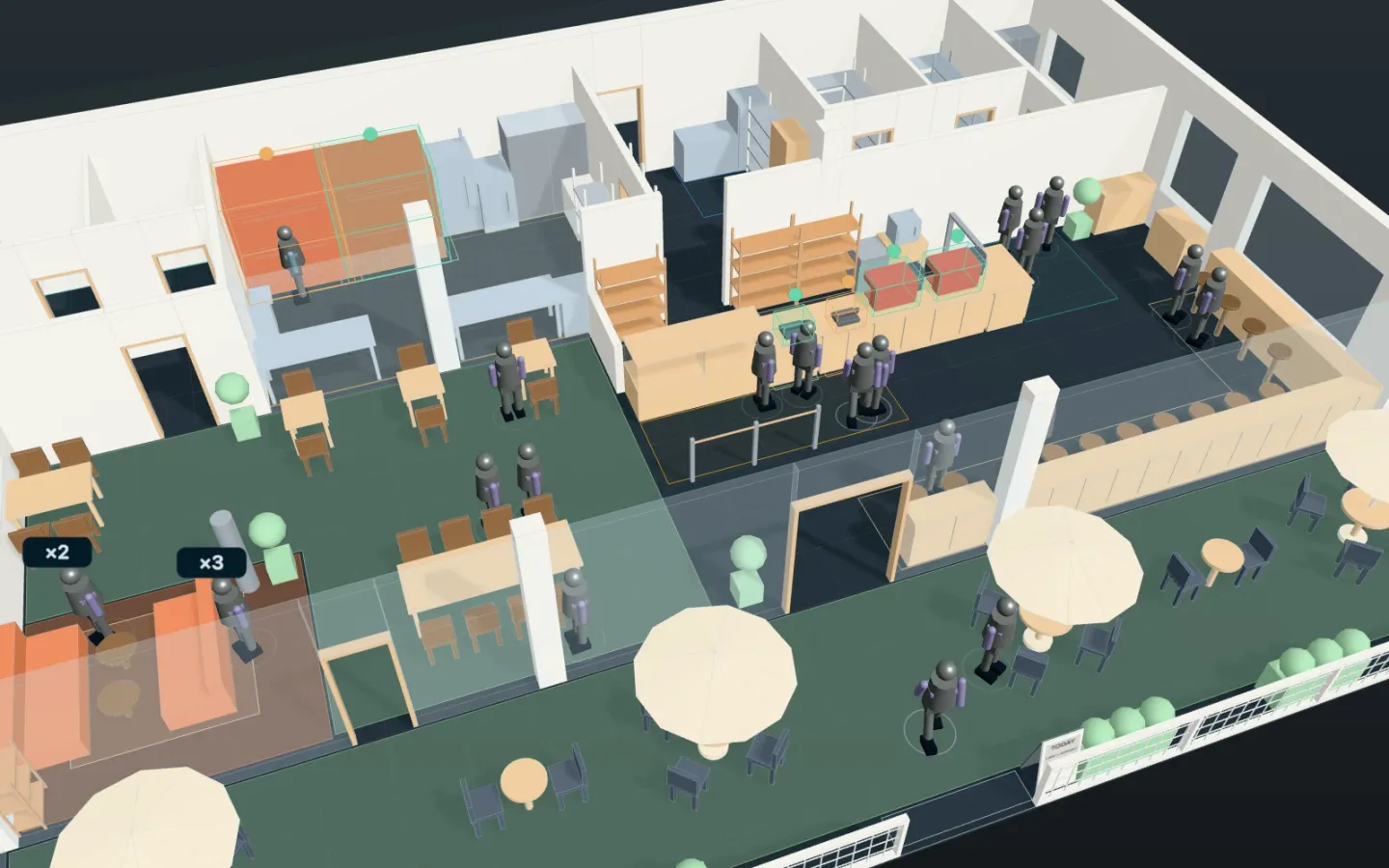
Open the café & bakery model (no sign-up needed; running a simulation needs Pro). How many people do you put at the tills and on the bar (the espresso machines) for the morning rush? Too few and the line grows; too many and the wages add up. In this article, your AI reads the saved morning peak of a mock café, saves a copy with the tills to open and app orders added, and compares ways of putting people on. It ran the same tools an AI calls over MCP. Every figure and number below comes from that run.
1. The café and its morning peak
The saved morning peak of the mock café & bakery (a 22 × 12 m shop, about 38 seats inside and 20 on the terrace):
- Guests come in from the street at random, at 90 an hour for 40 minutes (64.0 on average over the 20 runs).
- They join the order line and order at a free till (else the one with fewer waiting), in 40 s. Three in four order a drink and wait at pickup while a barista makes it at a free espresso machine (40 to 100 s, most often 55). The rest take only bread or a pastry, pay, and sit or go.
- Two tills and two espresso machines. Today two people are at the tills and two baristas on the bar. A baker, apart, bakes a batch every ten minutes and restocks the shelves.
- The order line holds 12 people and pickup 8; when one is full, guests wait at its edge.
Your AI reads the saved scenario (list_process_scenarios) and saves a copy (put_process_scenario, the saved one left as it is) that keeps the steps at the tills, the bar and the seats, and adds the tills to open (tills) and the share of drink guests who order in an app and skip the line (appShare). With two tills and no app orders, the copy gives the same waits as the saved scenario. With sweep_process_parameters, it runs the same twenty random runs at each combination.
2. Today’s wait, and the work
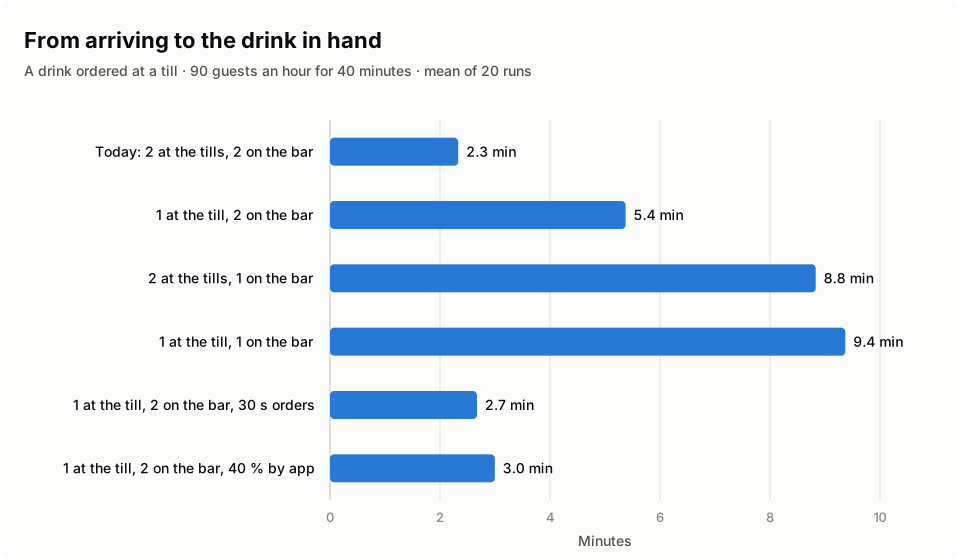
Today (two at the tills, two on the bar), a guest who orders a drink at a till has it in hand 2.3 min after arriving, on average: 0.8 min at the tills (in line and ordering) and 1.3 min waiting at pickup. A guest with only bread has paid in 0.9 min.
At 90 guests an hour, the tills have 60 minutes of work an hour (90 × 40 s) and the bar 73.1 (three in four of the 90, 65 s a drink). One person at a till would take orders without a pause, and one barista is not enough.
3. How many at the tills and on the bar
| Who is on | To the drink in hand | Against today | At the tills | At pickup |
|---|---|---|---|---|
| 2 at the tills, 2 on the bar (today, 4) | 2.3 min | – | 0.8 min | 1.3 min |
| 1 at the till, 2 on the bar (3) | 5.4 min | +3.0 min (95 % interval +2.1 to +4.0 min) | 3.8 min | 1.1 min |
| 2 at the tills, 1 on the bar (3) | 8.8 min | +6.5 min (+5.3 to +7.7 min) | 0.8 min | 6.2 min |
| 1 at the till, 1 on the bar (2) | 9.4 min | +7.0 min (+5.8 to +8.2 min) | 3.8 min | 4.7 min |
| 2 at the tills, 3 on the bar (5) | 2.3 min | 0.0 min (the same) | 0.8 min | 1.3 min |
- With three people, put two on the bar: 5.4 min against 8.8. With one barista the wait at pickup is 6.2 min and pickup (8 people) overflows: at most 6.3 on average wait at its edge.
- With one at the till, the time at the tills is 3.8 min and the line is 9.2 at its longest. The order line (12 people) fills too, and at most 2.0 wait before it. A guest with only bread takes 4.2 min to pay.
- A third barista gives the same numbers as two: with two espresso machines, the third has nothing to make.
4. Three people: quicker orders, or orders in the app
With one at the till and two on the bar, your AI changes the time an order takes at the till and the share of drink guests who order in the app. From arriving to the drink in hand:
| The order at the till | 2 at the tills (4) | 1 at the till (3) |
|---|---|---|
| 30 s | 2.1 min | 2.7 min |
| 40 s (today) | 2.3 min | 5.4 min |
| 50 s | 2.6 min | 9.8 min |
| Drink guests ordering in the app | 2 at the tills (4) | 1 at the till (3) |
|---|---|---|
| 0 % (today) | 2.3 min | 5.4 min |
| 20 % | 2.3 min | 4.0 min |
| 40 % | 2.3 min | 3.0 min |
- If an order takes 30 s (guests decide while in line, payment is quicker), one at the till gives 2.7 min, only 0.3 min (95 % interval 0.2 to 0.5 min) more than today. At 50 s it is 9.8 min.
- If 40 % of the drink guests order in the app, one at the till gives 3.0 min; those who ordered in the app have their drink 1.5 min after arriving (they only wait at pickup).
- With two at the tills, app orders change almost nothing (a difference within the noise): with four people, the tills had room already.
5. Busier and quieter mornings
| Guests an hour | In the 40 minutes (mean of 20 runs) | 2 at the tills, 2 on the bar | 1 at the till, 2 on the bar |
|---|---|---|---|
| 60 | 42.8 | 2.1 min | 2.6 min |
| 90 (today) | 64.0 | 2.3 min | 5.4 min |
| 120 | 85.0 | 3.1 min | 11.1 min |
- At 60 an hour, one at the till and two on the bar give 2.6 min.
- At 120, one at the till gives 11.1 min, and at most 17.8 wait before the order line; two at the tills give 3.1 min.
6. How to use these numbers
- Give your AI your own guests every 15 minutes (from the till records), order and drink times, and shares of drinks and takeaway: the numbers here are the example’s assumptions.
- Choose the rota with the wait and the wages together: a shorter wait alone does not show more sales.
- Here an app order comes in when the guest arrives, so its effect is on the low side (an order placed before arriving would shorten the wait at pickup further).
- Not calculated: someone free moving between the till and the bar, clearing and washing up, warming food, guests who leave on seeing the line, sales.