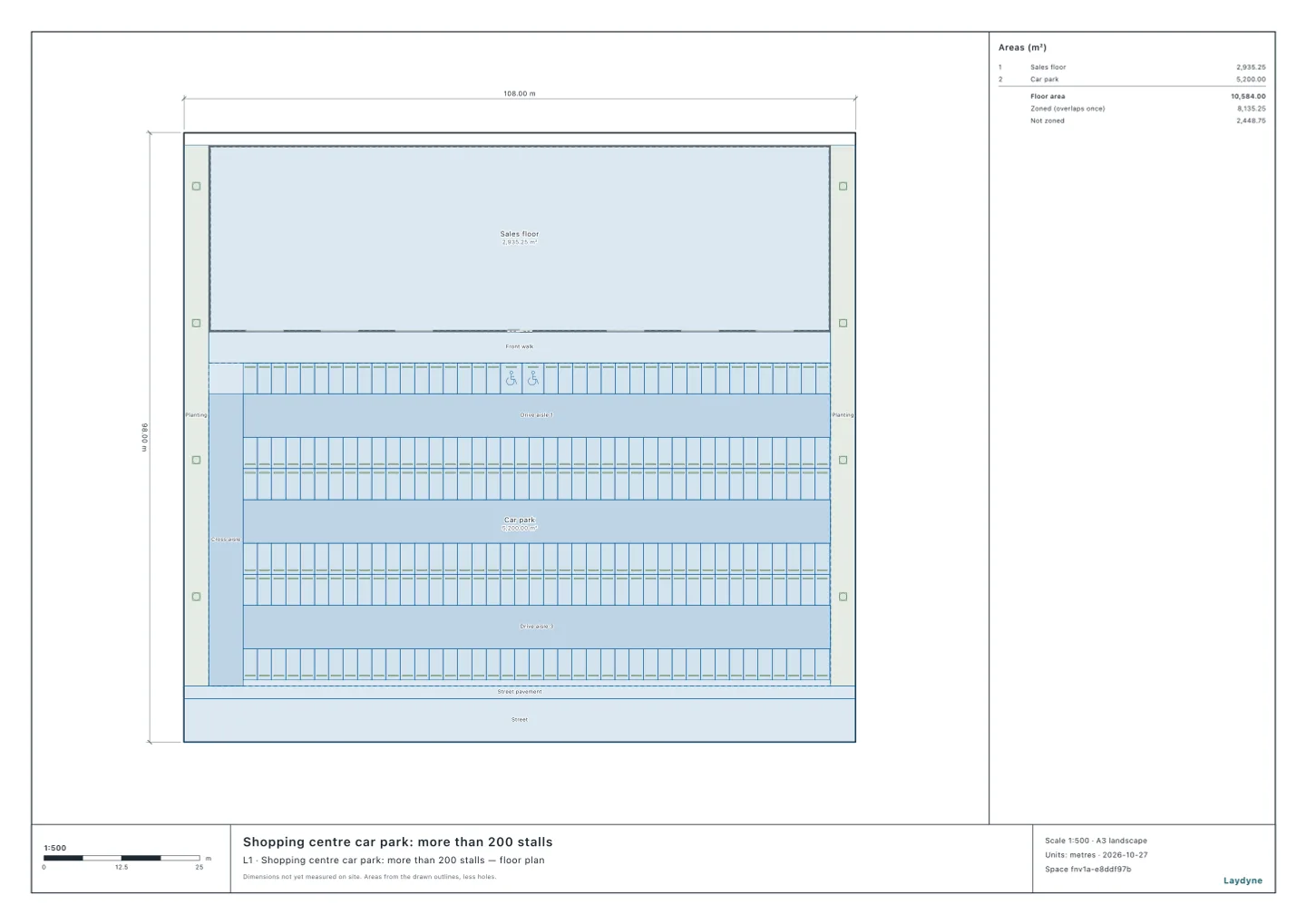
Start from the car park (free account) or from your own drawing. Japan's barrier-free order sets how many of a car park's stalls must be for wheelchair users, and the count changes past 200 stalls. This article checks a synthetic shopping centre car park, with the same tools your AI calls over MCP. Every number below comes from that run.
What the order asks
From e-Gov (高齢者、障害者等の移動等の円滑化の促進に関する法律施行令, article 18):
- For 200 stalls or fewer, at least 2% of them are for wheelchair users, rounded up. For more than 200, 1% rounded up, and 2 more.
- Each is 350 cm wide or more.
- Each is placed where the route from it to the rooms is as short as it can be.
check_space with accessibleParking counts the stalls in the lot and the wheelchair stalls among them. It measures each one's width, and finds each stall's route to the door without stairs. Of the wheelchair stalls, the nearest as many as needed must have no ordinary stall nearer.
1. The lot as drawn
| Stalls in the lot | 245 |
| Wheelchair stalls needed: 1% of 245 is 2.45, rounded up to 3, and 2 more | 5 |
| Wheelchair stalls drawn, by the main door, 3.5 m wide | 2 |
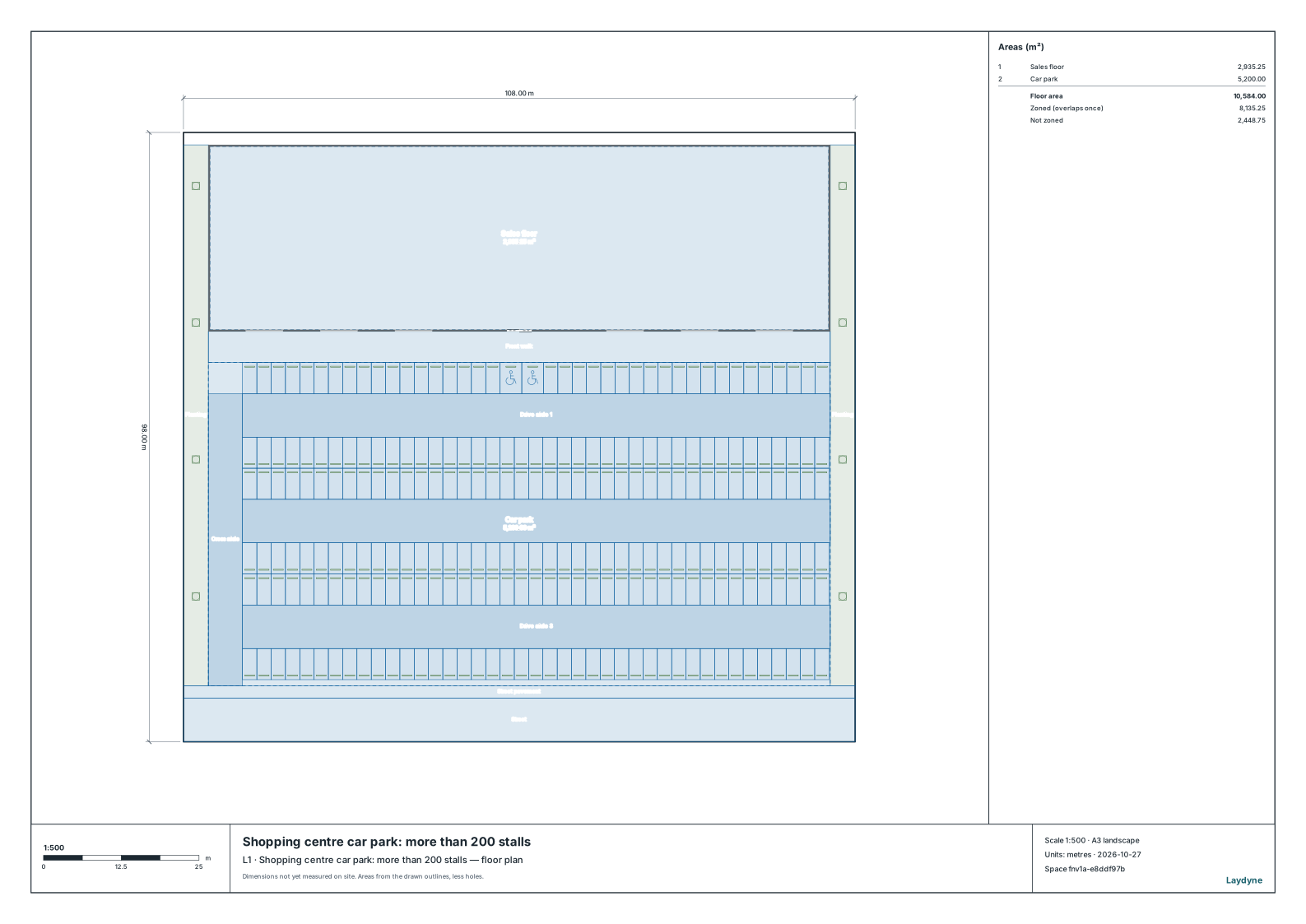
The two wheelchair stalls are wide enough and are the nearest stalls to the door, 7.74 m and 7.92 m away. But the lot has the 2 a small lot would have, and it needs 5. The floor check (check_space) finds no issues: the count is the order's, not the drawing's.
2. Set it out again
suggest_parking with accessible: law sets each way out with as many wheelchair stalls as its own stalls need, in the row nearest the door:
| Way | Stalls | Wheelchair stalls |
|---|---|---|
| Perpendicular | 217 | 5 |
| Parallel, cross aisle on the west | 243 | 5 |
| Parallel, cross aisle on the east | 243 | 5 |
The way with the most stalls, the cross aisle on the west, is applied as one change. Checked again:
| Stalls in the lot | 243 |
| Wheelchair stalls needed | 5 |
| Wheelchair stalls drawn, 3.5 m wide, the 5 nearest the door (7.70 m to 11.09 m) | 5 |
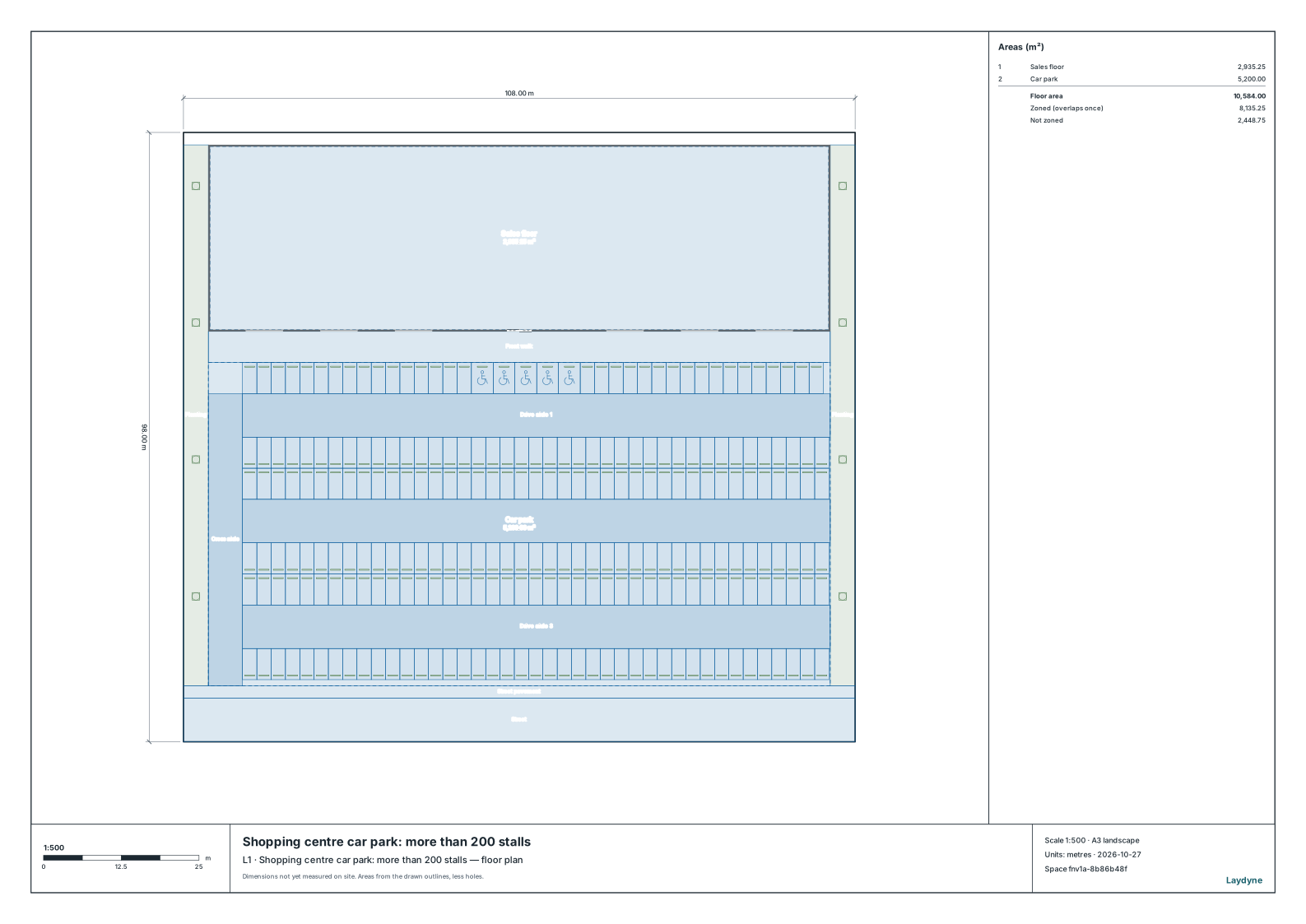
Three more wide stalls cost the lot 2 stalls. The floor check still finds no issues.
3. How to use these numbers
- They compare a drawing with the order's count; they are not a permit. The order applies to car parks many use, and local ordinances may ask more.
- A stall's width is its shorter side. Its route to the door is the shortest without stairs, as
accessibleRoutetakes it. - When a building has two or more car parks, the order counts all their stalls together. List them all in
lots; the check also says how many stalls in the building it did not count. - Cars are not driven: no swept paths or turning are checked.