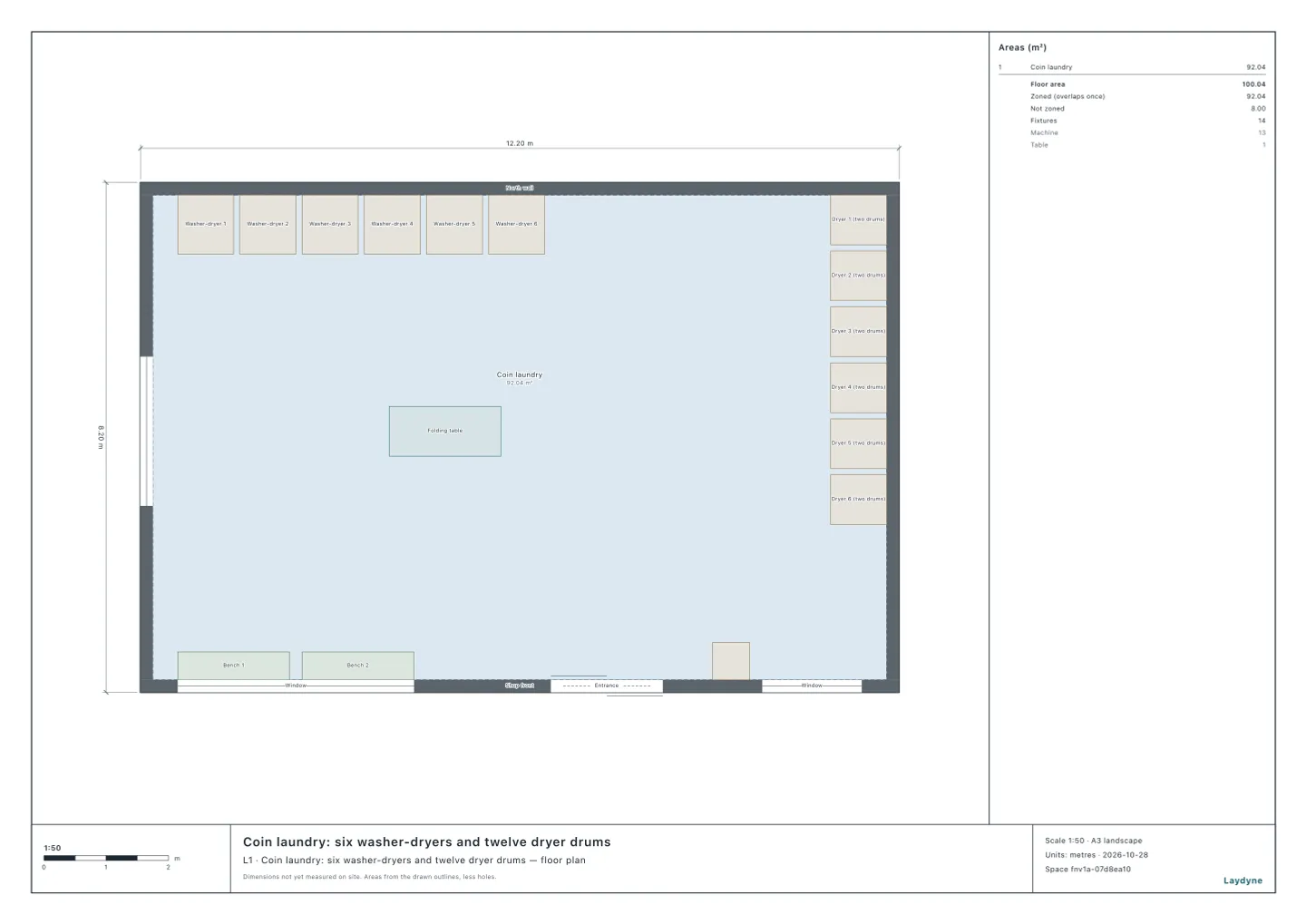
Start from the coin laundry model (free sign-up; running a simulation is Pro). A coin laundry’s customers use different machines: some wash and dry there, others wash at home and only dry. In this article, in the members’ coin laundry, your AI simulates a Saturday. It ran the same tools an AI calls over MCP. Every figure and number below comes from that run.
1. The shop and the Saturday
check_space finds nothing. Your AI writes the day as a scenario (put_process_scenario).
- From 8:00 to 22:00 customers come in at random: two hours at a time, 50, 100, 80, 100, 90, 80 and 50 % of the busiest hours’ count.
- Those who only dry use a dryer drum (30 to 45 minutes, most often 35); the others a washer-dryer (60 to 80 minutes, most often 70).
- By the benches they look for a free machine; with none, they wait up to 15 minutes, then leave.
- They load it (1 to 3 minutes), go out, come back 0 to 10 minutes after it ends, take the washing out (1 to 3 minutes) and fold it at the table (3 to 8 minutes). The machine is theirs until it is emptied.
- Every time is an assumption, to swap for your own.
2. The customers and the weather
Your AI sweeps the customers in the busiest hours (6, 8, 10) and the share who only dry (40 % on a sunny day, 70 % on a rainy one) with sweep_process_parameters, 20 runs each.
| An hour (most) | Only dry | Wash and dry | Waited | Left | Only dry | Waited |
|---|---|---|---|---|---|---|
| 6 | 40 % | 41.0 | 9.3 | 3.1 | 25.0 | 0.0 |
| 6 | 70 % | 21.9 | 0.5 | 0.1 | 44.1 | 0.0 |
| 8 | 40 % | 54.6 | 19.3 | 9.0 | 35.4 | 0.0 |
| 8 | 70 % | 29.4 | 2.7 | 0.9 | 60.6 | 0.0 |
| 10 | 40 % | 66.8 | 34.7 | 15.5 | 45.0 | 0.0 |
| 10 | 70 % | 35.2 | 4.9 | 2.2 | 76.6 | 0.1 |
- It is the washer-dryers that run short, on a sunny day when more wash. With 10 in the busiest hours, 15.5 a day give up and leave.
- The dryers (twelve drums) hardly keep anyone waiting, even on a rainy day.
3. The washer-dryers and the dryers
With 8 in the busiest hours and 60 % only drying, your AI changes the washer-dryers (4 or 6) and the dryers (three or six two-drum stacks).
| Washer-dryers | Dryer drums | Wash and dry: waited | Left | Only dry: waited | Left |
|---|---|---|---|---|---|
| 6 | 12 | 7.3 | 2.7 | 0.0 | 0.0 |
| 6 | 6 | 7.3 | 2.7 | 3.7 | 0.1 |
| 4 | 12 | 16.0 | 9.0 | 0.0 | 0.0 |
| 4 | 6 | 16.0 | 9.0 | 3.7 | 0.1 |
- Halving the dryers to six drums leaves 0.1 customers going away.
- Four washer-dryers raise those who leave from 2.7 to 9.0. In this shop, more washer-dryers than dryers keeps the customers.
4. Coming back for the washing
On a sunny day (40 % only drying), your AI changes how long customers take to come back after a machine ends (up to 2, 10 or 30 minutes).
| An hour (most) | Back within | Wash and dry: waited | Left |
|---|---|---|---|
| 8 | 2 min | 18.5 | 7.9 |
| 8 | 10 min | 19.3 | 9.0 |
| 8 | 30 min | 22.6 | 11.3 |
| 10 | 2 min | 32.7 | 14.2 |
| 10 | 10 min | 34.7 | 15.5 |
| 10 | 30 min | 37.2 | 19.7 |
- Coming back up to 30 minutes late raises those who leave on a day of 8 from 7.9 to 11.3. Telling customers when a machine has finished keeps them without more machines.
5. Using the check
- Draw your shop (from a PDF drawing or photos as well), and tell your AI the customers, the shares who wash and who only dry, and the machines’ times.
- Not checked: prices and takings, other machines such as sneaker washers, customers who use two machines in turn, and the electricity, gas and water supply.