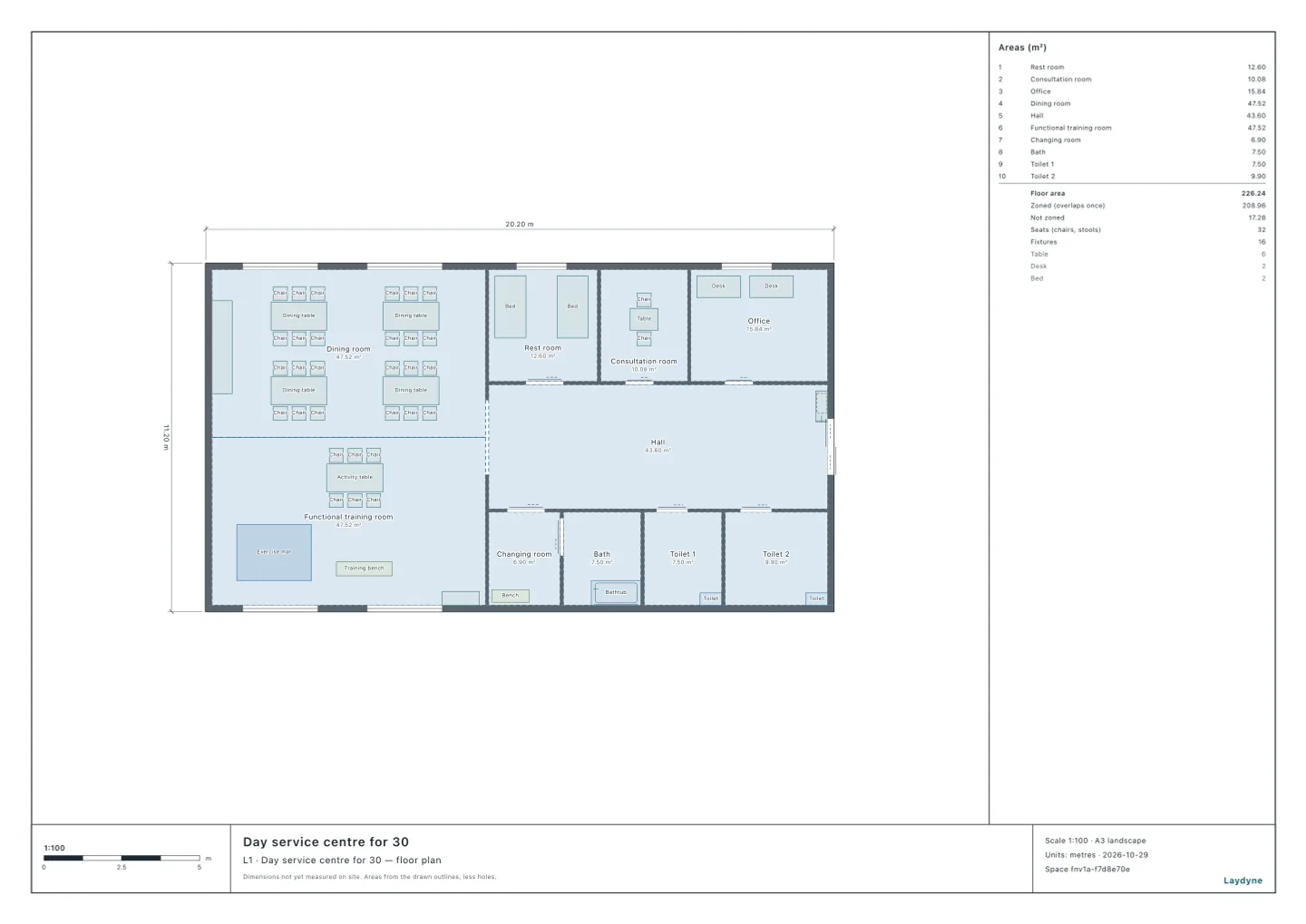
Start from the day service model (30 places) (free sign-up; running a simulation is Pro). In the morning at a day service, the vans arrive one after another, and the users wait at their seats for their vitals. The baths start after the vitals, so a wait here delays the whole day. In this article, in the members’ day service model, your AI simulates the morning arrivals. It ran the same tools an AI calls over MCP. Every figure and number below comes from that run.
1. The day service and the morning
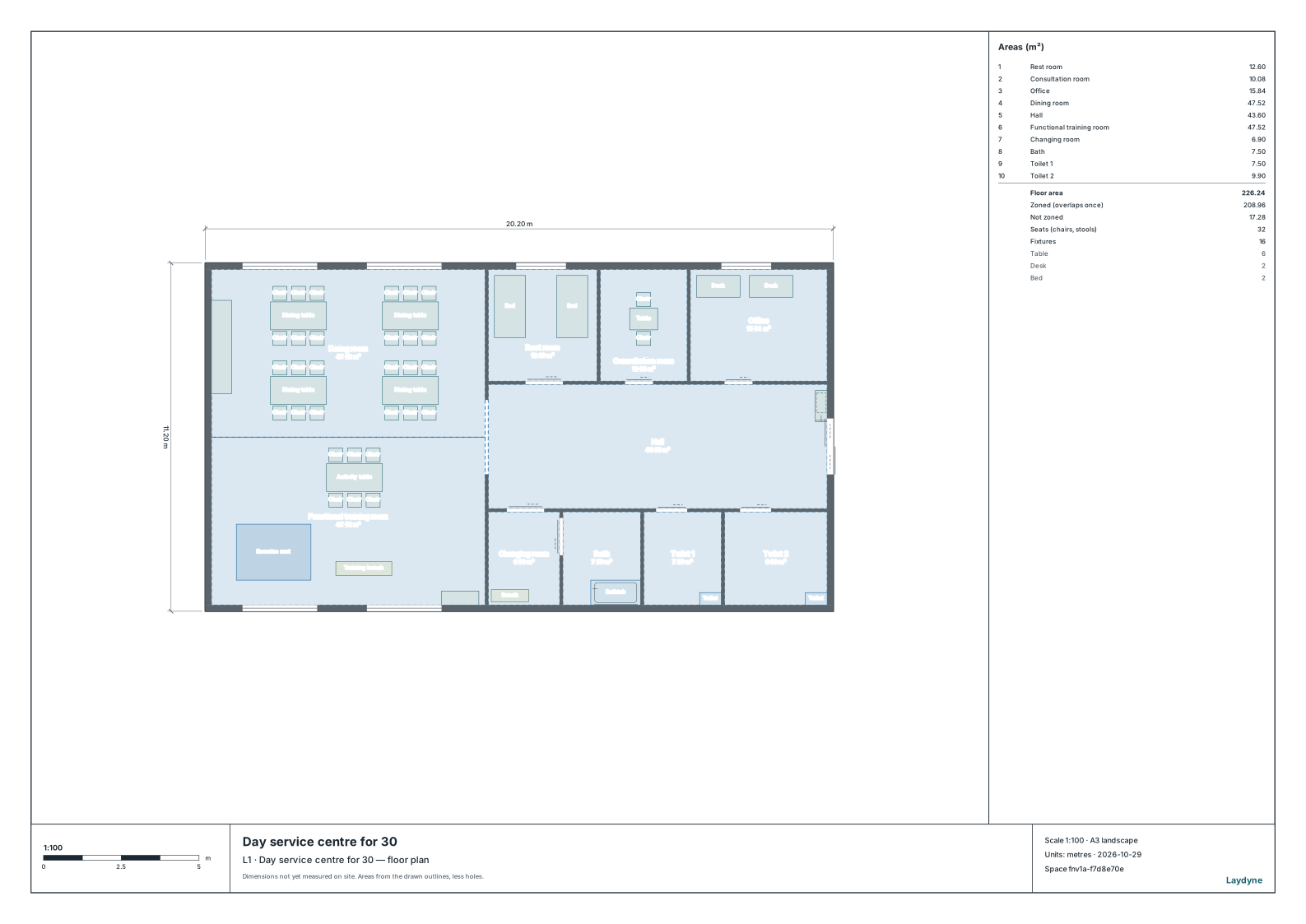
- A day service centre for 30. The four dining tables and the functional training room’s table have six seats each.
check_spacefinds nothing.
The AI wrote this flow as a scenario (put_process_scenario).
- Five vans bring the 30 users, six each. The middle van arrives at 9:20, and the vans are 3, 6 or 10 minutes apart.
- The users get off 20 seconds apart, change their shoes in the hall with help (30 seconds to 1.5 minutes, most often 45 seconds) and sit at their van’s table.
- Whoever takes the vitals comes from the office or the last user’s seat, takes the temperature, the blood pressure and the pulse and asks how they are (1 to 3 minutes, most often 1.5, 1 minute 50 seconds on average), then goes on to the nearest user waiting.
- Every number and time is an assumption. Put in your own centre’s records.
2. Those taking the vitals, and how far apart the vans arrive
The AI changed those taking the vitals (1, 2) and how far apart the vans arrive (3, 6, 10 minutes) (sweep_process_parameters), 20 runs each. Van to vitals taken and the wait are a user’s mean; the longest wait and the last vitals taken are means over the 20 runs.
| Taking the vitals | Vans | Van to vitals taken (mean) | Wait (mean) | Longest wait | Last vitals taken |
|---|---|---|---|---|---|
| 1 | Every 3 min (9:14 to 9:26) | 24.8 min | 21.5 min | 42.5 min | 10:14 |
| 1 | Every 6 min (9:08 to 9:32) | 18.8 min | 15.5 min | 30.5 min | 10:08 |
| 1 | Every 10 min (9:00 to 9:40) | 10.8 min | 7.5 min | 14.6 min | 10:00 |
| 2 | Every 3 min (9:14 to 9:26) | 10.6 min | 7.3 min | 14.5 min | 9:46 |
| 2 | Every 6 min (9:08 to 9:32) | 5.1 min | 1.7 min | 3.9 min | 9:41 |
| 2 | Every 10 min (9:00 to 9:40) | 4.7 min | 1.3 min | 3.4 min | 9:48 |
- With one taking the vitals and the vans 6 minutes apart, a user’s vitals are taken 18.8 minutes after they get off the van on average, the longest wait is 30.5 minutes, and the last vitals are taken at 10:08. Thirty users at 1 minute 50 seconds each are 55 minutes of work for one.
- With the vans 3 minutes apart the wait is 21.5 minutes on average; 10 minutes apart, 7.5.
- With two taking the vitals, even 6 minutes apart the wait is 1.7 minutes on average and the last vitals are taken at 9:41. Ten minutes apart, the last van arrives at 9:40, and the last vitals are taken later, at 9:48.
- The second may be a care worker. In Japan, taking the temperature with an electronic thermometer and the blood pressure with an automatic monitor are, as a rule, not medical acts (the Health Policy Bureau’s notice on the interpretation of article 17 of the Medical Practitioners’ Act and others, 医政発第0726005号, 26 July 2005). But judging from the values is, and a value outside the range given beforehand is reported to a doctor or a nurse.
3. A shorter check
With the vans still 6 minutes apart, the AI changed the time of a check (as now, down to 60 %, say with the temperature taken at the entrance first) and those taking the vitals.
| Check | Taking the vitals | Van to vitals taken (mean) | Wait (mean) | Longest wait | Last vitals taken |
|---|---|---|---|---|---|
| As now | 1 | 18.8 min | 15.5 min | 30.5 min | 10:08 |
| As now | 2 | 5.1 min | 1.7 min | 3.9 min | 9:41 |
| Down to 60 % | 1 | 7.2 min | 4.6 min | 8.8 min | 9:45 |
| Down to 60 % | 2 | 3.2 min | 0.6 min | 1.7 min | 9:37 |
- With the check down to 60 %, even one taking the vitals keeps the wait to 4.6 minutes on average, the last vitals taken at 9:45.
4. How to use this check
- Draw your own centre (from a PDF of the drawings or photos too), and tell your AI the users, the vans and when they arrive, the time to change shoes and to take the vitals, and those taking them. Your AI also runs and compares other seating or bathing orders.
- Not checked: the toilets, washing hands and gargling, getting wheelchair users off the vans, late vans, checks taken again, the order of the baths, and the nurse’s other work.