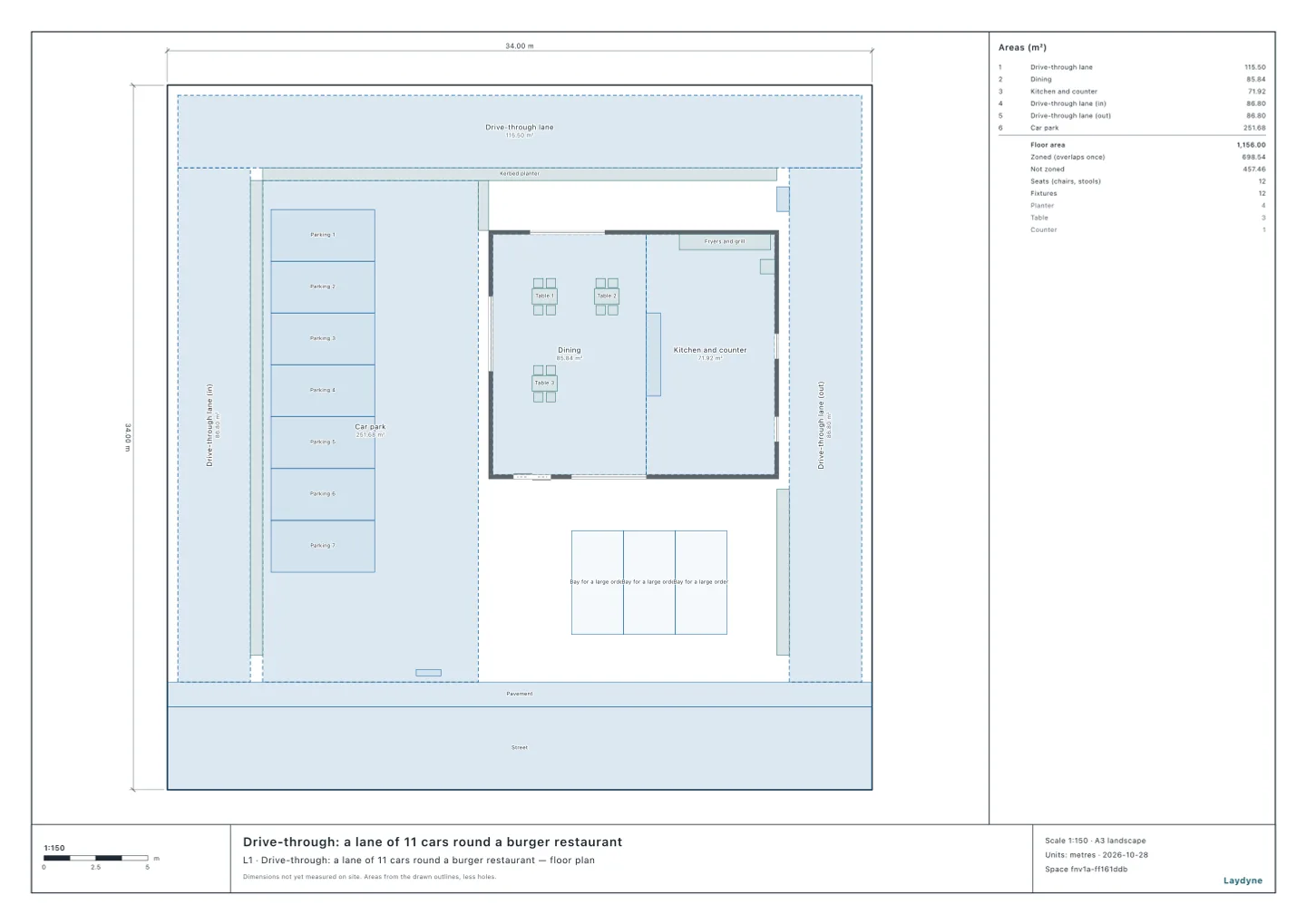
Start from the drive-through model (free sign-up; running a simulation is Pro). When a drive-through lane is full, the cars behind it wait on the street. In this article, in the members’ restaurant with a drive-through, your AI simulates a weekday lunch. It ran the same tools an AI calls over MCP. Every figure and number below comes from that run.
1. The restaurant and the lunch
check_space finds nothing. The lane runs 69.4 m from the way in to the pickup window, 11 cars at 6 m a car (an assumption). Your AI writes the lunch as a scenario (put_process_scenario).
- From 11:00 to 14:00 cars come in at random: half an hour at a time from 11:00, 50, 90, 100, 100, 70 and 40 % of the cars from 12:00 to 13:00, the busiest hour.
- A car turns in if there is room in the lane and no car waiting on the street; otherwise it waits on the street.
- Round the lane, it orders at the menu board (30 to 90 seconds, most often 50), then goes to the pay window (20 to 40 seconds) and the pickup window (20 to 90 seconds, 40). It waits where it is until the next place is free.
- A large order (20 % to begin with) takes 60 to 150 seconds to order (90) and 120 to 300 seconds at pickup (180). Sent to a bay, it gets the drinks at the window (15 seconds) and waits for the rest in the bay (105 to 285 seconds, 165).
- Cars drive at 9 km/h. Every time is an assumption, to swap for your own.
2. The cars that come, and the waiting bays
Your AI sweeps the cars from 12:00 to 13:00 (30, 45, 60) and whether large orders are sent to a bay (bay) with sweep_process_parameters, 20 runs each. The wait on the street is over every car (0 for those straight in).
| 12:00 to 13:00 | Large orders | Cars | Waited on the street | Wait on the street | From arriving to leaving | Longest line on the street |
|---|---|---|---|---|---|---|
| 30 | At the window | 69.5 | 0.1 | 0.0 min | 5.4 min | 0.1 |
| 30 | To a bay | 69.5 | 0.0 | 0.0 min | 4.1 min | 0.0 |
| 45 | At the window | 104.1 | 35.5 | 3.3 min | 14.6 min | 8.7 |
| 45 | To a bay | 104.1 | 4.0 | 0.1 min | 5.6 min | 0.9 |
| 60 | At the window | 138.9 | 94.3 | 18.8 min | 33.1 min | 30.6 |
| 60 | To a bay | 138.9 | 51.7 | 3.0 min | 12.3 min | 11.0 |
- With 45 cars from 12:00 and large orders waited for at the window, 35.5 of 104.1 cars (34.1 %) wait on the street, the line at its longest 8.7 cars. Sent to a bay, it is 4.0, and from arriving to leaving drops from 14.6 to 5.6 minutes.
- A large order holding the pickup window keeps the pay window and the menu board taken, and the whole lane stops. Sent to a bay, it frees the window at once.
- With 60 cars from 12:00, 51.7 still wait on the street even with the bays.
3. The share of large orders
With 45 cars from 12:00, your AI changes the share of large orders (10, 20, 30 %).
| Share of large orders | Large orders | Waited on the street | From arriving to leaving | Longest line on the street |
|---|---|---|---|---|
| 10 % | At the window | 9.6 | 7.3 min | 2.6 |
| 10 % | To a bay | 0.6 | 4.6 min | 0.3 |
| 20 % | At the window | 35.5 | 14.6 min | 8.7 |
| 20 % | To a bay | 4.0 | 5.6 min | 0.9 |
| 30 % | At the window | 49.2 | 22.2 min | 13.6 |
| 30 % | To a bay | 5.4 | 6.7 min | 1.2 |
- With 30 % large orders waited for at the window, 49.2 cars wait on the street; sent to a bay, 5.4.
- The three bays never kept a car waiting for one, in any of these.
4. Using the check
- Draw your restaurant and its site (from a PDF drawing or photos as well), and tell your AI the cars at lunch, the times to order and to hand over, and the share of large orders.
- Not checked: the customers inside and the kitchen staff, the street’s traffic and talks with the police and the road authority, pedestrians’ safety, and a lane with two order points.