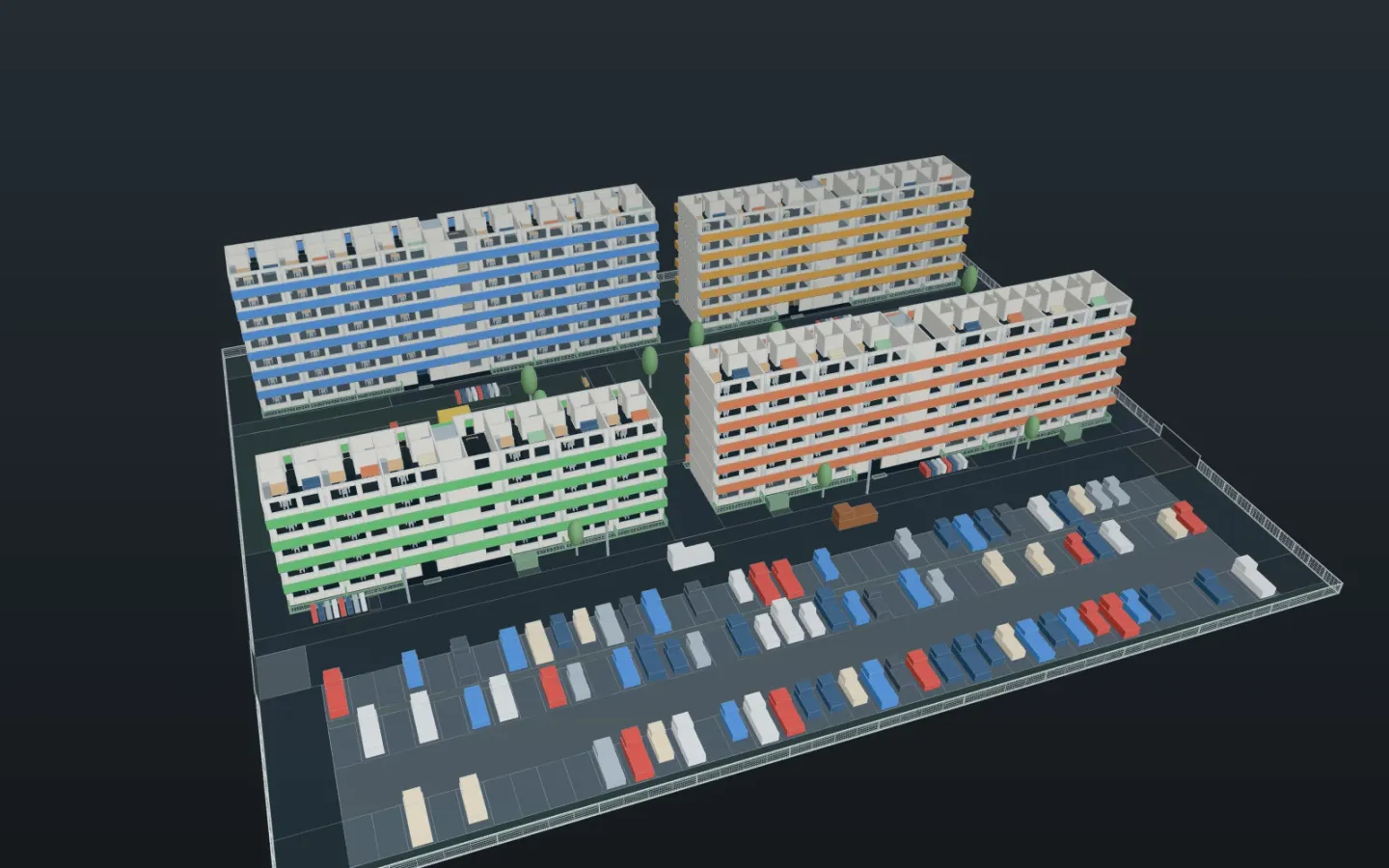
Open the apartment estate model (no sign-up needed; running a simulation needs Pro). In the morning the lift is slow to come: is a second car needed? And do parcels taken to the door or put in delivery boxes change the lifts and the deliveries? In this article, your AI reads the saved weekday morning of a mock estate, saves a copy that reads each block’s residents’ time from the door to the ground-floor hall, and compares the lift cars, the residents leaving and the parcels put in delivery boxes. It ran the same tools an AI calls over MCP. Every figure and number below comes from that run.
1. The estate and its weekday morning
The saved weekday morning (7:30 to 8:30) of the mock estate:
- Four blocks: A of seven floors, B of six, C of five, D of six. Each block has one lift car (for 9 people, 1 m/s, each stop 5 s of doors and 3 s open).
- Residents leave their flats at random from 7:30 to 8:15, 6 a floor an hour (twice that from 7:40 to 8:00). From the first and second floors they walk; from the third up they take the lift down.
- One in four stops at the refuse cage; 60 % walk to the station, 25 % cycle and 15 % drive.
- At 8:00 two couriers come (blocks A and B, and C and D) with 4 parcels a block, half into the delivery boxes on the ground floor and half to the door.
Your AI reads the saved scenario (list_process_scenarios) and saves a copy (put_process_scenario, the saved one left as it is) that keeps the residents’ steps and calls, from one process per block, the way down to the ground-floor hall of the residents from the third floor up, so their time from the door to the hall (the wait for the lift and the ride included) is read for the residents alone. The lift waits count the couriers too, so the residents’ time is read apart. With sweep_process_parameters, it runs the same twenty random runs at each combination.
2. Today’s morning
| Block | Floors | From the door to the ground-floor hall | Waiting for the lift (mean, longest) |
|---|---|---|---|
| A | 7 | 53.4 s | 15.1 s, 42.8 s |
| B | 6 | 45.7 s | 11.6 s, 35.8 s |
| C | 5 | 41.0 s | 9.1 s, 24.9 s |
| D | 6 | 48.2 s | 11.9 s, 35.5 s |
- Even in block A, the tallest, a resident takes 53.4 s on average from the door to the ground-floor hall (95 % interval 52.4 to 54.3 s). The wait for the lift is 15.1 s on average, 42.8 s for whoever waited longest (the lift waits include the couriers).
3. A second car, and the residents leaving
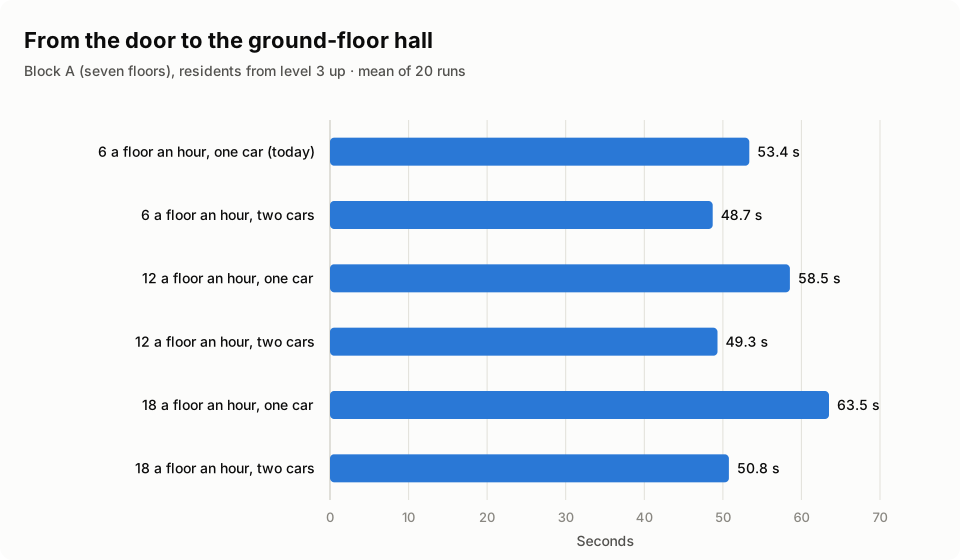
Block A’s residents, from the door to the ground-floor hall:
| Leaving a floor an hour | One car | Two cars |
|---|---|---|
| 6 (today) | 53.4 s | 48.7 s |
| 12 | 58.5 s | 49.3 s |
| 18 | 63.5 s | 50.8 s |
- On today’s morning, a second car saves only 4.7 s (95 % interval 3.8 to 5.5 s).
- If three times as many leave (18 a floor an hour, 36 from 7:40 to 8:00), one car gives 63.5 s, 10.1 s more than today, and whoever waited longest for the lift waited 66.4 s. Two cars give 50.8 s.
- With cars for 6 or 13 people, every block gives the same numbers: on this morning a car for 9 is never full.
4. Delivery boxes
| Parcels into delivery boxes | Courier (A and B) | Courier (C and D) | Rides on block A’s lift |
|---|---|---|---|
| 0 % (all to the door) | 20.8 min | 18.2 min | 39.6 |
| 50 % (today) | 16.9 min | 14.0 min | 36.5 |
| 100 % | 10.8 min | 9.5 min | 33.0 |
- With every parcel in the delivery boxes, the courier for blocks A and B takes 6.1 min (95 % interval 4.9 to 7.2 min) less than today.
- The residents’ time from the door to the hall does not change with the boxes’ share (53.2, 53.4 and 53.3 s in block A, differences from today within the noise): the couriers come at 8:00, after the 7:40 to 8:00 rush.
- Block A’s lift rides (residents and couriers) fall to 33.0 with every parcel in the boxes, the residents’ 33.0 alone.
5. How to use these numbers
- Give your AI your own residents leaving in each part of the morning, flats on each floor, the car’s speed and door times, and parcels: the numbers here are the example’s assumptions.
- A shorter delivery round does not show how many parcels fewer are taken back for redelivery: this calculation does not say.
- Not calculated: group control of the cars (which car answers which call), residents away, redelivery, moving and refuse-collection days, inspections and breakdowns, crowding, satisfaction, costs.