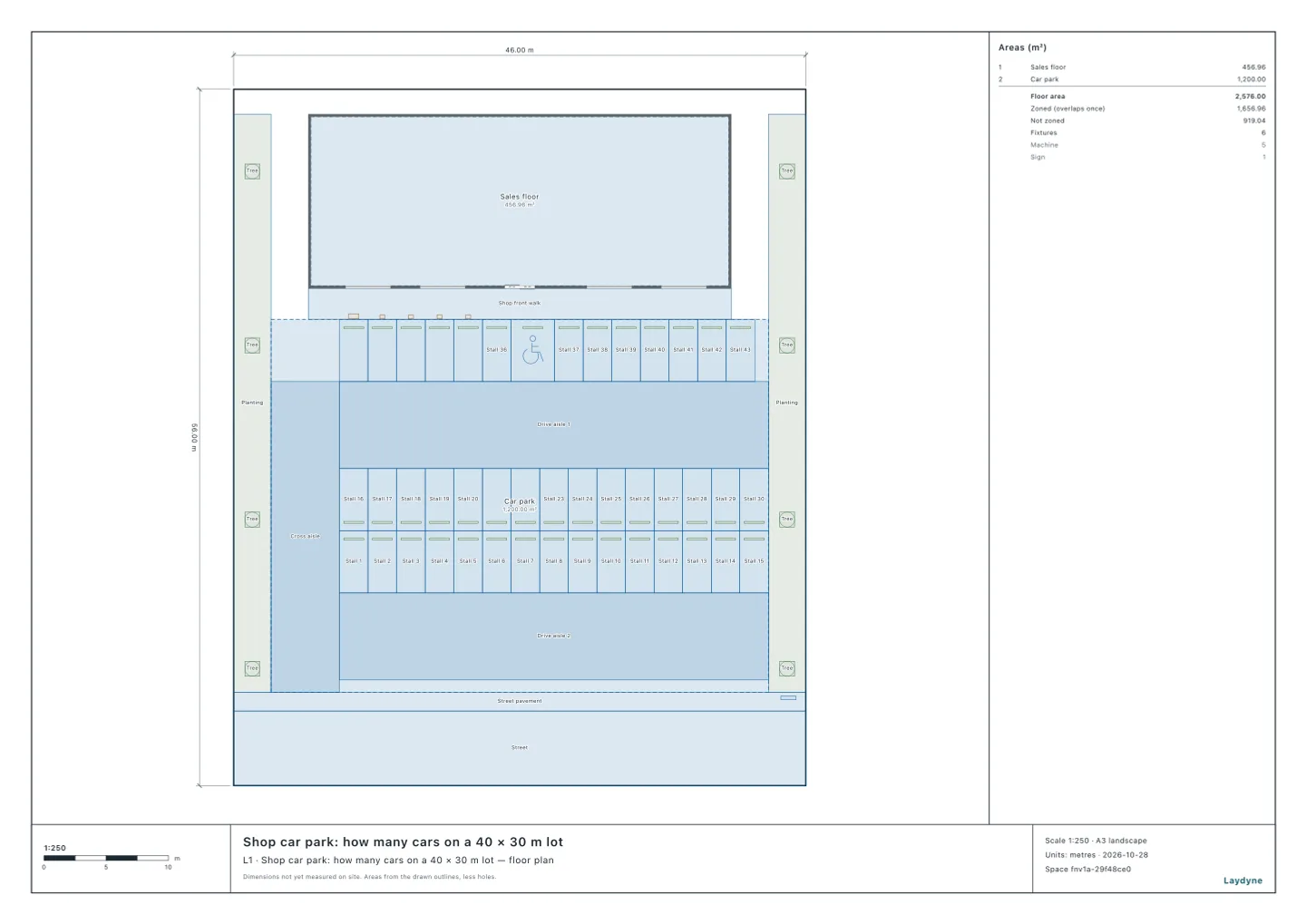
Start from the shop car park model (free sign-up; running a simulation is Pro). Japan’s Ministry of Economy, Trade and Industry, in its guideline on charging infrastructure (October 2023), aims at 300,000 charging points by 2030 and quick charging of 50 kW or more away from expressways too. At shopping centres and the like, it says, the quick charging output should follow how long people stay; public normal chargers are expected to charge cheaply while people stay. In this article, in the members’ shop car park, your AI puts in chargers and simulates a day. It ran the same tools an AI calls over MCP. Every figure and number below comes from that run.
1. The chargers and the day
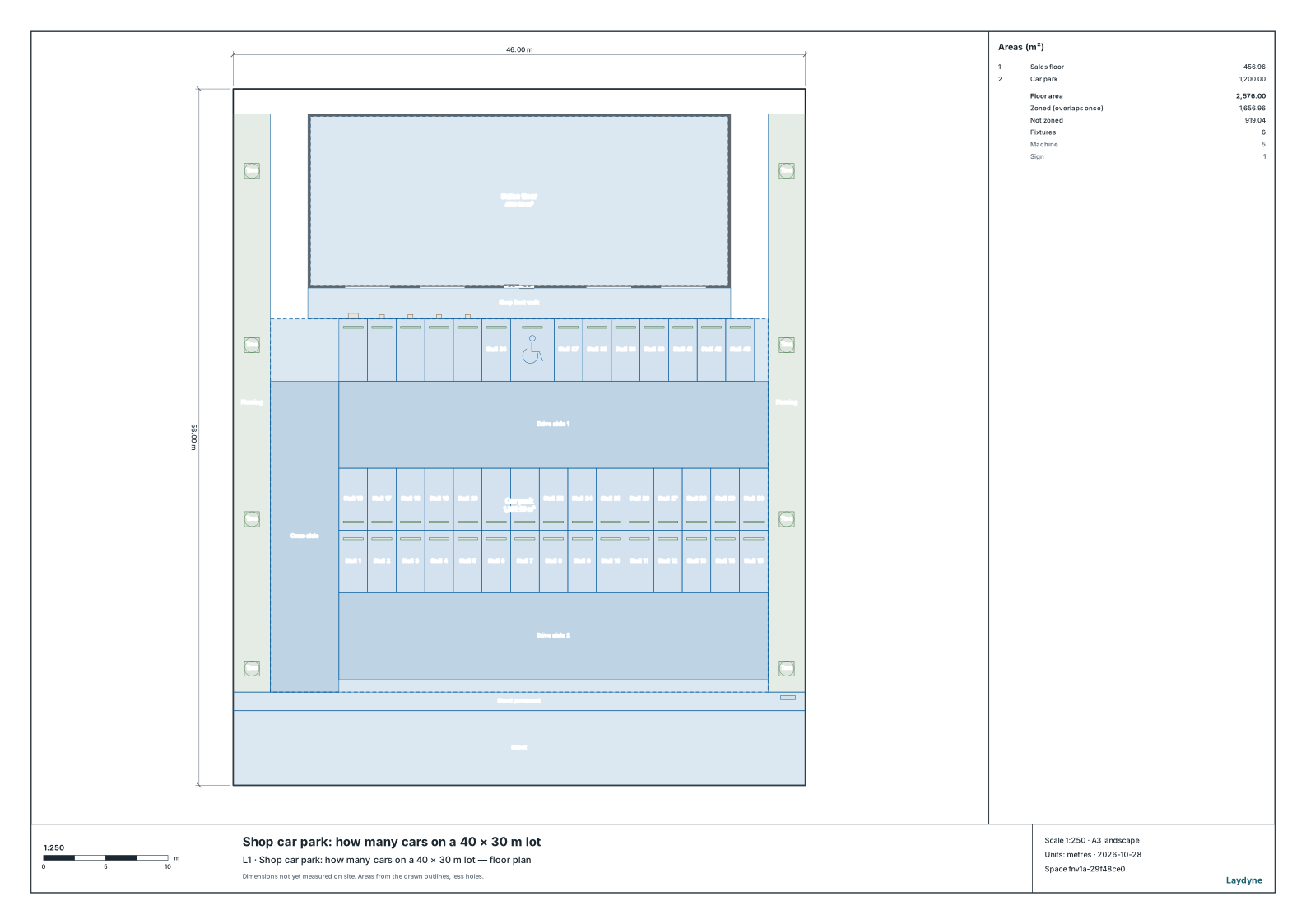
In one change (edit_space) your AI puts a quick charger (50 kW) and four normal ones (6 kW) at the five stalls at the west end of the row by the shop front. check_space finds nothing.
Your AI writes the day as a scenario (put_process_scenario).
- From 10:00 to 20:00 two kinds of electric car come in at random.
- Shoppers plug in, shop (15 to 60 minutes, most often 30) and unplug when they come back: the charger is theirs for the shopping, whether the battery is full or not. With no charger free, they shop without charging.
- Cars that come only to charge (one an hour) charge at a quick charger for 10 to 30 minutes (most often 20). With none free they wait up to 15 minutes, then leave.
- Every time and number is an assumption, to swap for your own.
2. Quick chargers only
With no normal chargers, your AI sweeps the shoppers an hour (2, 3, 4) and the quick chargers (1 or 2) with sweep_process_parameters, 20 runs each.
| Shoppers an hour | Quick | Shoppers a day | Charged | Not charged | Came only to charge, left |
|---|---|---|---|---|---|
| 2 | 1 | 19.0 | 6.5 | 12.5 | 3.0 |
| 2 | 2 | 19.0 | 12.5 | 6.5 | 1.0 |
| 3 | 1 | 27.9 | 8.2 | 19.7 | 3.8 |
| 3 | 2 | 27.9 | 16.2 | 11.7 | 1.2 |
| 4 | 1 | 37.3 | 9.6 | 27.8 | 4.2 |
| 4 | 2 | 37.3 | 18.4 | 19.0 | 1.2 |
- With one quick charger and three shoppers an hour, 8.2 of the day’s 27.9 shoppers charge. Of the 10.6 cars that come only to charge, 3.8 leave.
- A quick charger, too, is taken for as long as a shopper is plugged in.
3. Adding normal chargers
At three shoppers an hour, your AI changes the quick chargers (1 or 2) and the normal ones (0, 2, 4, 6). Shoppers take a normal charger first.
| Quick | Normal | Shoppers charged | Not charged | Came only to charge, left |
|---|---|---|---|---|
| 1 | 0 | 8.2 | 19.7 | 3.8 |
| 1 | 2 | 22.5 | 5.4 | 2.5 |
| 1 | 4 | 26.9 | 1.0 | 1.7 |
| 1 | 6 | 27.7 | 0.2 | 1.2 |
| 2 | 2 | 25.3 | 2.6 | 0.3 |
| 2 | 4 | 27.5 | 0.4 | 0.3 |
| 2 | 6 | 27.7 | 0.2 | 0.1 |
- Four normal chargers beside one quick one charge 26.9 of the 27.9 shoppers, and the cars that come only to charge and leave fall from 3.8 to 1.7.
- A 6 kW normal charger gives 3.5 kWh in the mean shopping time of 35 minutes; a 50 kW quick one up to 29.2 kWh in the same time. Most normal chargers are 3 kW today, the guideline says, and JARI’s certification goes up to 6 kW.
4. Which charger shoppers take first
With one quick charger and four normal ones, your AI compares shoppers taking a normal charger first or a quick one first.
| Shoppers take first | Shoppers at the quick charger | Not charged | Came only to charge, left |
|---|---|---|---|
| quick | 8.2 | 0.9 | 3.8 |
| normal | 1.0 | 1.0 | 1.7 |
- Taking the quick charger first, the cars that come only to charge and leave stay at 3.8, four normal chargers or none.
- Shoppers, who stay long, at the normal chargers and the quick one kept for cars that come only to charge: both get charged.
5. Using the check
- Draw your car park (from a PDF drawing or photos as well), and tell your AI the cars that come, the shopping times and the charging times.
- Not checked: the electricity supply contract, the chargers’ cost and subsidies, prices, the cars’ movements and who takes which stall, and time limits on quick charging.