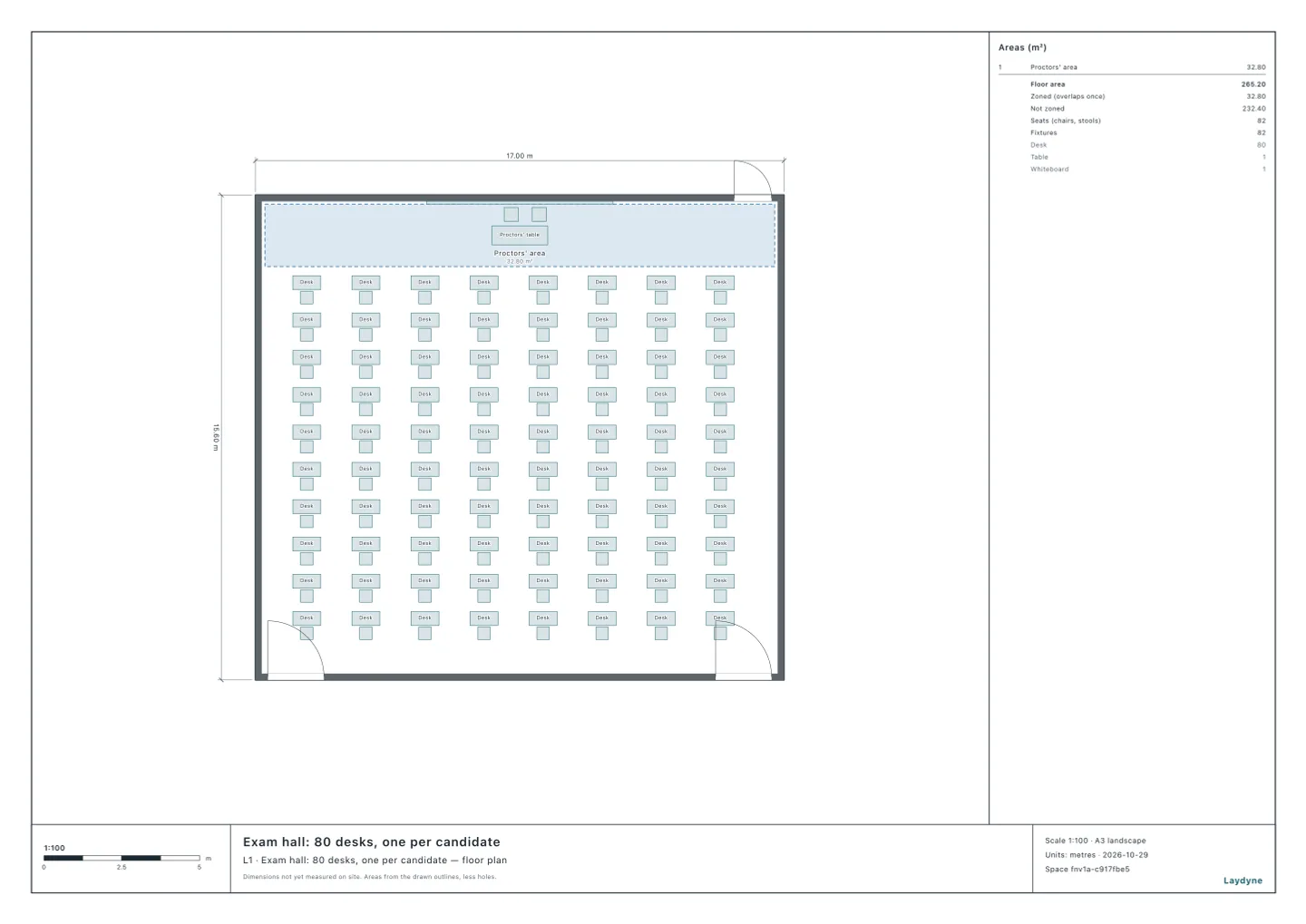
Start from the exam hall model (80 desks) (free sign-up; running a simulation is Pro). Before an exam, candidates arrive right before the deadline, and the admission ticket and ID checks at the doors make a line. In this article, in the members’ exam hall model, your AI simulates the hour before the exam. It ran the same tools an AI calls over MCP. Every figure and number below comes from that run.
1. The exam hall and coming in
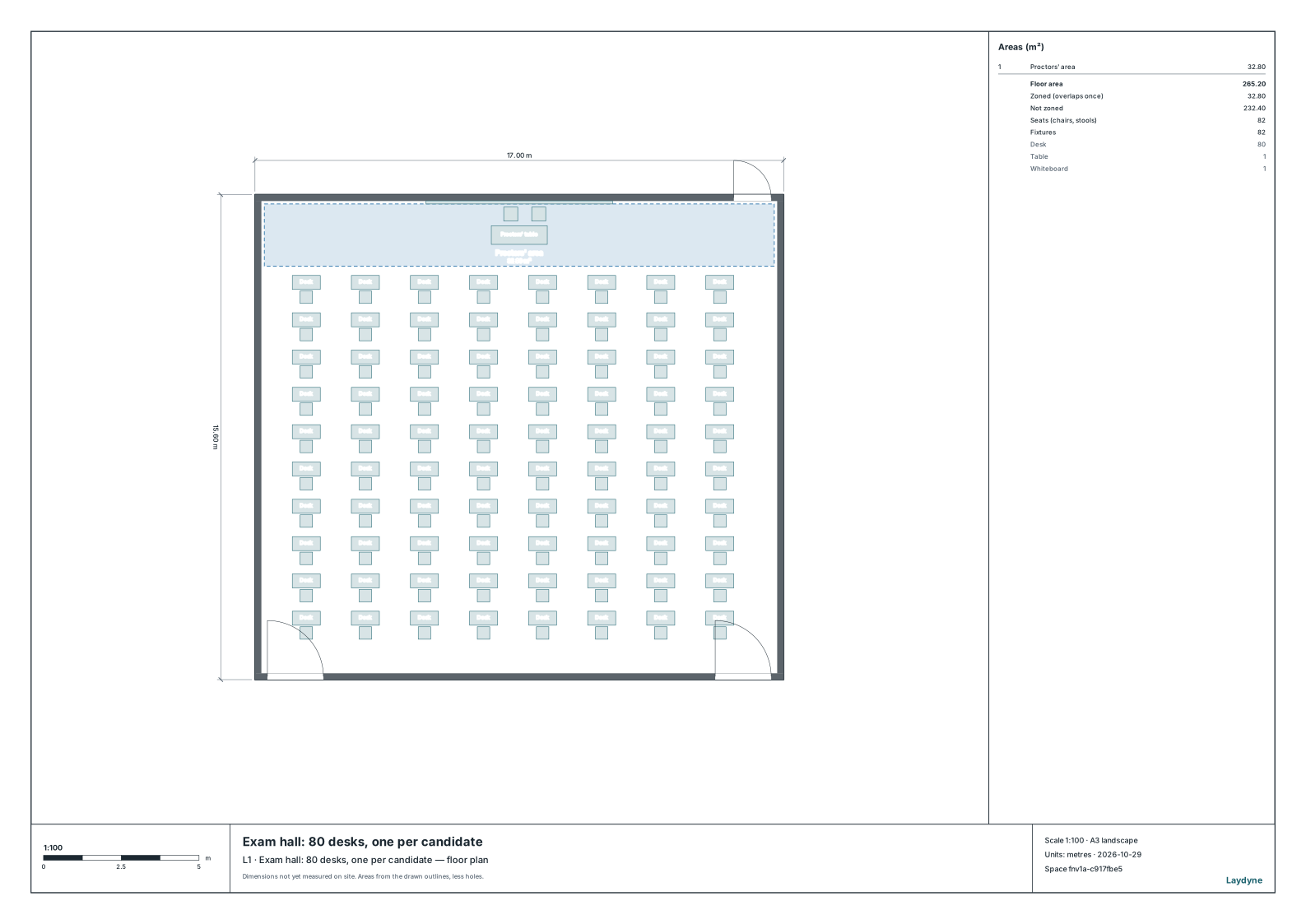
- An exam hall of 80 desks, with the candidates’ doors at the west and the east of the back wall. The AI read the candidates’ 80 chairs with
get_spaceand tagged them in one change (edit_space).check_spacefinds nothing.
The AI wrote this flow as a scenario (put_process_scenario).
- The exam starts at 10:00 and candidates are to be seated by 9:50. The hall opens at 9:00.
- 80 candidates on average come in at random from 9:00 to 9:50: 5 % in the first 10 minutes, then 10, 15, 30 and 40 % every 10 minutes, crowding before the deadline.
- Half come in by the west door and half by the east, where one member of staff checks the admission ticket and a photo ID (45 seconds on average, from half to about twice that). Then each walks to a free desk and sits down.
- Every number and time is an assumption. Put in your own exam’s records.
2. The ID check and the staff at the doors
The AI changed the mean time of a check (20, 30, 45, 60 seconds) and the staff at each door (1, 2) (sweep_process_parameters), 20 runs each. “Door to desk” is the mean; the longest wait is the mean over the 20 runs of the longer of the two doors’ longest waits. “The last seated” is how many minutes after 9:50 the last candidate sits down, on average.
| ID check | Staff at each door | Door to desk | Longest wait | Waiting (most) | The last seated (after 9:50) |
|---|---|---|---|---|---|
| 20 s | 1 | 0.4 min | 0.7 min | 2.7 | 0.1 min |
| 20 s | 2 | 0.4 min | 0.2 min | 1.1 | 0.0 min |
| 30 s | 1 | 0.8 min | 1.6 min | 3.6 | 1.1 min |
| 30 s | 2 | 0.5 min | 0.4 min | 1.8 | 0.2 min |
| 45 s | 1 | 2.0 min | 4.2 min | 6.0 | 4.5 min |
| 45 s | 2 | 0.9 min | 0.8 min | 2.6 | 0.5 min |
| 60 s | 1 | 4.0 min | 8.7 min | 9.2 | 10.6 min |
| 60 s | 2 | 1.3 min | 1.5 min | 3.5 | 1.5 min |
- With 45-second checks and one at each door, the last candidate sits down 4.5 minutes after 9:50. The one who waits longest waits 4.2 minutes.
- At 60 seconds a check it is 10.6 minutes after: past the 10:00 start. With two at each door, 1.5 minutes after.
- At 30 seconds, even one at each door makes it 1.1 minutes after.
3. When the candidates come
With one at each door, the AI changed when the candidates come (crowding before the deadline, in between, evenly from 9:00 to 9:50) and the time of a check.
| Coming | ID check | Door to desk | Longest wait | The last seated (after 9:50) |
|---|---|---|---|---|
| Most in the last minutes | 45 s | 2.0 min | 4.2 min | 4.5 min |
| Most in the last minutes | 60 s | 4.0 min | 8.7 min | 10.6 min |
| In between | 45 s | 1.4 min | 2.8 min | 2.3 min |
| In between | 60 s | 2.7 min | 5.6 min | 5.5 min |
| Evenly | 45 s | 1.3 min | 2.3 min | 1.0 min |
| Evenly | 60 s | 2.5 min | 4.6 min | 2.6 min |
- When candidates come evenly, the last sits down 1.0 minutes after 9:50 with 45-second checks, and 2.6 even with 60. Asking candidates to come in early works as well as more staff at the doors.
4. How to use this check
- Draw your own exam hall (from a PDF of the drawings or photos too), and tell your AI the candidates and when they come, the staff at each door and how long a check takes. Your AI also puts moved doors or desks on the drawing and checks them.
- Not checked: assigned seats (finding the desk with your number), toilets and left luggage, late candidates, guiding to several rooms, and the proctors’ briefing.