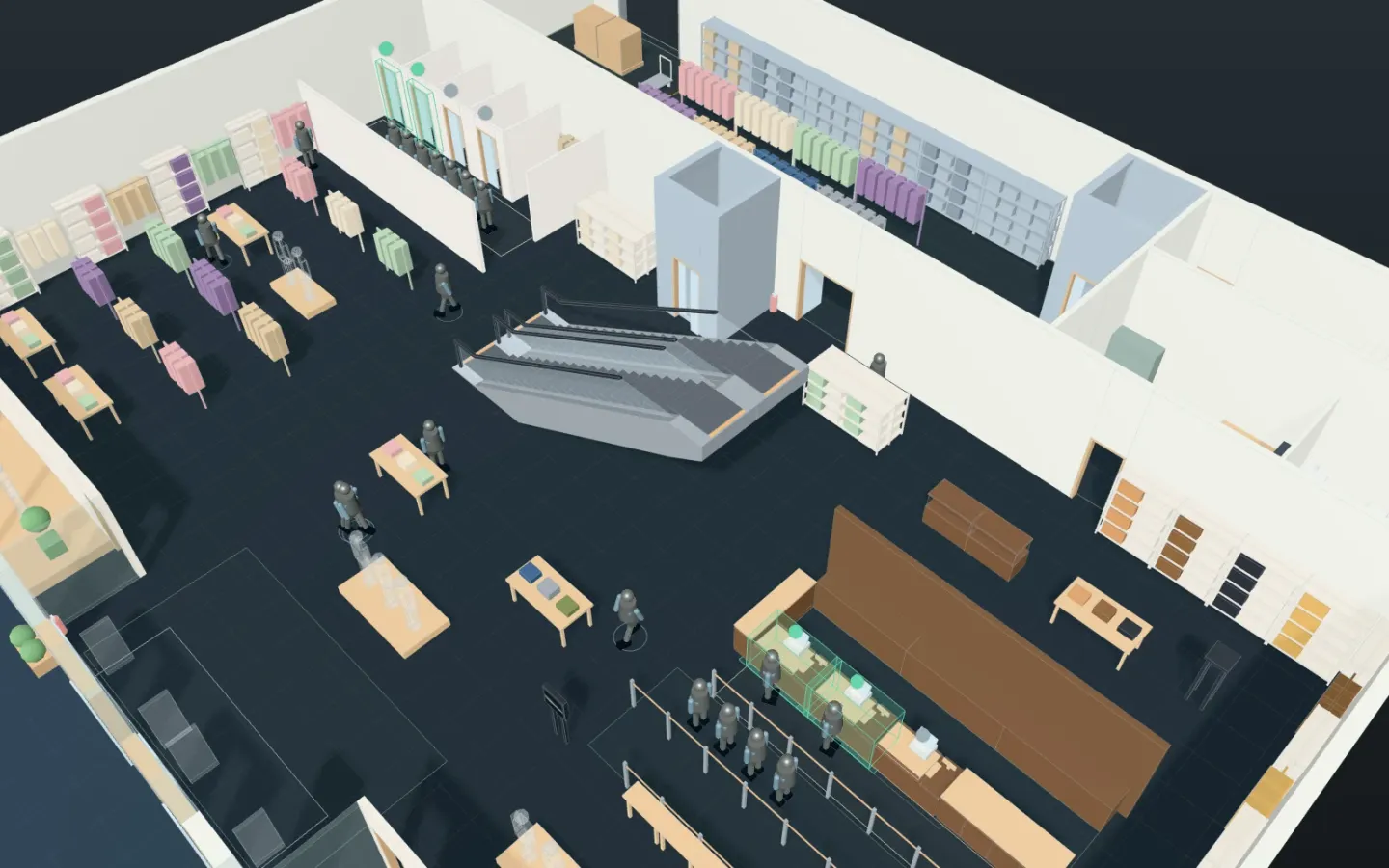
Open the fashion store (no account needed to open it; running simulations takes Pro). On a Saturday afternoon, how many fitting rooms and tills keep shoppers from waiting? With the same shoppers, your AI changes the fitting rooms and tills and compares them in a simulation. This article runs on a synthetic store with the same tools your AI calls over MCP. Every number below comes from that run.
1. The store and the Saturday afternoon
The synthetic store is a two-floor high-street fashion store.
- Shoppers arrive at random, 170 an hour (Poisson arrivals, 173.6 on average over the 20 runs). 55 % browse the ground floor (women’s, accessories, new season), 45 % take the escalator to the first (men’s, denim, sale), looking at 2 to 4 fixtures.
- 40 % try clothes on in their floor’s fitting rooms (one line, any free cubicle, 2 to 10 minutes). 70 % of them buy, against 35 % of those who did not try anything on (87.0 buyers on average).
- Buyers queue in one line for the tills on the ground floor (tags off, folding and payment, 45 s to 3 minutes). Four cubicles a floor and three tills are built; today two cubicles a floor and two tills are open.
- Not counted: crowd physics, how shoppers choose fixtures, shoppers who leave at a long line, sales forecasts.
2. Fitting rooms
Your AI ran the saved scenario’s parameters, the fitting rooms a floor and the tills, at each value with sweep_process_parameters, twenty runs each on the same random numbers. With two tills, as the fitting rooms grow:
| Fitting rooms a floor | Fitting-room wait (ground) | (first floor) | Fitting-room line (ground, longest) | Till wait | Till line (longest) | Time in the store |
|---|---|---|---|---|---|---|
| 2 (today) | 22.0 min | 18.4 min | 16.4 | 2.2 min | 8.7 | 19.3 min |
| 3 | 6.8 min | 4.9 min | 9.2 | 6.1 min | 14.7 | 15.2 min |
| 4 | 1.9 min | 1.3 min | 5.0 | 8.2 min | 20.0 | 14.5 min |
- With today’s two, shoppers wait 22.0 minutes for a fitting room on the ground floor and 18.4 on the first.
- More fitting rooms cut that wait, but the till wait grows by as much (from 2.2 to 8.2 minutes with four, 6.0 minutes longer, 95 % interval 4.7 to 7.4): shoppers done trying on sooner reach the tills at the same time.
3. A third till
With three tills, and two to four fitting rooms a floor:
| Fitting rooms a floor | Fitting-room wait (ground) | Till wait | Till line (longest) | Time in the store |
|---|---|---|---|---|
| 2 | 22.0 min | 0.3 min | 3.9 | 18.3 min |
| 3 | 6.8 min | 0.6 min | 5.3 | 12.4 min |
| 4 | 1.9 min | 1.1 min | 6.6 | 10.8 min |
- With three tills, even four fitting rooms leave a till wait of 1.1 minutes, and the time in the store falls from today’s 19.3 to 10.8 minutes (8.4 minutes less, 95 % interval 7.4 to 9.5).
- A third till alone, with two fitting rooms, gives 18.3 minutes: only 1.0 minute less. Fitting rooms and tills are decided together.
4. More shoppers trying on
Your AI raised the share trying on from 40 % to 50 % (two tills).
| Fitting rooms a floor | 40 % try on: ground wait | Time in the store | 50 % try on: ground wait | Time in the store |
|---|---|---|---|---|
| 3 | 6.8 min | 15.2 min | 14.5 min | 19.2 min |
| 4 | 1.9 min | 14.5 min | 5.4 min | 17.2 min |
- On a day when more shoppers try on (a sale, a new season), three rooms leave a 14.5-minute wait on the ground floor; four leave 5.4.
5. How to use these numbers
- Give your AI the footfall by hour from the door counters, the shares who try on and buy, and the fitting-room and till times measured in your stores; and the cost of a cubicle and a till position.
- Shorter waits alone do not show extra sales. Weigh each option against the floor space, the build cost and the staff hours.
- Not counted: crowd physics, how shoppers choose fixtures, shoppers who leave at a long line, sales forecasts.