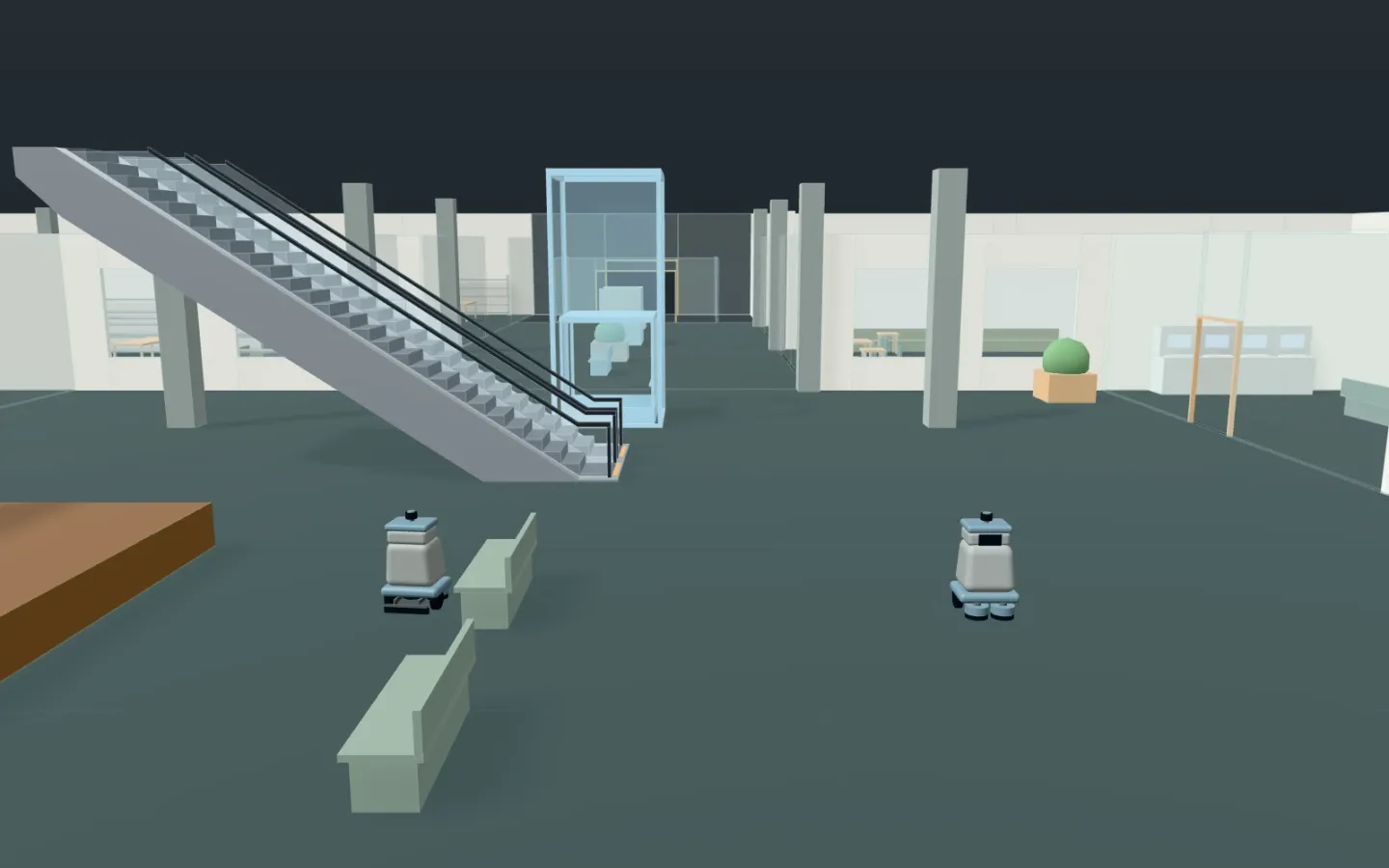
Open the mall night scrubbing (no account needed to open it; running simulations takes Pro). After a shopping centre closes, how many floor-scrubbing robots finish the common floors before opening? On the same floors, your AI changes the robots, the fill points and the robot model and compares them in a simulation. This article runs on a synthetic mall with the same tools your AI calls over MCP. Every number below comes from that run.
1. The mall and the night scrub
The synthetic mall is a three-level shopping centre.
- After closing at 22:00, scrubber robots clean the common floors of the three levels in 14 sections (5,016 m²), one section at a time, L2 first, then L3, then L1. The floors are due by 06:00 (drying time is not computed).
- A robot scrubs 700 m² an hour, and after each section drains the dirty water and refills at a fill & drain point (8 minutes, queuing if it is taken). There is one point by the docks on L2, and a second can be opened in the north corridor of L1. Robots ride the service lift between levels, one per car.
- The battery lasts 4 hours of work on sections (driving, scrubbing, refilling) and charges from empty in 4 hours. It is full at 22:00. A robot that finishes a section at 30 % or less charges at its dock to 95 %, and does not stop charging when other sections wait.
- A crew of four does the restrooms, the food court, the escalators, the glass, the lift cars, the play area, the entrances and the rubbish, and is all back by 23:56.
- Every time in it is fixed and nothing is random, so one run gives the answer (the tool refuses more runs).
2. The robots and the fill points
Your AI ran the saved scenario’s parameters (the number of robots and the fill points in use) for every combination with sweep_process_parameters. When the last section is done (its draining and refilling included):
| Robots | One fill point (today) | Two |
|---|---|---|
| 2 (today) | 6:20 | 6:11 |
| 3 | 4:27 | 4:17 |
| 4 | 0:59 | 0:46 |
- With today’s two robots the last section is done at 6:20, 20 minutes after 06:00.
- With two robots, the wait to refill is 1.6 minutes on average (6.4 at most). A second fill point finishes at 6:11, only 9 minutes earlier.
- Four robots wait 4.6 minutes on average at the one fill point (14.1 at most) and still finish at 0:59.
- The wait for the service lift is 12.3 seconds on average with two robots, 1.9 minutes at most.
3. Two or three robots: every robot goes to charge at once
Your AI ran the scenario once for each number of robots with run_process_scenario, changing nothing else, and read the night in 10-minute slices with get_process_series. Robots on a section (driving to it, scrubbing, refilling):
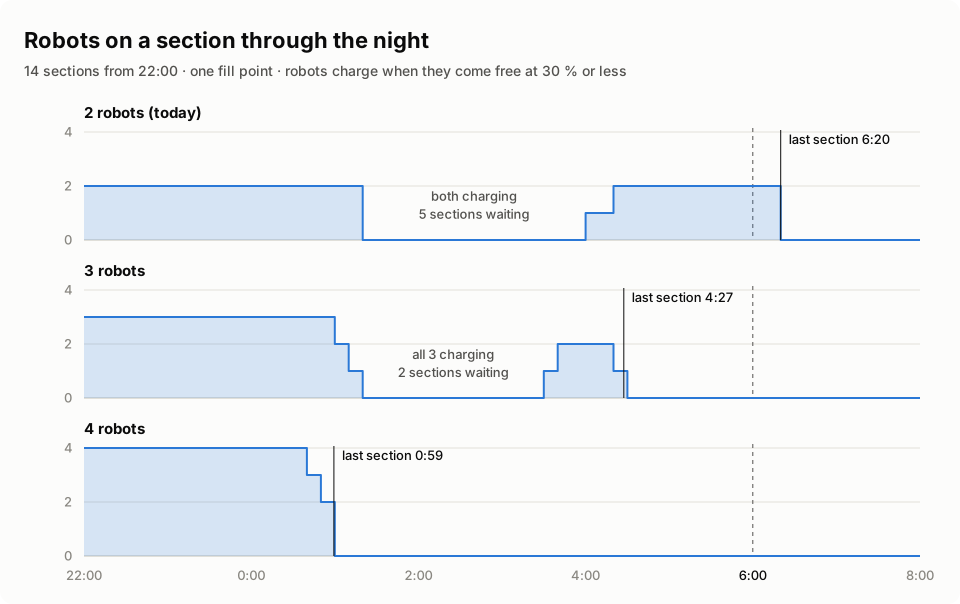
- Two robots leave full at 22:00 together and their batteries fall alike. From 1:20 to 4:00 neither robot is on a section: both have gone to charge, while 5 sections wait.
- Three robots do the same: from 1:20 to 3:30 all three stop, while 2 sections wait.
- With four, no robot goes to charge while a section waits, and the last section is done at 0:59. Each robot charges once, after its own last section.
4. With other robot models
With two and three robots, your AI changed the battery, the charge time and the scrubbing rate one at a time. When the last section is done:
| Robot model | 2 robots | 3 robots |
|---|---|---|
| Today’s (4-hour battery, 4-hour charge, 700 m² an hour) | 6:20 | 4:27 |
| A 6-hour battery | 6:13 | 1:40 |
| Charges from empty in 2 hours | 4:47 | 3:03 |
| Scrubs 1,000 m² an hour | 5:19 | 1:00 |
- With two robots, whatever the model, both stop once in the night (2:50 to 4:50 with the 6-hour battery, 1:20 to 2:40 with the 2-hour charge, 1:30 to 4:10 at 1,000 m² an hour). The two that make 06:00 are the 2-hour charge, which shortens the stop (4:47), and the 1,000 m² model (5:19). A 6-hour battery still finishes at 6:13, too late.
- With three robots, the 6-hour battery and the 1,000 m² model both finish with no robot going to charge while a section waits, at 1:40 and 1:00. The 2-hour charge stops them from 1:20 to 2:10 and finishes at 3:03.
- The same difference in the model helps or not depending on the fleet. Of the nine nights read through, the three with no stop all finish by 1:40, and the six with a stop all finish at 3:03 or later.
5. How to use these numbers
- Give your AI the sections and their areas from your own plan, and the scrubbing rate measured on your floors; the battery hours and charge time, the area a tank covers (in this model, a refill after every section), the minutes to drain and refill, and how the lifts can be used at night.
- In this model every robot leaves full at 22:00. Charging in turn and swapping batteries are not tried.
- An earlier finish is worth weighing against the cost of the robots, the chargers and a second fill point.
- Not computed: what each square metre is left like, how dirty the floor is, spills, drying time, battery ageing, people in the mall.