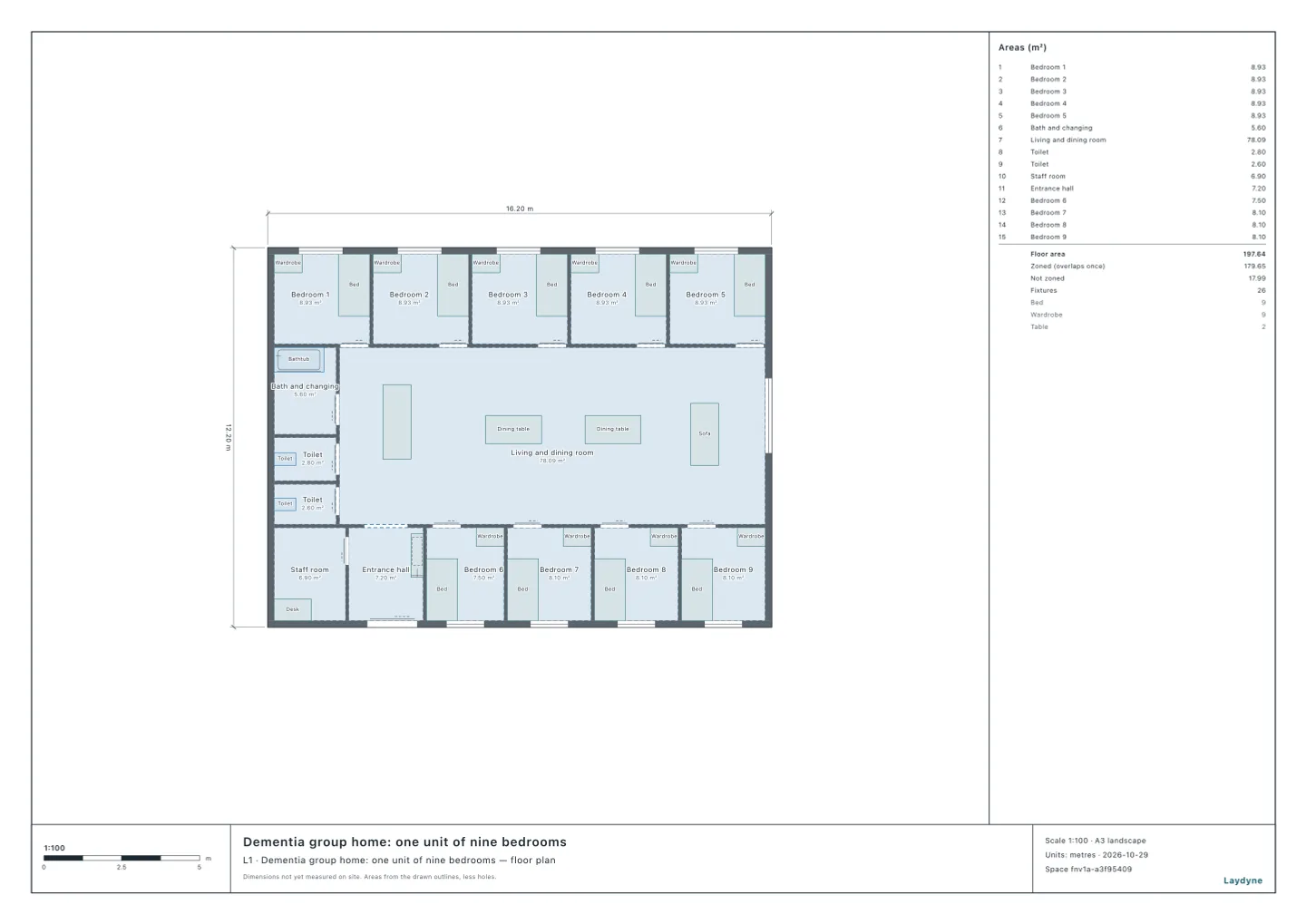
Start from the dementia group home model (free sign-up; running a simulation is Pro). With one carer on the night shift, when two residents call, the second waits. In this article, in the members’ group home of one unit of nine bedrooms, your AI simulates the calls of a night. It ran the same tools an AI calls over MCP. Every number below comes from that run.
1. The home and the night
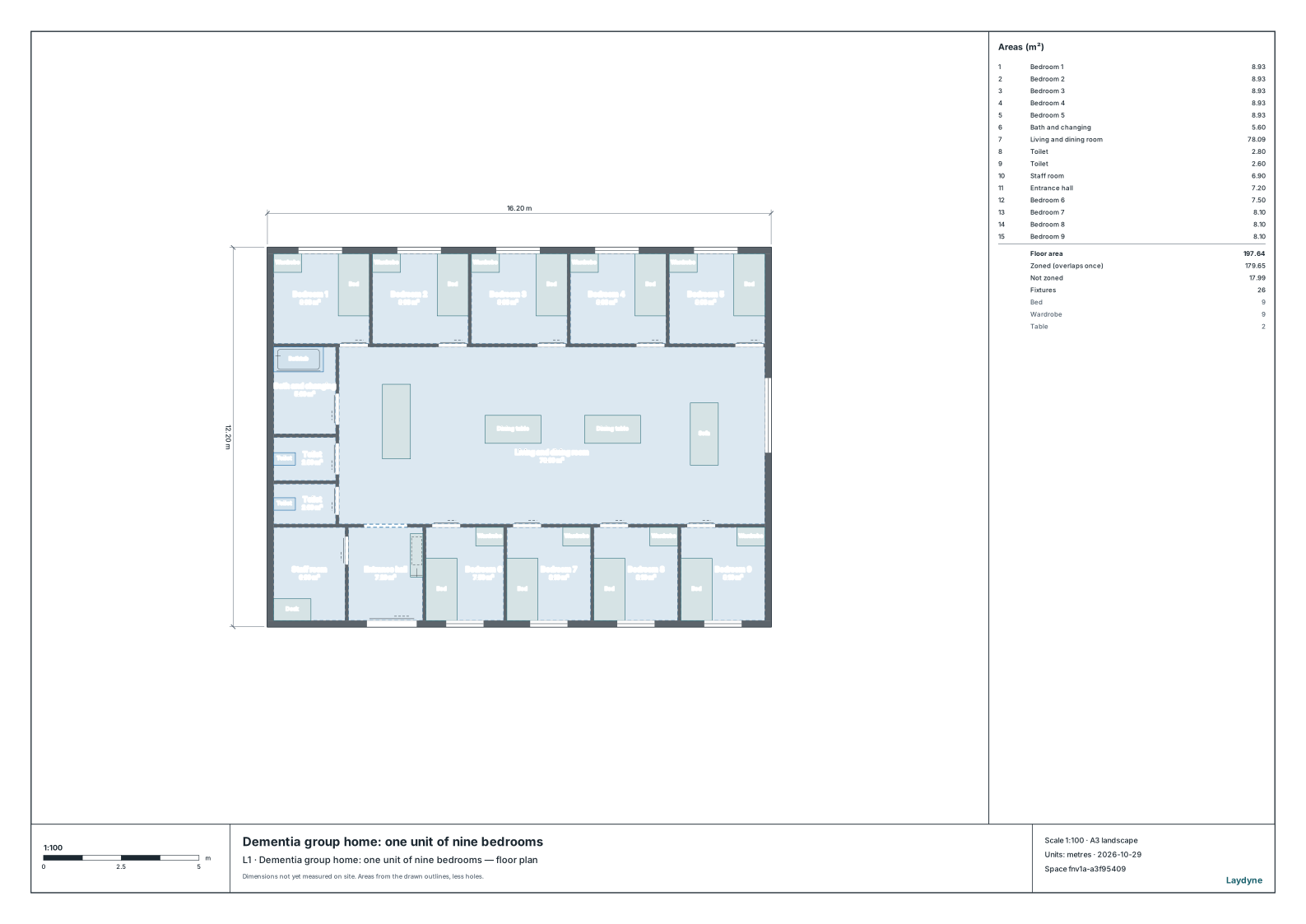
- One unit (a shared living unit) of nine bedrooms and a staff room.
check_spacefinds nothing. - Japan’s standard asks for at least one care worker on night duty through the night for each shared living unit (指定地域密着型サービスの事業の人員、設備及び運営に関する基準 第90条第1項; three units side by side on one floor may have two between them, on conditions).
The AI wrote this flow as a scenario (put_process_scenario).
- From 22:00 to 6:00 the nine residents call from their bedrooms at random, each 2 times a night on average (for help to the toilet, or awake and uneasy).
- The carers wait in the staff room; a free one goes to the bedroom and helps, for 10 minutes on average (5 to 20 minutes, most often 5).
- A call that comes while the carers are helping in other bedrooms waits until one is done.
- Every number and time is an assumption. Put in your own residents’ nights.
2. The calls and the carers
The AI changed the calls a resident makes in a night (1, 2, 3) and the carers on the night shift (1, 2) (sweep_process_parameters), 20 nights each. The wait is from the call until a carer’s hands are free. The longest wait is the mean over the 20 nights of each night’s longest.
| Carers | Calls a resident | Calls a night | Wait (mean) | Longest wait | Waiting at once (most) |
|---|---|---|---|---|---|
| 1 | 1 | 8.4 | 0.8 min | 5.0 min | 0.9 |
| 1 | 2 | 16.9 | 3.3 min | 15.2 min | 1.7 |
| 1 | 3 | 26.6 | 7.0 min | 27.3 min | 2.9 |
| 2 | 1 | 8.4 | 0.0 min | 0.4 min | 0.1 |
| 2 | 2 | 16.9 | 0.2 min | 2.2 min | 0.5 |
| 2 | 3 | 26.6 | 0.6 min | 6.0 min | 1.4 |
- With one carer and 2 calls a resident, a call waits 3.3 minutes on average, but the night’s longest wait is 15.2 minutes on average; with 3 calls, 27.3 minutes.
- Once free, a carer walks to the bedroom in 7.6 seconds on average: nearly all the wait is the help in another bedroom.
- With two carers, the longest wait is 6.0 minutes even at 3 calls.
3. How long a help takes
At 2 calls a resident, the AI changed a help’s average time (10, 15, 20 minutes).
| Carers | Help (mean) | Wait (mean) | Longest wait |
|---|---|---|---|
| 1 | 10 min | 3.3 min | 15.2 min |
| 1 | 15 min | 8.3 min | 30.9 min |
| 1 | 20 min | 17.6 min | 54.5 min |
| 2 | 10 min | 0.2 min | 2.2 min |
| 2 | 15 min | 0.8 min | 6.1 min |
| 2 | 20 min | 1.9 min | 11.7 min |
- With residents whose help takes long, the waits grow fast with one carer: at 20 minutes on average, the longest wait is 54.5 minutes.
4. How to use this
- Draw your home (from a PDF of the drawings or photos too), and tell the AI each resident’s calls at night and how long a help takes. Counts taken from your records bring it nearer the real nights.
- Not checked: the night shift’s other work (rounds, records, laundry), breaks and naps, residents who need two carers, falls and other sudden needs, and sensors and monitoring.