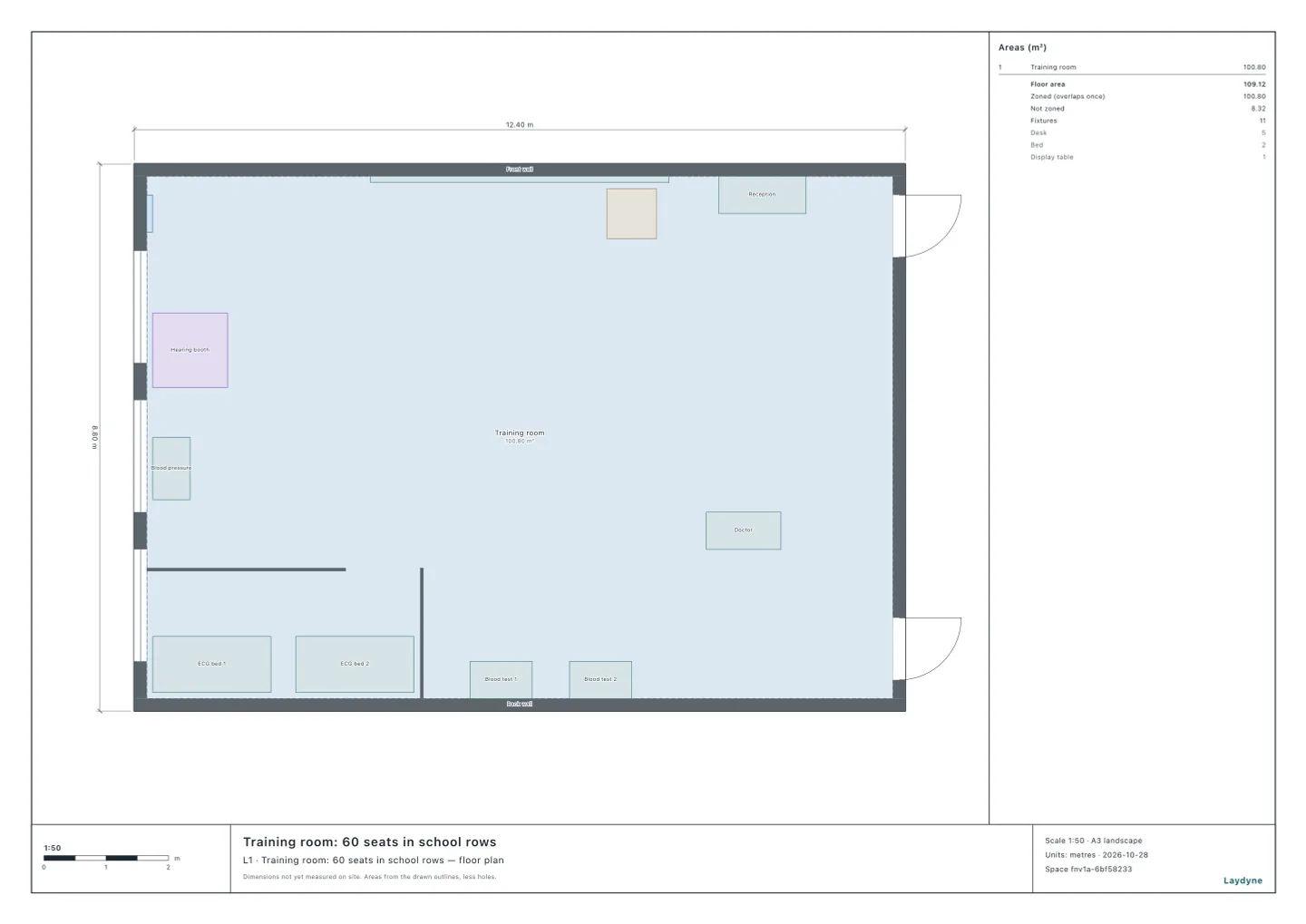
Start from the training room model (free sign-up; running a simulation is Pro). Article 44 of Japan’s Industrial Safety and Health Regulations gives every worker a checkup once a year: medical history; height, weight, waist, vision and hearing; a chest X-ray; blood pressure; anaemia, liver function, blood lipids and blood sugar (a blood test); urine; an ECG; and more. In this article, your AI sets the members’ training room out as the checkup venue and simulates a morning of 60. It ran the same tools an AI calls over MCP. Every figure and number below comes from that run.
1. The training room as the venue
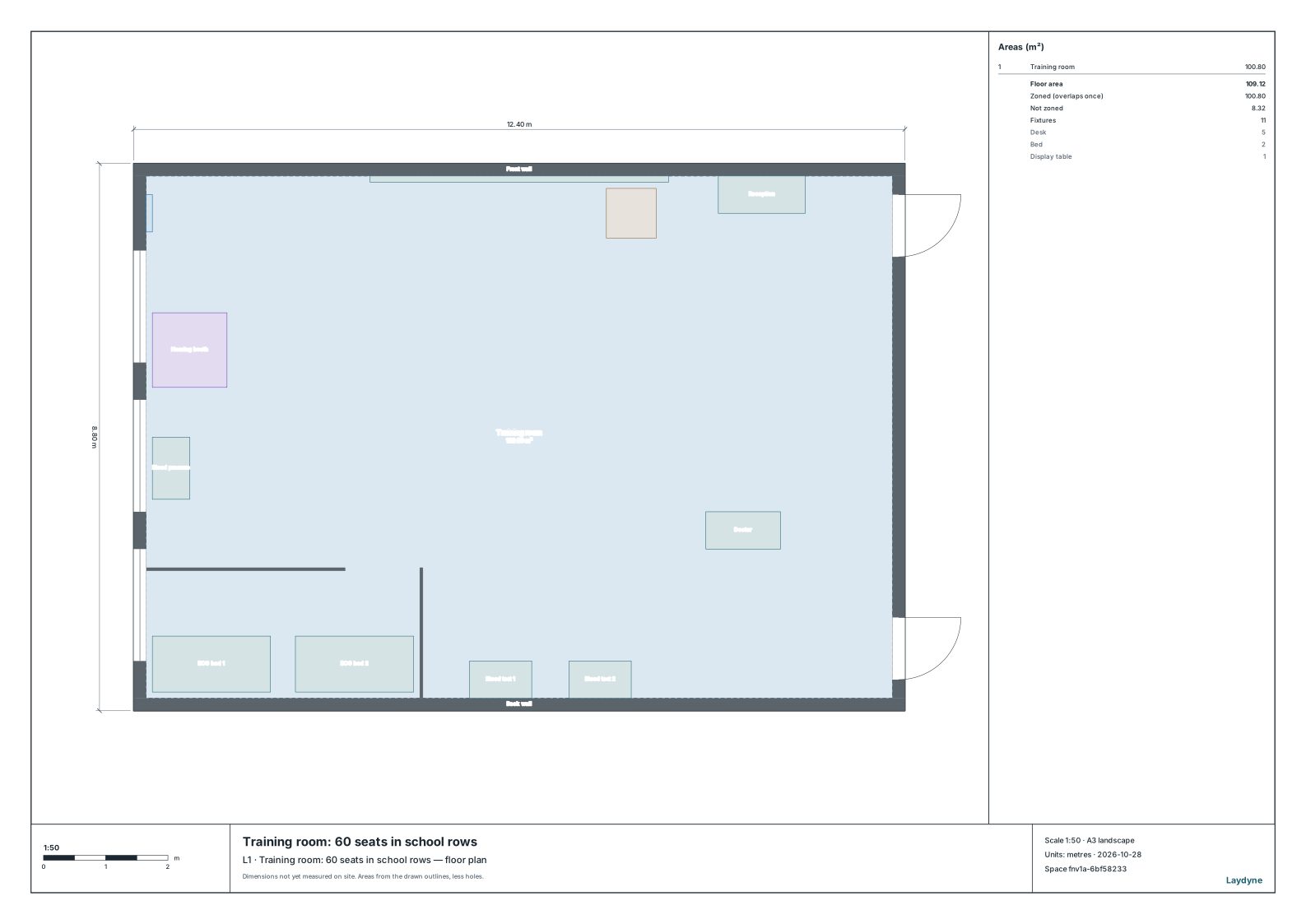
In one change (edit_space) your AI takes out the room’s 81 tables, chairs and podium and puts in, clockwise from the front door: the reception (where the urine is handed in), height, weight and waist, the vision chart (read from 5 m), the hearing booth, blood pressure, two ECG beds behind screens, two blood-test desks and the doctor. The chest X-ray is in the van outside the back door. check_space finds nothing.
Your AI writes the flow as a scenario (put_process_scenario).
- 60 come in either by department, ten every half hour from 9:00, or booked, one every three minutes.
- From the reception on, each waits for each station in turn, has the chest X-ray in the van and leaves.
- The ECG 3 to 6 minutes (most often 4), the blood test 1.5 to 4, the doctor 1 to 4, and so on: every time is an assumption.
2. How people come in, and the ECG beds
Your AI sweeps how people come in (by department or booked) and the ECG beds (one or two) with sweep_process_parameters, 20 runs each.
| Coming in | ECG beds | In the venue | Waiting for the ECG | Last one out |
|---|---|---|---|---|
| By department | 1 | 69.3 min | 43.4 min | 13:31 |
| By department | 2 | 29.8 min | 1.2 min | 12:12 |
| Booked | 1 | 57.7 min | 39.6 min | 13:34 |
| Booked | 2 | 18.9 min | 0.0 min | 12:16 |
- The ECG takes 260 seconds on average: 260 minutes for 60, more than the morning’s 180. With one bed, it is not over by half past one, booked or not.
- With two beds it is over just after noon. With ten at a time by department, people wait 2.0 minutes at the reception and 2.5 at hearing on average; booked, they hardly wait.
3. A second blood-test desk
Coming in by department, your AI changes the ECG beds (one or two) and the blood-test desks (one or two).
| ECG beds | Blood-test desks | In the venue | Waiting for the blood test | Waiting for the doctor |
|---|---|---|---|---|
| 1 | 1 | 69.3 min | 0.2 s | 1.6 s |
| 1 | 2 | 69.3 min | 0.0 s | 1.7 s |
| 2 | 1 | 29.8 min | 114.7 s | 36.1 s |
| 2 | 2 | 29.0 min | 0.1 s | 97.5 s |
- With one bed, a second blood-test desk changes nothing.
- With two beds and two desks, the wait for the blood test goes, but the wait for the doctor grows from 36.1 to 97.5 seconds: the time in the venue is only 0.8 minutes shorter.
4. Using the check
- Draw your venue (from a PDF drawing or photos as well), and tell your AI how many will come, how, and the checks and their times.
- Not checked: separate times for men and women at the ECG and the doctor, filling in the questionnaire, how quiet the hearing booth is, the walk to the van and the weather, and the checks a doctor may leave out.