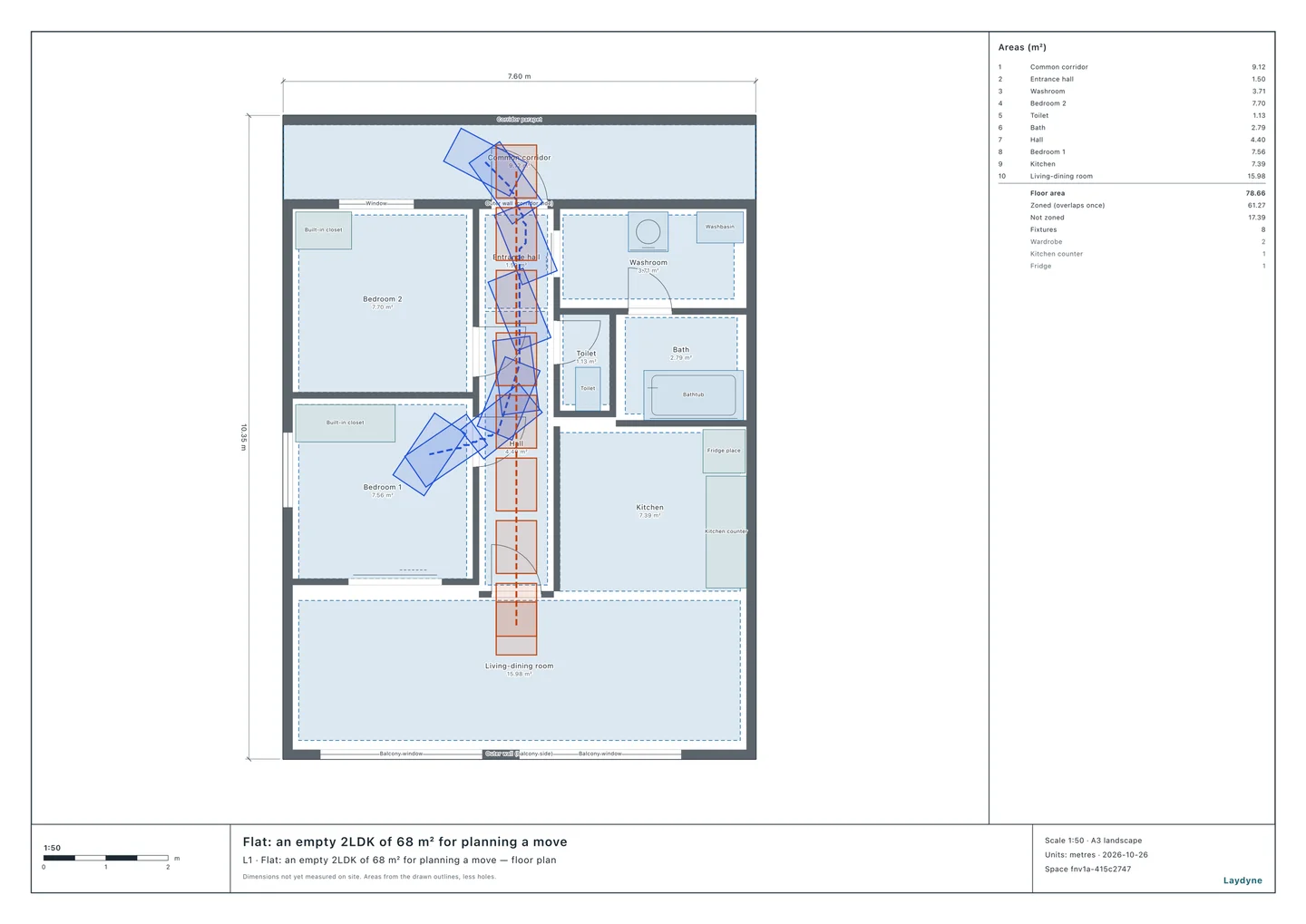
Start from the empty 2LDK flat (free account) or draw your own flat. Before a move, or before buying a sofa, people ask whether it gets through the door. The answer depends on the corridor outside the front door, the width and height of every door on the way, the turns in the hall, and which way up the piece is carried. This article runs that check on a synthetic flat, with the same tools your AI calls over MCP. Every number below comes from that run.
The flat
A 2LDK of 68 m²: two bedrooms with closets, a 16 m² living-dining room with an open kitchen, a washroom, a bath and a toilet. Outside the front door, the open-air common corridor is 1.2 m wide behind its parapet. The front door is 0.9 m wide and 2.1 m high, the doors inside are 0.8 m wide and 2.0 m high, and bedroom 1 also opens onto the living room by 1.5 m sliding doors.
1. Will the sofa get in?
The household is choosing between three sofas. check_space with carry moves each one as a rigid box from the corridor to the living room, turning it round corners and through doors: upright, then on its back, then on its side (stood on its arm), with 2.5 cm to spare on each side.
| Sofa (width × depth × height) | Result |
|---|---|
| Three-seat, 2.1 × 0.85 × 0.8 m | Does not get in. Upright or on its back, it cannot turn from the corridor into the front door. Stood on its arm, it is 2.1 m high, too high for every doorway in the flat. |
| Two-seat, 1.6 × 0.8 × 0.8 m | Does not get in. Upright, it cannot turn into the front door. Stood on its arm, it goes down the hall but stops at the 0.8 m living-room door. |
| Low sofa, 1.8 × 0.85 × 0.65 m | Gets in on its side (1.8 m high), through the front door and the living-room door, 7.4 m. |
For each way that fails, the answer says where the piece got closest to the room (in front of the front door, or at the living-room door) and which walls and doorways stopped it. Two things decide it in this flat. One is the turn in from the 1.2 m corridor, which none of the three sofas makes upright or on its back. The other is the 0.8 m living-room door: with 2.5 cm to spare on each side, a piece needs a side under 0.75 m to pass it.
2. The rest of the furniture
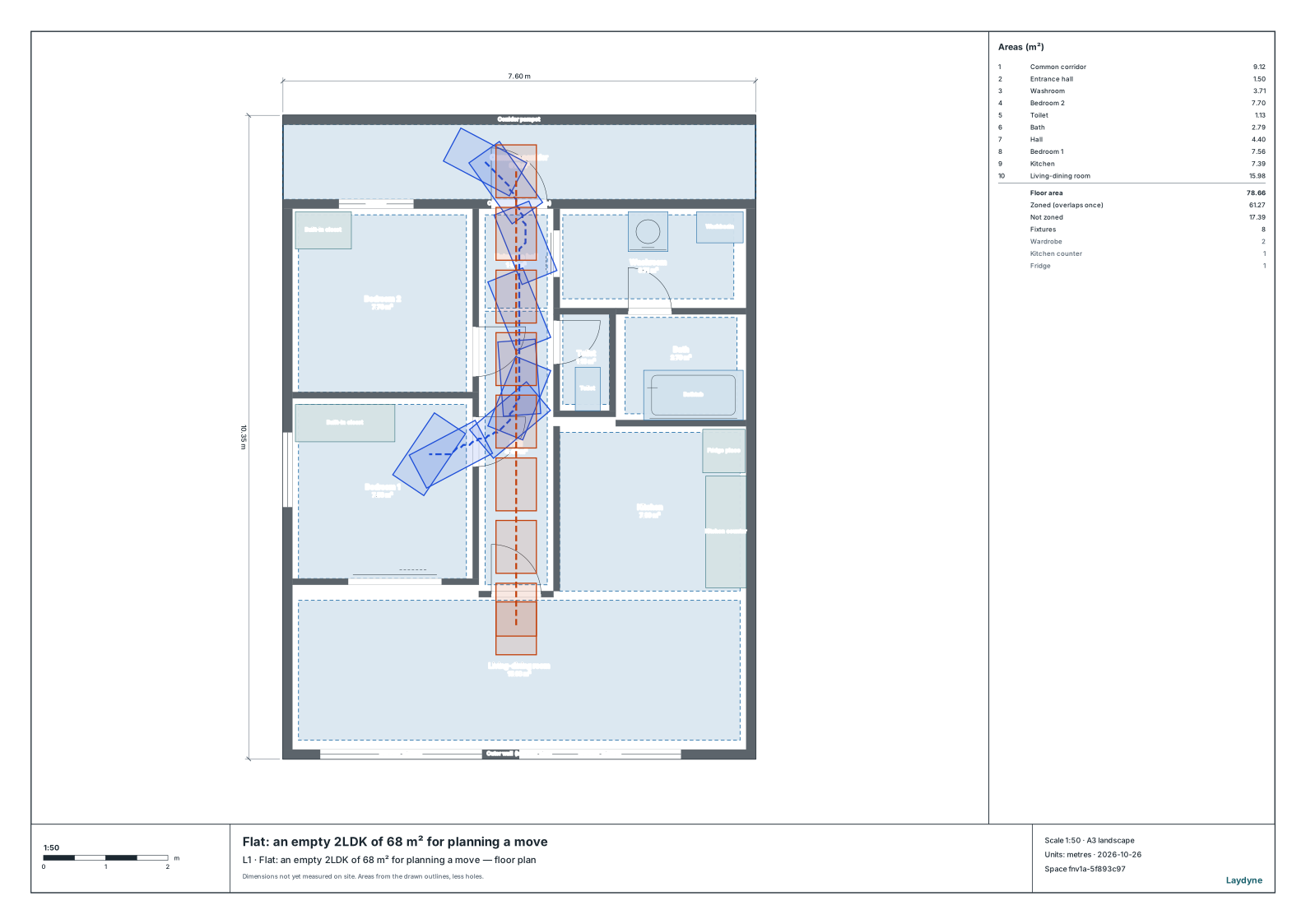
One more carry call checks the other six pieces, each to its room. The fridge and the washing machine are kept upright (upright: true), as their makers ask.
| Piece (width × depth × height) | To | Way | Through |
|---|---|---|---|
| Double mattress, 1.4 × 1.95 × 0.25 m | Bedroom 2 | On end, 1.95 m high | Front door, bedroom 2 door |
| Wardrobe, 1.2 × 0.6 × 1.8 m | Bedroom 1 | Upright | Front door, bedroom 1 door |
| Fridge, 0.65 × 0.7 × 1.8 m | Kitchen | Upright | Front door, living-room door |
| Washing machine, 0.6 × 0.65 × 1.0 m | Washroom | Upright | Front door, washroom door |
| Dining table, 1.4 × 0.8 × 0.72 m | Living room | On its side, 1.4 m high | Front door, bedroom 1 and its sliding doors |
| Desk, 1.0 × 0.6 × 0.72 m | Bedroom 1 | Upright | Front door, bedroom 1 door |
All six get in. Lying flat, the mattress does not even fit in the corridor, so it goes stood on end. The table cannot turn in at the front door upright or on its back, so it goes on its side, and the way found passes through bedroom 1.
3. Place it and check the rooms
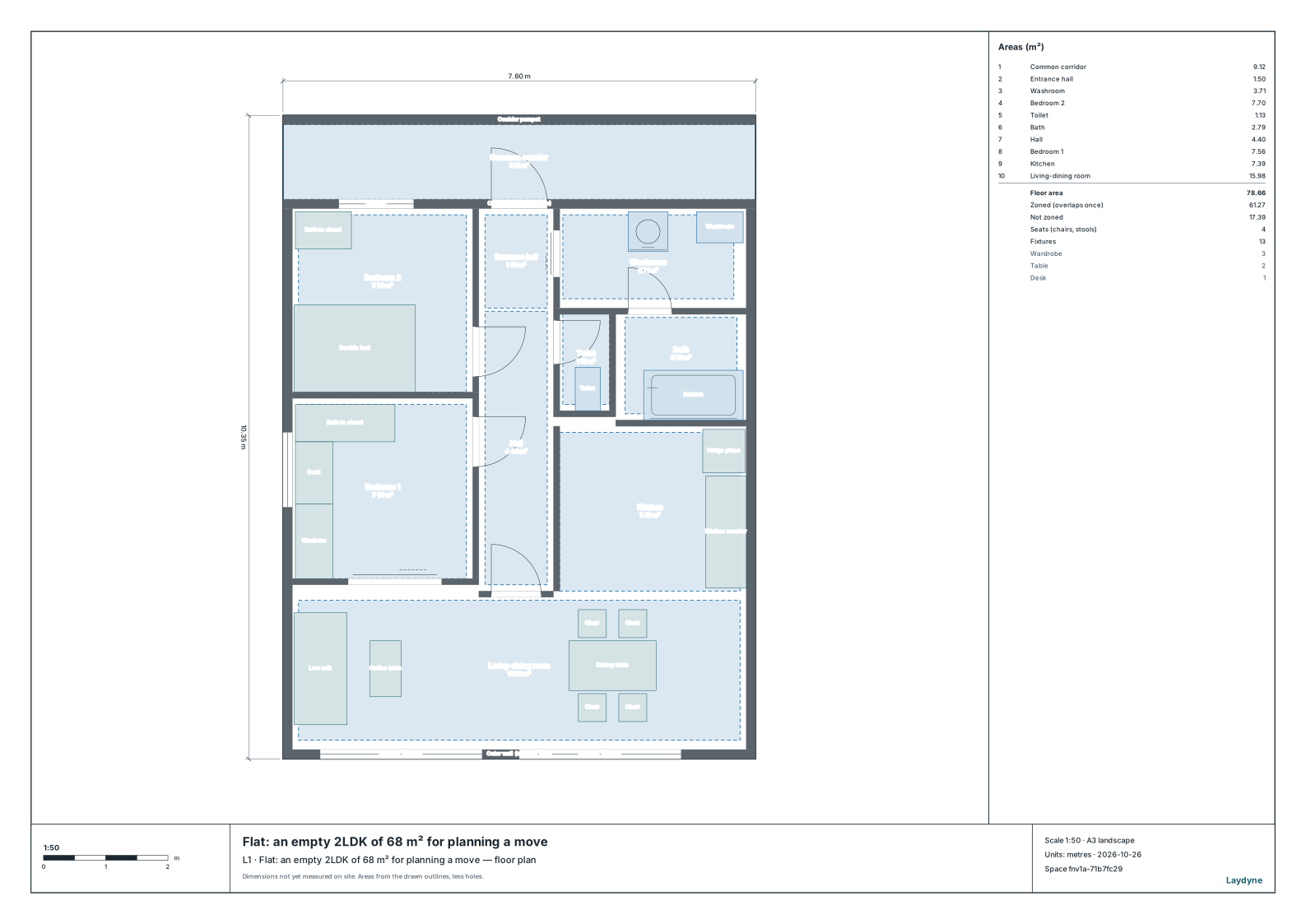
The AI places the pieces with edit_space:
- the low sofa against the living room's west wall, facing a coffee table;
- the dining table with four chairs by the kitchen;
- the double bed in bedroom 2;
- the desk under bedroom 1's window, with the wardrobe beside it.
check_space finds one issue: the bed stands 0.8 m from bedroom 2's closet, less than a 0.9 m passage. The AI moves it 0.1 m south and the check finds none. With everything in place, carry with part checks the sofa and the wardrobe again, now with the other furniture in the way. Both still get in the same way.
What Laydyne does and does not do
Laydyne moves each piece as a rigid box in plan, with 2.5 cm to spare on each side. A doorway lower than the piece, carried that way, stays shut. A way it finds is a real way.
It does not:
- tilt a piece in 3D round a corner or through a door;
- turn the piece over on the way;
- take legs or doors off;
- use stairs, lifts or the balcony.
So movers can sometimes get in what Laydyne says will not go, and a piece within about 10 cm of the longest that turns a corner can be told no. Door leaves and stops narrow a doorway by a few centimetres, so measure the clear opening and the piece, and model the corridor or landing outside your own door. The sizes here are representative, not a surveyed flat.
The same check moves any box through a plan: a display case to a shop floor, a dental unit to its bay, a machine to its place.