Start from the hospital model (no sign-up needed; running a simulation is Pro). After their consultation, outpatients wait until their bill is worked out, and then to pay. In this article, on the hospital model’s outpatient ground floor, your AI simulates a morning at the cashier. It ran the same tools an AI calls over MCP. Every number below comes from that run.
1. The outpatient floor and the morning
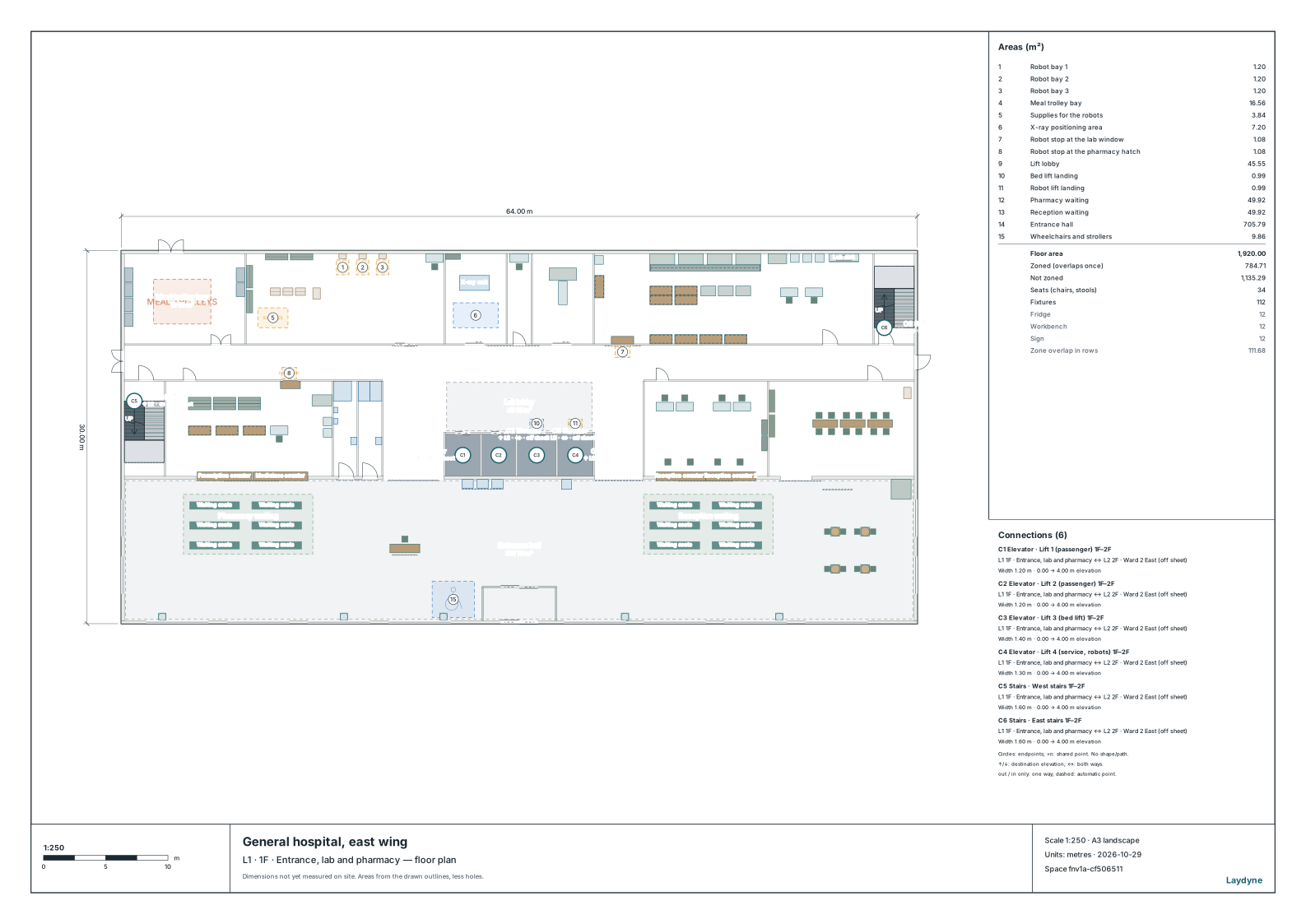
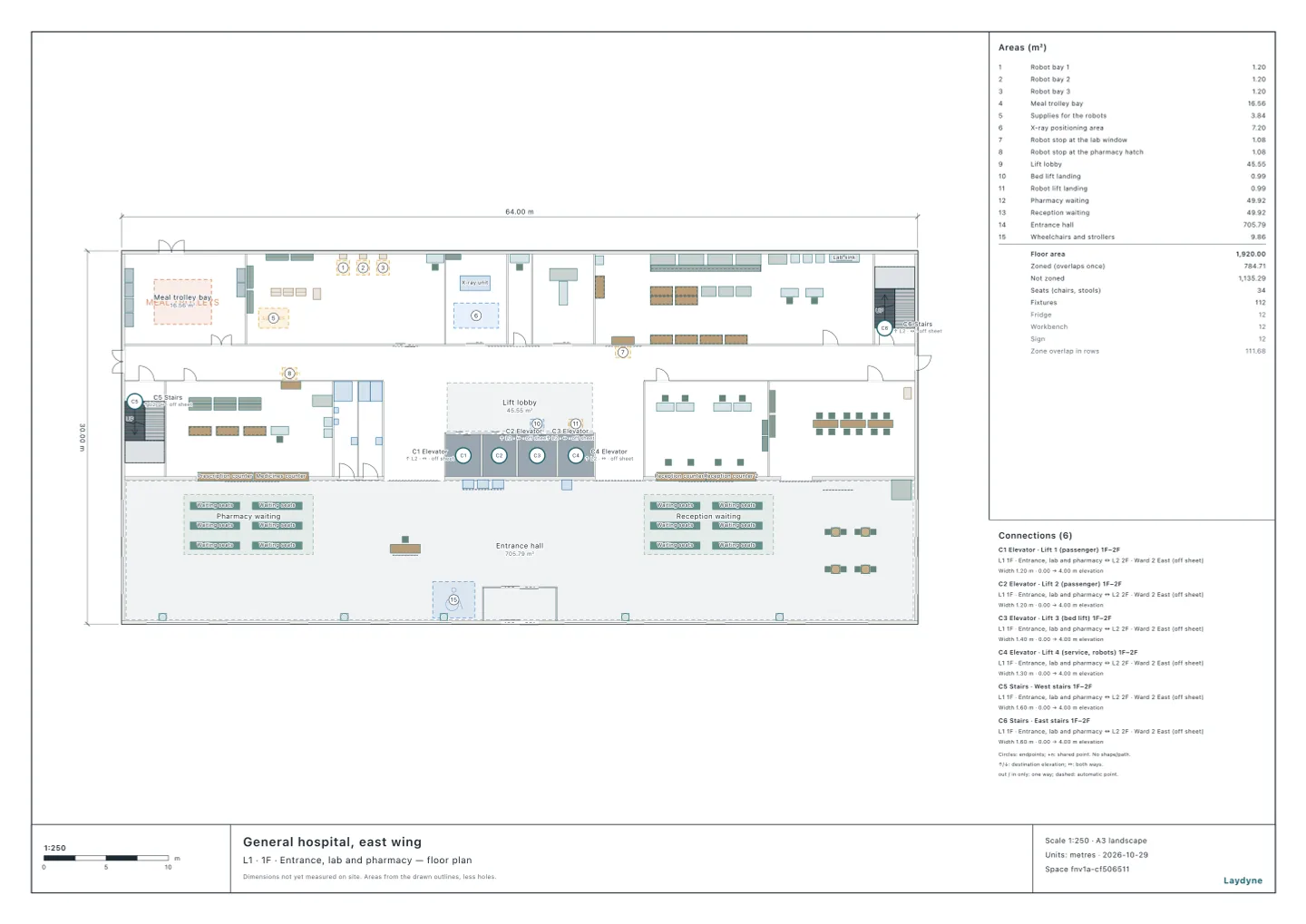
- The ground floor’s entrance hall has two reception counters, a reception and cashier waiting area and three self-pay machines. In one change (
edit_space), the AI tagged the three machines.check_spacefinds nothing.
The AI wrote this flow as a scenario (put_process_scenario).
- From 9:30 to 13:30, 250 outpatients come to the cashier at random after their consultation: 16 % in the first hour, then 32, 36 and 16 %.
- Each puts their file in the tray at the cashier’s window at reception counter 2 (15 seconds) and waits in the waiting area until one of the three clerks of the medical office is free to work out the bill: 3.5 minutes on average (1.5 to 6 minutes, most often 3).
- With the bill worked out, 70 % pay at a self-pay machine (30 seconds to 2 minutes, most often 1) and the others at the cashier’s window (1 to 3 minutes, most often 1.5), and leave by the main entrance.
- Every number and time is an assumption. Put in your own outpatient records.
2. The clerks and the outpatients
The AI changed the clerks who work out bills (2, 3, 4) and the outpatients who come (200, 250, 300) (sweep_process_parameters), 20 runs each. Until the bill is the mean from putting the file in to the bill worked out. The longest wait is the mean over the 20 runs of each run’s longest.
| Outpatients | Clerks | Until the bill | Wait for a clerk (mean) | Longest wait | Waiting for a bill (most) |
|---|---|---|---|---|---|
| 200 | 2 | 64.1 min | 60.1 min | 124.5 min | 72.0 |
| 200 | 3 | 20.3 min | 16.4 min | 39.6 min | 34.1 |
| 200 | 4 | 6.6 min | 2.7 min | 10.3 min | 12.0 |
| 250 | 2 | 100.4 min | 96.4 min | 197.8 min | 112.8 |
| 250 | 3 | 40.5 min | 36.5 min | 79.1 min | 68.2 |
| 250 | 4 | 15.5 min | 11.6 min | 30.0 min | 34.9 |
| 300 | 2 | 141.4 min | 137.5 min | 279.4 min | 160.1 |
| 300 | 3 | 62.8 min | 58.9 min | 121.9 min | 105.1 |
| 300 | 4 | 30.0 min | 26.1 min | 58.2 min | 66.6 |
- With 250 outpatients and three clerks, the bill takes 40.5 minutes on average, nearly all of it (36.5 minutes) waiting for a clerk’s turn.
- With four, 15.5 minutes; with two, 100.4.
3. The time to work out a bill
With 250 outpatients, the AI changed a bill’s average time (about 2.3, 3.5 and about 4.7 minutes) and the clerks.
| Bill (mean) | Clerks | Until the bill | Wait for a clerk (mean) | Longest wait |
|---|---|---|---|---|
| 2.3 min | 2 | 39.5 min | 36.7 min | 79.4 min |
| 2.3 min | 3 | 8.3 min | 5.6 min | 16.9 min |
| 3.5 min | 2 | 100.4 min | 96.4 min | 197.8 min |
| 3.5 min | 3 | 40.5 min | 36.5 min | 79.1 min |
| 4.7 min | 2 | 169.5 min | 164.4 min | 334.5 min |
| 4.7 min | 3 | 80.1 min | 75.0 min | 155.3 min |
- With bills of 2.3 minutes on average, three clerks take 8.3 minutes; even two take 39.5, about the same as three at 3.5 minutes (40.5). Shortening each bill, for example by entering it during the consultation, works about as well as another clerk.
4. Self-pay machines
With 250 outpatients and three clerks, the AI changed the share who use the self-pay machines (none, 70 %).
| Self-pay machines | Until the bill | Paying at the window | Window: wait (mean) | Window: longest wait | Machines: longest wait |
|---|---|---|---|---|---|
| None | 40.5 min | 245.5 | 71.4 min | 152.1 min | — |
| 70 % | 40.5 min | 72.2 | 0.5 min | 3.3 min | 0.0 min |
- Without the self-pay machines, the single window to pay has a line too: 71.4 minutes on average. With 70 % at the machines, the window’s wait is 0.5 minutes.
- But the 40.5 minutes until the bill do not change with the machines or without them. To shorten the wait at the cashier, look at the bills before the paying.
5. How to use this
- Draw your hospital’s outpatient floor (from a PDF of the drawings or photos too), and tell the AI the outpatients at the cashier each hour and how long the bills and the paying take.
- Not checked: the waits for consultations and tests, prescriptions and medicines, paying later or calling patients for their bill, those who take longer (large payments, checking insurance cards), and the medical office’s other work.