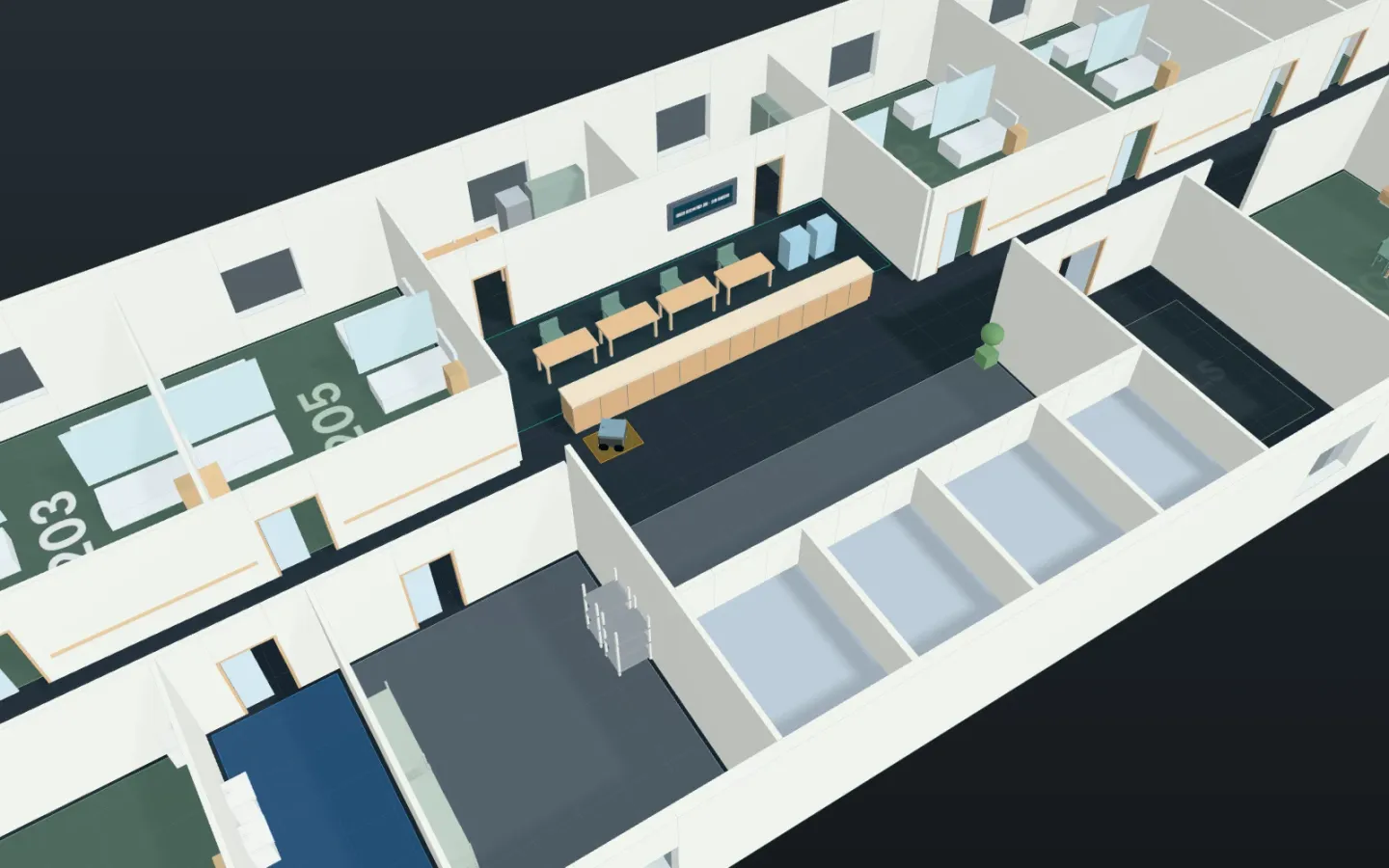
Open the hospital specimen transport (no account needed to open it; running simulations takes Pro). To get the morning’s specimens to the lab sooner, should the hospital add a delivery robot or change how the lifts are used? With the same morning, your AI changes the robots and the lift rule and compares them in a simulation. This article runs on a synthetic hospital with the same tools your AI calls over MCP. Every number below comes from that run.
1. The hospital and the morning runs
The synthetic hospital is a five-storey ward wing on a weekday morning, from 6:30.
- Each of the four wards (2F to 5F) has a box of blood specimens ready for the 1F lab every 15 minutes from 6:35 (6 boxes a ward, the wards 3 minutes apart, 24 boxes in all). The pharmacy sends each ward its morning medicines at 7:00 and the day’s injections at 7:50, and the stores one cart of supplies at 6:50.
- Delivery robots (0.8 m/s) make every run: the nearest free robot drives to the sender, is loaded in 60 s, rides the service lift (lift 4) alone, and is unloaded in 40 s (the lab has one reception window; the boxes take turns).
- The service lift has one car, taking one robot or one trolley at a time. From 7:10 it carries 12 breakfast trolleys up, and from 8:10 the trays down. Porters take six patients on beds to X-ray and back by the bed lift (lift 3).
- The time to the lab runs from a box being ready to the lab taking it. Not counted: robot charging and faults, robots and people passing at doors and in corridors, priority calls, passenger lift traffic, nurses’ availability beyond the fixed loading time, pneumatic tubes or carrying by hand, specimen stability, costs.
2. The robots and the lift rule
Your AI ran the saved scenario’s parameters, the robots and whether the meal trolleys use the service lift, at every combination with sweep_process_parameters, twenty runs each on the same random numbers.
| Delivery robots | Meal trolleys | Specimens to the lab | Service lift wait (longest queue) | Bed lift wait (longest queue) | The robots busy |
|---|---|---|---|---|---|
| 2 (today) | Service lift | 17.2 min | 74.5 s (6.0) | 4.0 s (1.0) | 58 % |
| 2 | By the bed lift | 8.4 min | 10.5 s (1.0) | 30.7 s (2.7) | 48 % |
| 3 | Service lift | 8.4 min | 61.7 s (6.0) | 4.0 s (1.0) | 43 % |
| 3 | By the bed lift | 5.2 min | 18.0 s (2.0) | 30.7 s (2.7) | 34 % |
- With today’s two robots, specimens take 17.2 minutes to the lab, and up to 6 robots and trolleys wait at the service lift.
- A third robot, or keeping the service lift for the robots by sending the meal trolleys by the bed lift, gets the specimens there in 8.4 minutes (8.8 and 8.9 minutes sooner). Both together: 5.2 minutes.
- The time to the lab was the same in all 20 runs; what varies is the bed transfers.
3. The lift rule slows the bed transfers
With the meal trolleys on the bed lift, its wait rises from 4.0 to 30.7 s, and each of the porters’ bed transfers takes 50.5 s longer (the difference run by run, 95 % interval 37.3 to 63.7 s longer). A third robot leaves the bed transfers as they were.
- A third robot gets specimens there sooner without touching other work, but it costs a robot.
- Changing the lift rule costs nothing, but moves a wait onto the patients’ bed transfers.
4. How to use these numbers
- Give your AI the specimen, medicine and supply runs by ward and time of day, the loading and unloading times including nurses coming to the robot, the robot’s speed, the lifts’ speed, door times and control, the meal trolley and bed transfer schedules, and the lab’s cut-off.
- The lift here follows simple fixed rules, with no priority call for robots and no group control. Check the lift’s real dispatch and the robot vendor’s fleet rules before deciding.
- Specimens arriving sooner do not establish earlier results or savings. Weigh them with the lab’s own processing, the robot’s cost and the effect on bed transfers.