Open the logistics hub model (no sign-up needed; running a simulation needs Pro). In Japan, shippers are asked to keep a truck’s waiting and loading or unloading to two hours in all, and once within two hours to aim for one (the guideline of the ministries of economy, agriculture and transport on the logistics efforts of shippers and logistics companies, June 2023). The same guideline recommends a truck reservation system, and enough forklifts and staff for the unloading. In this article, your AI reads the saved weekday morning of a mock logistics hub and compares a truck’s time from arriving to the unloading with the check-in staff, the docks open, the forklifts and reservations changed. It ran the same tools an AI calls over MCP. Every figure and number below comes from that run.
1. The hub and its morning trucks
The saved weekday morning of the mock logistics hub (an office block, two warehouses and overflow storage, and a truck yard with ten docks):
- From 9:00 to 10:00, trucks arrive at random, 10 an hour and 22 an hour from 9:15 to 9:45 (18.2 on average over the 20 runs).
- A truck stops in a free waiting bay (8 of them) and its driver checks in at the office window (2 staff, 2.5 to 7 min, most often 4).
- When one of the open docks (8 of the 10) is free the truck backs onto it, and a forklift (8 of them, which also put away 30 received pallets an hour) unloads it (10 to 25 min, most often 15). The truck takes 2 min to close up and leaves.
- The times are assumptions. Not counted: drivers walking, traffic in the yard, breakdowns, shift changes, costs.
Your AI reads the saved scenario (list_process_scenarios) and saves a copy (put_process_scenario, the saved one left as it is) that keeps the truck’s steps, reads the time to the unloading in three parts (the check-in, a dock, a forklift), adds a parameter that spreads the arrivals by reservations (reserved), and runs until every truck that came by 10:00 has left (to 13:00). It counts the trucks arriving from 9:10, as the saved scenario does. With sweep_process_parameters, it runs the same twenty random runs at each combination.
2. Today’s time
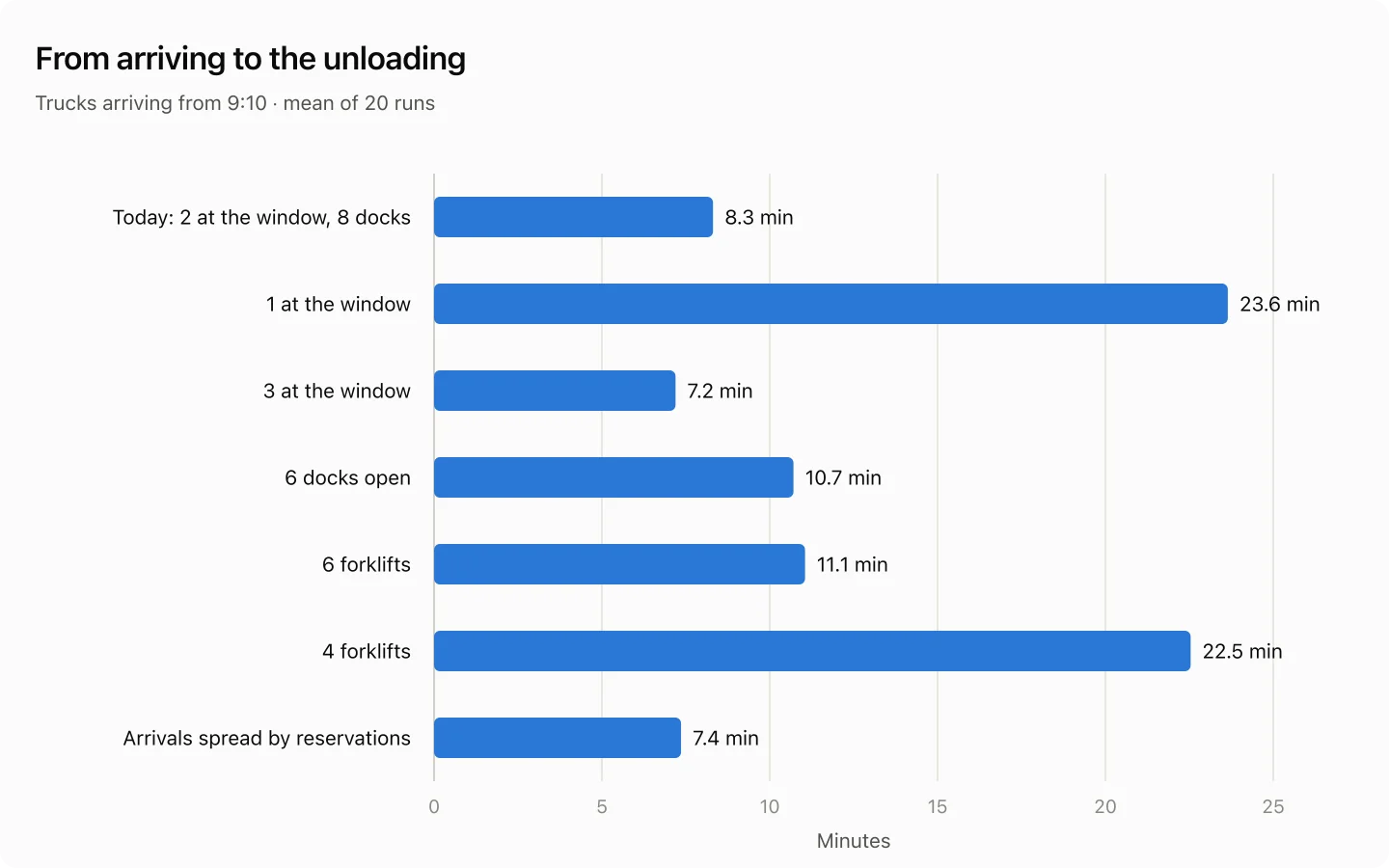
Today (2 at the window, 8 docks, 8 forklifts), a truck’s unloading starts 8.3 min after it arrives on average (95 % interval 6.6 to 10.0 min): 7.1 min at the check-in (2.6 min in line on average, 7.0 at the longest, the rest checking in), 0.6 min for a dock and 0.4 min waiting for a forklift. From arriving to leaving takes 27.2 min, far within the guideline’s two hours (and its one-hour aim). Changing the conditions still shows where the trucks wait.
3. The check-in staff and the docks open
From arriving to the unloading:
| At the window | 6 docks | 8 docks (today) | 10 docks |
|---|---|---|---|
| 1 | 23.6 min | 23.6 min | 23.6 min |
| 2 (today) | 10.7 min | 8.3 min | 8.2 min |
| 3 | 10.0 min | 7.2 min | 7.0 min |
- With one at the window it is 23.6 min whatever the docks, 15.3 min (95 % interval 12.0 to 18.6 min) more than today. Trucks wait 18.4 min in line at the window on average, 34.3 at the longest. At most 8.1 trucks on average wait for the window, which fills the waiting bays (8).
- With 6 docks it is 10.7 min (2.4 min more than today, 95 % interval 1.4 to 3.4 min). With 3 at the window it is still 10.0 min: the wait moves from the window to the docks (4.2 min waiting for a dock on average).
- With 10 docks it is 8.2 min, a difference from today within the noise.
4. The forklifts
| Forklifts | 2 at the window (today) | 1 at the window |
|---|---|---|
| 4 | 22.5 min | 26.5 min |
| 6 | 11.1 min | 23.7 min |
| 8 (today) | 8.3 min | 23.6 min |
- With 6 forklifts it is 11.1 min (2.7 min more than today), and with 4 it is 22.5 min: trucks wait 11.7 min on average for a forklift to come. The forklifts also put pallets away, so fewer of them shows in the trucks’ wait.
- With one at the window, 6 or 8 forklifts make almost no difference (23.7 and 23.6 min).
5. Spreading the arrivals by reservations
Keeping the trucks an hour the same, your AI spreads the 9:15 to 9:45 bunching by reservations (arrival times still at random). From arriving to the unloading:
| Arrivals 9:15 to 9:45 | Without reservations | Spread by reservations |
|---|---|---|
| 22 an hour (today) | 8.3 min | 7.4 min |
| 30 an hour | 12.4 min | 9.7 min |
- On today’s morning, spreading saves only 1.0 min (95 % interval 0.4 to 1.5 min).
- If the peak brings 30 an hour, it is 12.4 min, and 9.7 spread.
- With one at the window, spreading still leaves 21.2 min.
6. How to use these numbers
- Give your AI your own trucks every 15 minutes (from the gate log), with your check-in and unloading times: the numbers here are the example’s assumptions.
- Under the guideline, shippers keep track of the waiting and the loading or unloading time. Knowing where the trucks wait lets you compare another person at the window, more forklifts and spreading the arrivals, before choosing where to start.
- Here reservations only spread the bunching. Assigning each truck a fixed time should cut the waits further, which this article does not calculate.
- Not calculated: what the check-in involves, drivers walking, traffic in the yard, trucks kept out when the waiting bays are full (this model does not stop them), trucks missing their reserved time, breaks, costs.