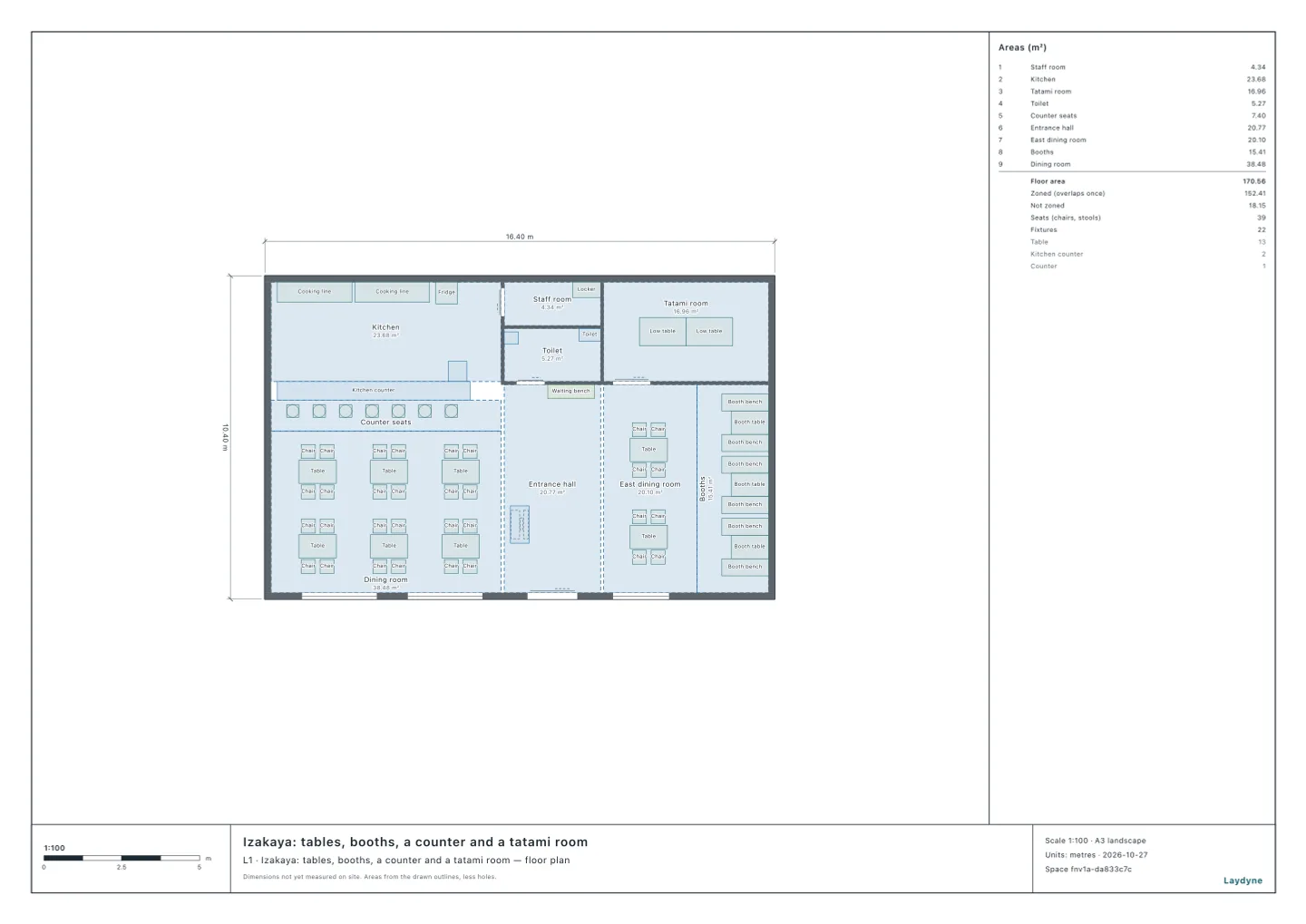
Start from the izakaya (free account) or from your own drawing. In Japan, a restaurant whose occupant load (収容人員) is 30 or more must appoint a fire prevention manager (防火管理者). The occupant load is not the number of chairs: the fire code counts it from the plan, room by room. This article counts it for a synthetic 170 m² izakaya, with the same tool your AI calls over MCP. Every number below comes from that run.
How the fire code counts
From the fire service regulation (消防法施行規則, article 1-3) and order (消防法施行令, articles 1-2 and 3), read from e-Gov, for a restaurant (令別表第一 (3)項):
- The staff: the most on duty at one time on an ordinary day, whatever the contract.
- Fixed seats: one each; a long seat such as a booth bench by its front width, 0.5 m a person, the fraction dropped.
- The rest of the seating (movable tables and chairs, a tatami room): its floor area divided by 3 m², the fraction dropped.
- Corridors, stairs and toilets are left out; the kitchen and the staff room count through their staff.
- From 30, a fire prevention manager is needed. One who took the 乙種 course qualifies when the building’s gross floor area is under 300 m²; the 甲種 course otherwise.
Each long seat and each room drops its own fraction before they are added, as the Niigata City fire department’s standard (運用基準) sets out; the Tokyo Fire Department’s guide (収容人員の算定方法) drops them too. Given the use, the staff and how each room counts, check_space with occupantLoad returns each room’s count, the total and what it means for a fire prevention manager.
1. The izakaya’s occupant load
| Room | Counted as | Count |
|---|---|---|
| Counter (7 fixed stools) | fixed seats | 7 |
| Booths (6 benches of 1.5 m) | fixed seats, 1.5 / 0.5 m a bench | 18 |
| Dining room (38.48 m²) | floor area / 3 m² | 12 |
| East dining room (20.10 m²) | floor area / 3 m² | 6 |
| Tatami room (16.96 m²) | floor area / 3 m² | 5 |
| Staff | the most on duty at one time | 6 |
| Total | 25 seats + 23 by floor area + 6 | 54 |
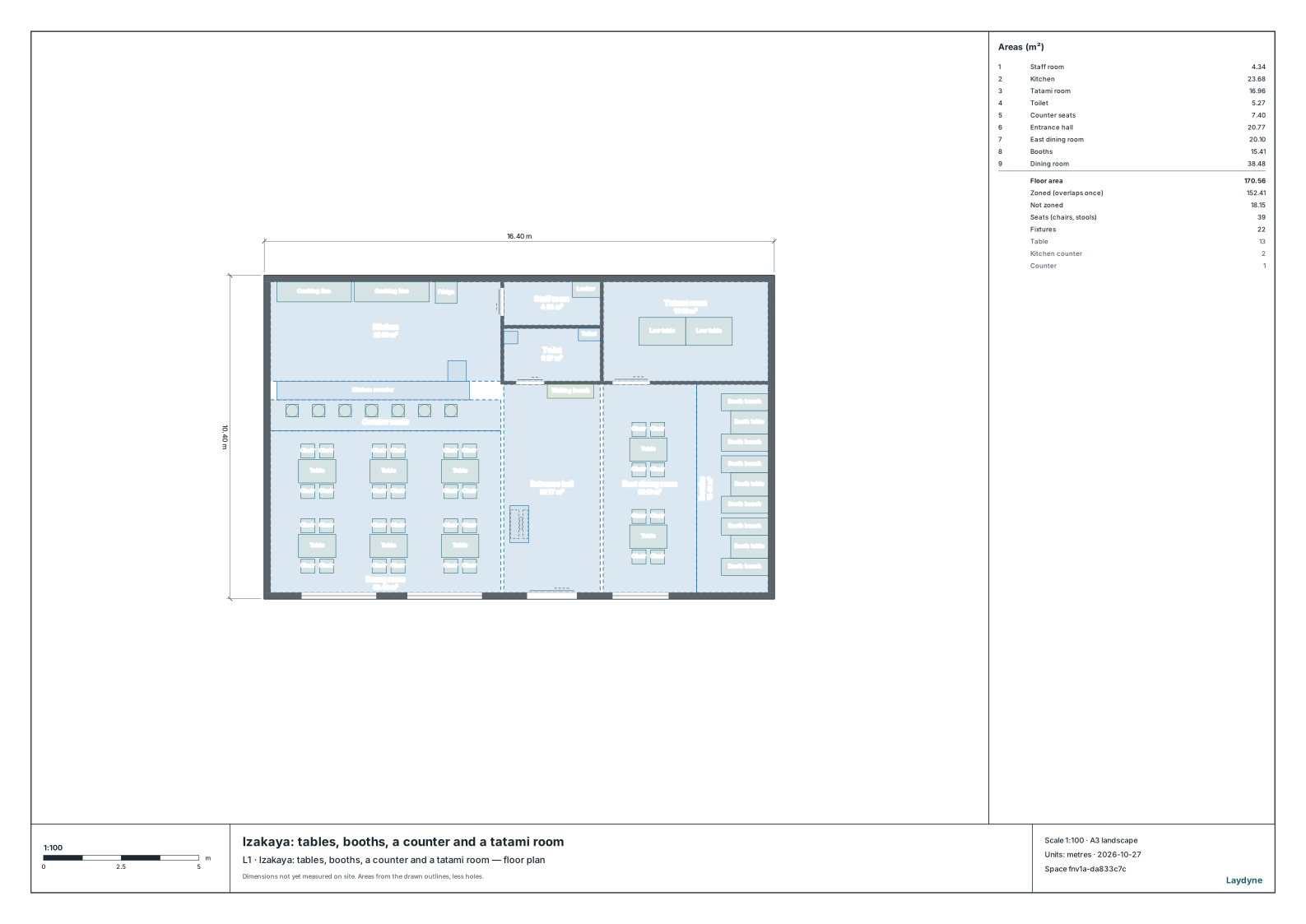
Each room drops its own fraction (12 + 6 + 5 = 23); the 75.54 m² added up first would make 25, so ask the fire department how they count. The floor check (check_space) finds no issues, and from the entrance a person reaches every room.
2. Does it need a fire prevention manager?
Yes: 54 is 30 or more. Standing on its own, the izakaya’s gross floor area is its 170.56 m² of floor, under 300 m², so the 乙種 course qualifies. On one floor of a 400 m² building, the same 54 would need the 甲種 course (grossFloorArea: 400).
The fire code counts a building whole: in a building of several floors, tenants or uses, each part is counted and added up, so the line of 30 is the building’s. List the rooms of every floor (each with its floor), or give the rest of the building’s count as othersInBuilding and what it is used for as othersUse: a building of several uses has its own line, 10 with a care home in it, 30 with a restaurant, shop or other specific use, 50 otherwise. A count of part of a building under the line cannot say that no manager is needed, and the tool answers needed: null. Where the building’s management is divided among tenants, a tenant whose own part counts under 30 may appoint a manager who took the 乙種 course (令第3条第3項).
3. Chairs are not the count
The two dining rooms have 32 chairs, but chairs that move count by floor area: 18 (12 + 6). Were every chair at the tables fixed to the floor, they would count one by one and the total would be 68. A booth bench of 1.5 m counts 3, whether two or three sit on it. Whether a seat is fixed is for the fire department to say: draw each kind of seating as its own zone and say how it counts.
4. How to use these numbers
- They are the fire code’s count, not how many fit, and not the fire department’s decision: how rooms are classed (whether a bench is fixed, whether a waiting area counts) is theirs.
- The staff number is yours to give: the most on duty at one time, part-timers included.
- Fire equipment duties (alarms, extinguishers, exit signs), which also turn on the use, the floor area and the occupant load, are not checked.
- The same
occupantLoadcounts a theatre or hall, a shop, a clinic, a library or an office, each by its own rates.