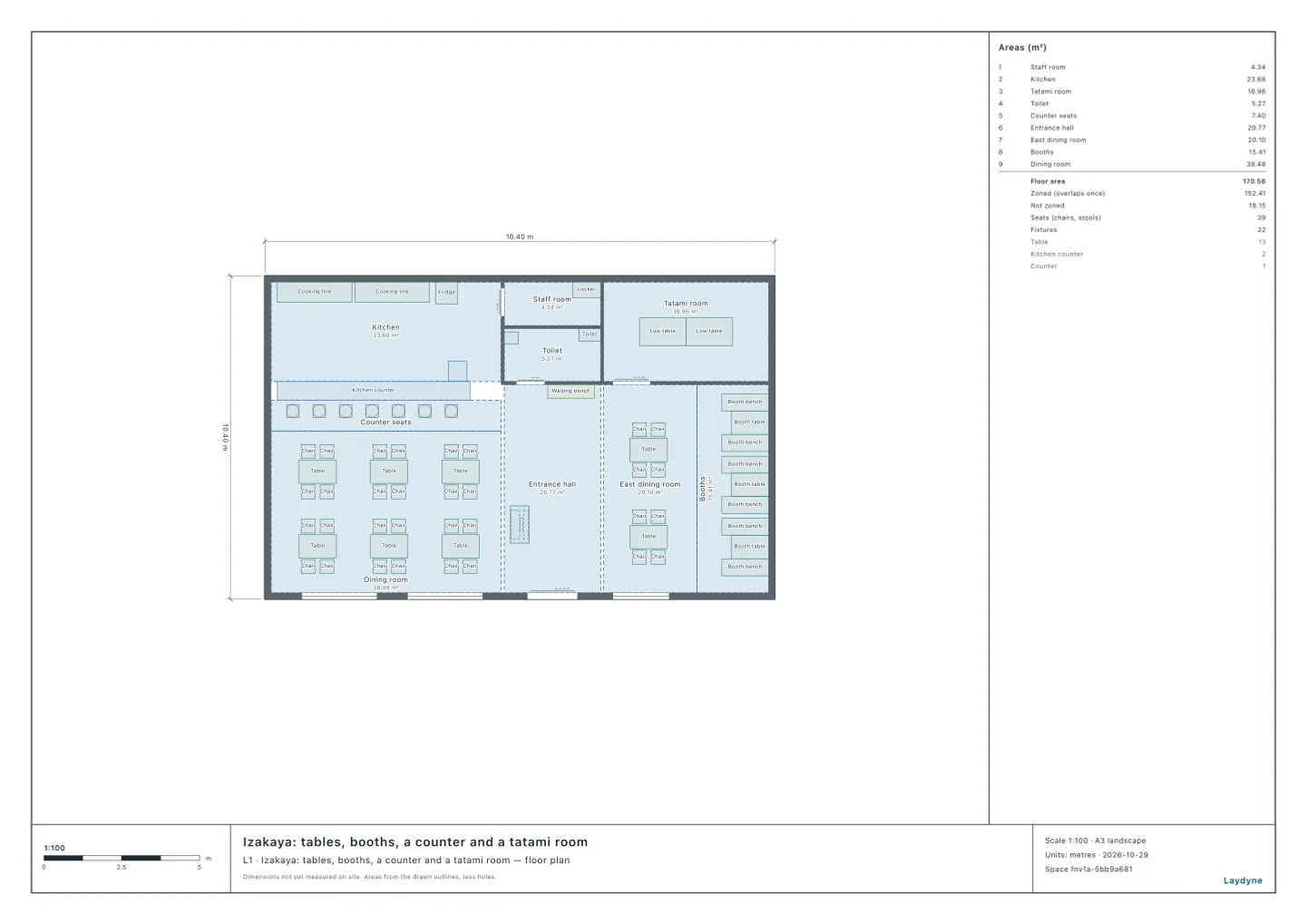
Start from the izakaya model (free sign-up; running a simulation is Pro). An izakaya’s counter, tables, booths and tatami room each seat different numbers, so the seats that run short depend on the size of the groups. In this article, in the members’ izakaya, your AI simulates a Friday night. It ran the same tools an AI calls over MCP. Every figure and number below comes from that run.
1. The izakaya and the Friday night
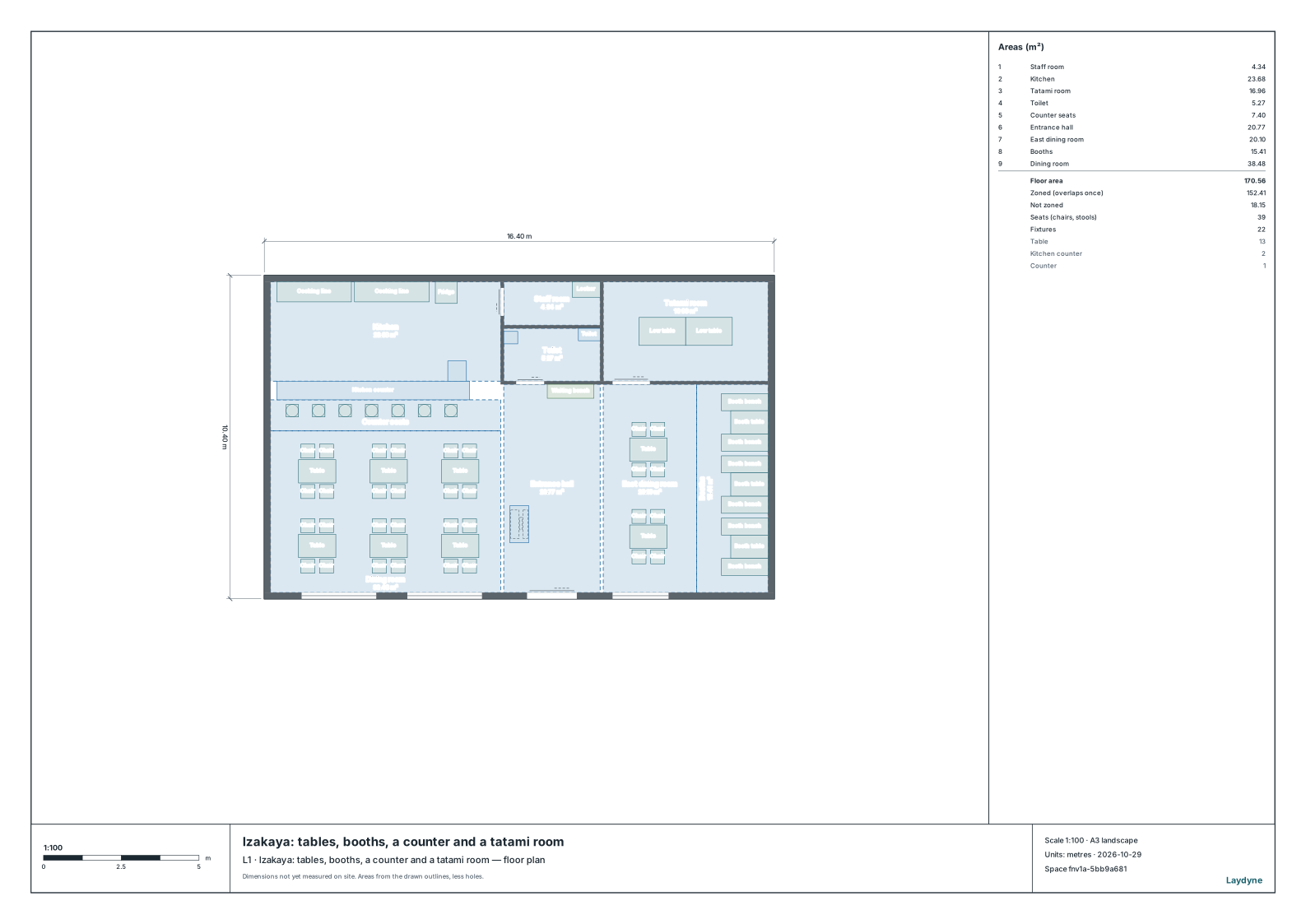
In one change (edit_space) your AI tags the seats by kind: the counter’s seven stools, the eight tables, the booths’ three tables and the tatami room’s two low tables. check_space finds nothing. Your AI writes the night as a scenario (put_process_scenario).
- From 17:00 to 23:00 groups come in at random: an hour at a time from 17:00, 50, 80, 100, 100, 70 and 40 % of the groups in an hour from 19:00 to 21:00, the busiest.
- One alone (15 %) or two (35 %) sit at the counter, or at a table if it is full. Three or four sit at a table, or in a booth.
- Five or six (two thirds of the parties of five or more) sit in a booth, or at one low table of the tatami room. Seven to twelve (a third) take both low tables. Parties of five or more are 15 % to begin with.
- With no seat they like free, a group waits by the bench at the way in up to 15 minutes, then leaves. One or two wait for the counter or a table (
counterWait); the others for their first choice. - One alone stays 40 to 90 minutes, two 60 to 120, three or four 90 to 150, a party 120 to 180, then leaves. Every time and share is an assumption.
2. The groups that come, and where one or two wait
Your AI sweeps the groups in an hour from 19:00 to 21:00 (6, 9, 12) and where groups of one or two wait (a table or the counter) with sweep_process_parameters, 20 runs each.
| An hour, 19:00 to 21:00 | One or two wait for | Groups | Left | Of them one or two | Three or four |
|---|---|---|---|---|---|
| 6 | A table | 26.9 | 0.7 | 0.3 | 0.1 |
| 6 | The counter | 26.9 | 0.7 | 0.3 | 0.1 |
| 9 | A table | 39.8 | 5.6 | 3.0 | 1.6 |
| 9 | The counter | 39.8 | 4.2 | 2.3 | 0.9 |
| 12 | A table | 54.4 | 12.9 | 6.9 | 4.1 |
| 12 | The counter | 54.4 | 10.2 | 6.0 | 2.0 |
- With 9 groups an hour from 19:00, 5.6 of 39.8 groups leave when one or two wait for a table. Asked to wait for the counter, 4.2 leave, and the groups of three or four who leave fall from 1.6 to 0.9: the tables stay free for them.
- With 12 an hour, 12.9 and 10.2 groups leave.
3. The share of large parties
With 9 groups an hour from 19:00, your AI changes the share of parties of five or more (15, 30 %) and where one or two wait.
| Parties of five or more | One or two wait for | Five or six | Left | Seven or more | Left | Left in all |
|---|---|---|---|---|---|---|
| 15 % | A table | 3.8 | 0.5 | 1.3 | 0.6 | 5.6 |
| 15 % | The counter | 3.8 | 0.6 | 1.3 | 0.5 | 4.2 |
| 30 % | A table | 7.8 | 1.7 | 3.2 | 2.0 | 5.8 |
| 30 % | The counter | 7.8 | 1.6 | 3.2 | 2.0 | 5.1 |
- With 30 % parties of five or more, 2.0 of the 3.2 groups of seven or more leave. They can sit only at both low tables of the tatami room, and while it is taken they can only wait.
4. Using the check
- Draw your izakaya (from a PDF drawing or photos as well), and tell your AI the groups on a weekend night and their sizes, how long each stays, and how you seat them.
- Not checked: bookings, putting tables together, how fast the food and drinks come, spend and takings, and the staff.