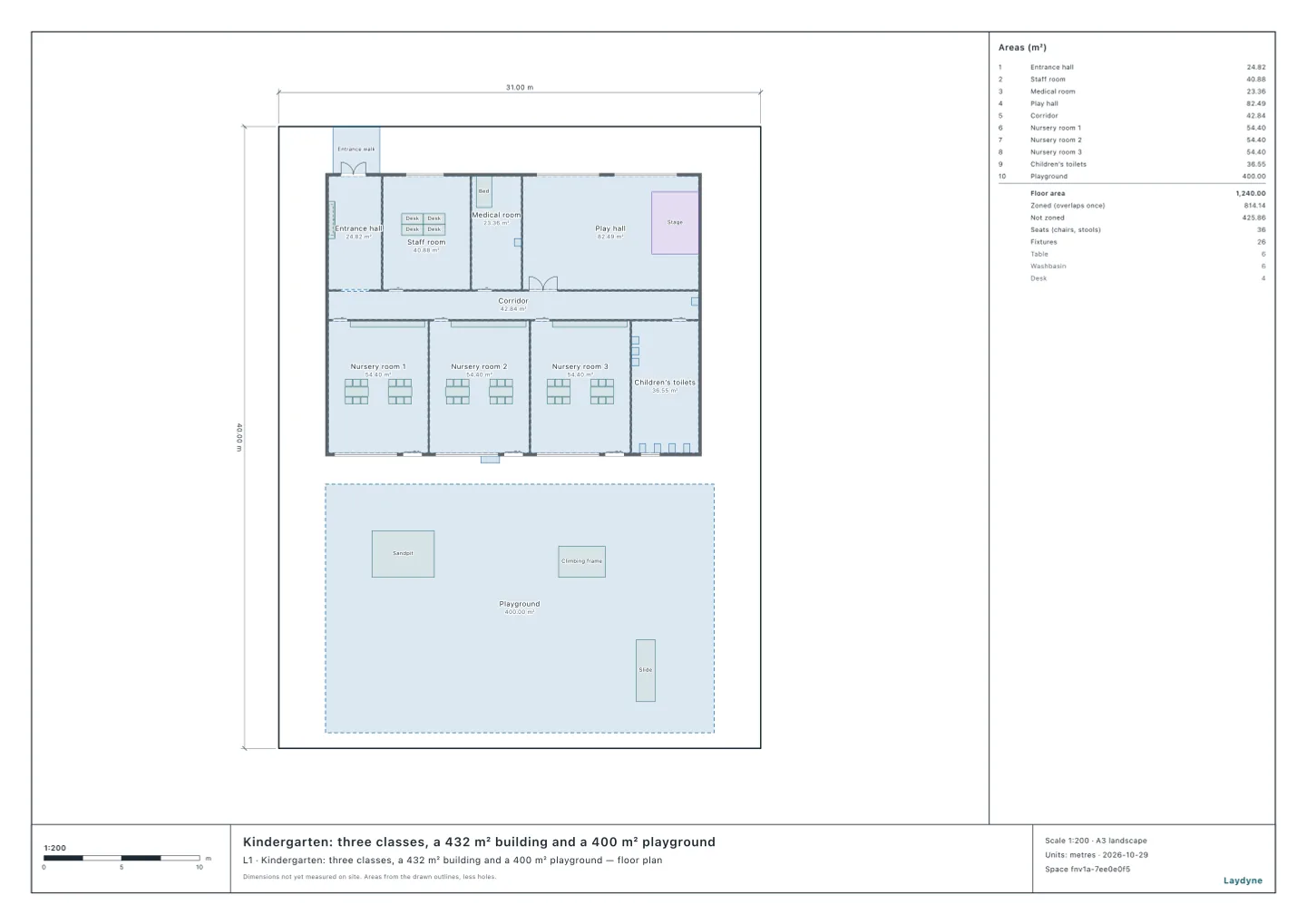
Start from the kindergarten model (three classes) (free sign-up; running a simulation is Pro). When the children go home, the parents gather at the entrance and wait for them to come out. In this article, in the members’ kindergarten model, your AI simulates picking up 75 children. It ran the same tools an AI calls over MCP. Every figure and number below comes from that run.
1. The kindergarten and the pick-up
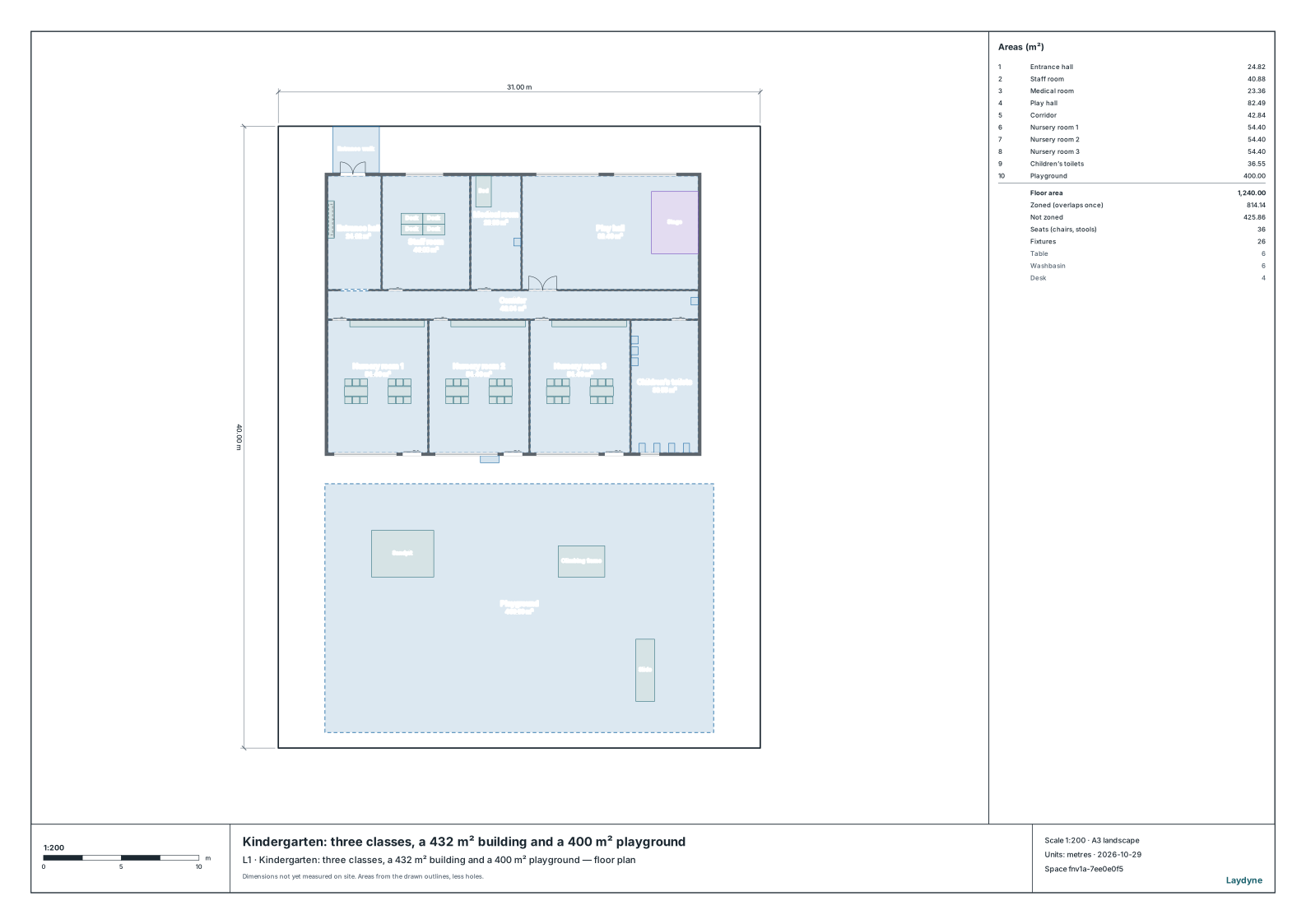
- A kindergarten of three classes. The entrance is 24.82 m².
check_spacefinds nothing.
The AI wrote this flow as a scenario (put_process_scenario).
- The three classes (25 children each) go home at 14:00. Staggered, the youngest go at 13:50, the middle at 14:00 and the eldest at 14:10.
- A parent for each child comes in at the entrance from 15 minutes before their class’s time to 5 minutes after (most often 8 minutes 20 seconds before), and waits in the entrance for the class to come out.
- At the class’s time its teacher hands the children over one at a time, with a word about the day (15 to 45 seconds, most often 20). Then the parent leaves by the entrance.
- Every number and time is an assumption. Put in your own kindergarten’s records.
2. The classes’ times, and the teachers handing over
The AI changed the classes’ times (all at once, ten minutes apart) and the teachers handing over in each class (1, 2) (sweep_process_parameters), 20 runs each. The wait is a parent’s mean (over the three classes); those waiting and those in the entrance are the most at once, and the last parent out is the mean over the 20 runs.
| Classes go home | Teachers handing over (each class) | Wait (mean) | Waiting (most at once, a class) | In the entrance (most at once) | Last parent out |
|---|---|---|---|---|---|
| All at 14:00 | 1 | 11.1 min | 22.5 | 68.4 | 14:12 |
| All at 14:00 | 2 | 8.2 min | 22.3 | 68.3 | 14:06 |
| Ten minutes apart (13:50, 14:00, 14:10) | 1 | 11.1 min | 22.5 | 33.4 | 14:21 |
| Ten minutes apart (13:50, 14:00, 14:10) | 2 | 8.2 min | 22.3 | 29.3 | 14:16 |
- With all at 14:00, at the most 68.4 are in the entrance (24.82 m²) at once, 0.36 m² each. The parents wait 11.1 minutes on average.
- Ten minutes apart, at the most 33.4 are in the entrance at once. The wait is the same, and the last parent leaves at 14:21 instead of 14:12.
- With two teachers handing over, the wait is 8.2 minutes on average, and all at once the last parent leaves at 14:06.
3. Asking the parents not to come early
With one teacher, the AI changed when the parents come (from 15 minutes before as now, or from 5 minutes before when asked) and the classes’ times.
| Parents come | Classes go home | Wait (mean) | In the entrance (most at once) | Last parent out |
|---|---|---|---|---|
| From 15 min before | All at 14:00 | 11.1 min | 68.4 | 14:12 |
| From 15 min before | Ten minutes apart (13:50, 14:00, 14:10) | 11.1 min | 33.4 | 14:21 |
| From 5 min before | All at 14:00 | 5.6 min | 54.2 | 14:12 |
| From 5 min before | Ten minutes apart (13:50, 14:00, 14:10) | 5.6 min | 21.5 | 14:21 |
- Coming from 5 minutes before, the parents wait 5.6 minutes on average, and even all at once at the most 54.2 are in the entrance.
- Together with staggered times, at the most 21.5 are in the entrance at once (1.15 m² each).
4. How to use this check
- Draw your own kindergarten (from a PDF of the drawings or photos too), and tell your AI the children of each class and their time to go home, when the parents come, the time to hand over and the teachers. Your AI also runs handing over in the playground, or a gate apart from the entrance, on the drawing.
- Not checked: parents picking up brothers and sisters together, children going home by the school bus, after-hours care, the car park and the bicycle racks, umbrellas on rainy days, and those waiting outside the entrance.