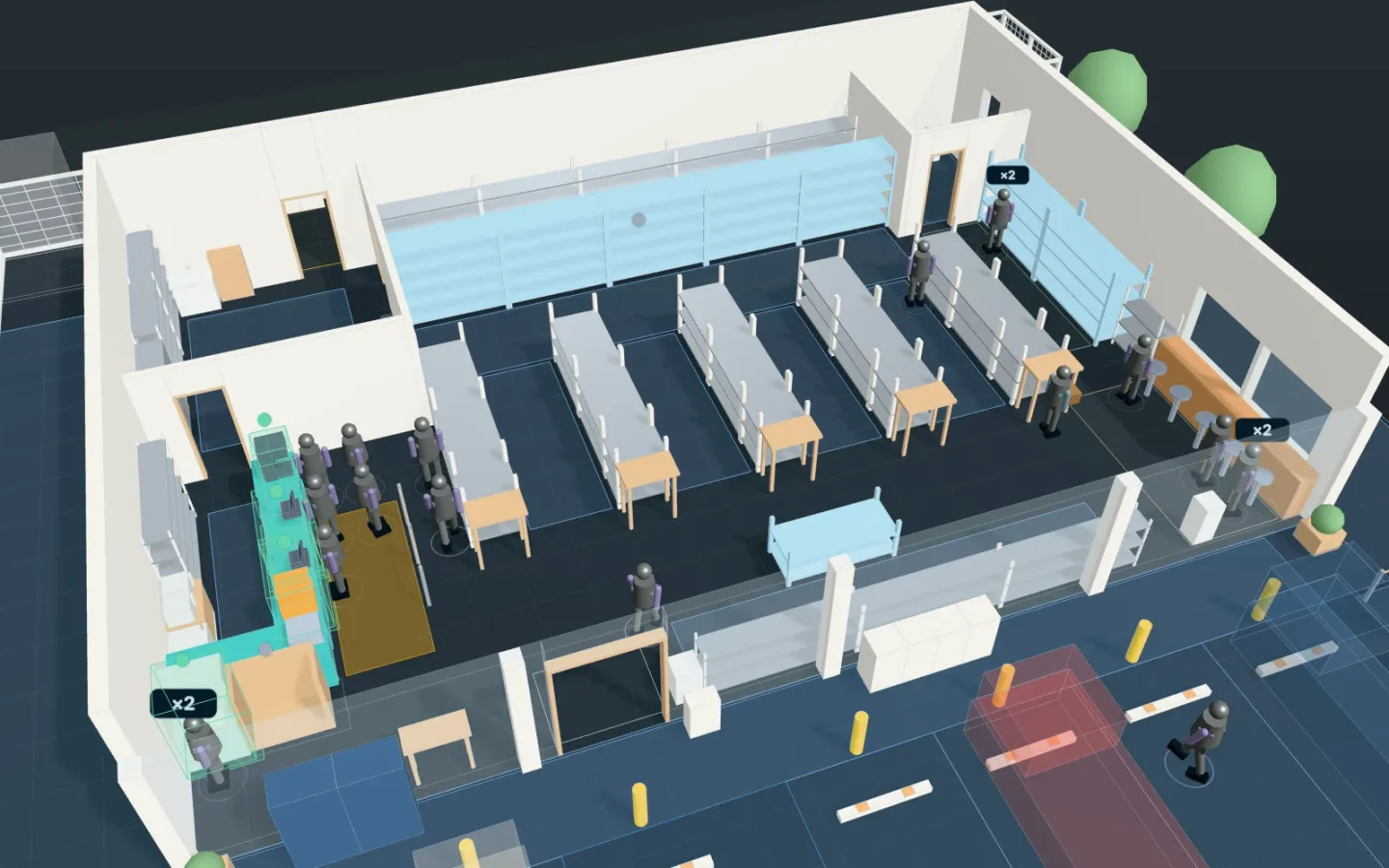
Open the convenience store model (no sign-up needed; running a simulation needs Pro). At the lunch peak, how many people are on the registers, and who restocks? Too few on the registers and the line grows; someone away restocking means one register fewer meanwhile. In this article, your AI reads the saved lunch peak of a mock convenience store, saves a copy with the restocking clerk also on the registers and semi-self registers added, and compares ways of putting people on. It ran the same tools an AI calls over MCP. Every figure and number below comes from that run.
1. The store and its lunch peak
The saved lunch peak of the mock convenience store:
- Shoppers come in from the car park at random, at 150 an hour for 35 minutes (86.1 on average over the 20 runs).
- They pick up items 1 to 3 times at the shelves, the drinks wall, the bento chiller, the magazines and so on, join the line and pay at a free register (else the one with fewer waiting), in 35 s. One in four pours a coffee, and 15 % eat in before leaving.
- Two registers, and today two cashiers. Another clerk restocks the drinks twice (4 min each) and shelves the bento once. A delivery driver rolls three cages into the back room.
- The line in front of the counter holds 8 people; when it is full, shoppers wait in the aisle in front of it.
Your AI reads the saved scenario (list_process_scenarios) and saves a copy (put_process_scenario, the saved one left as it is) that keeps the steps at the shelves, the registers, the coffee and the restocking, adds whether the restocking clerk is one of the cashiers (clerkOnTill: when 1, one cashier fewer while restocking) and semi-self registers (semiSelf: the clerk scans in 20 s, and the shopper pays at the machine in 20 s; assumed values), reads a shopper’s time from joining the line to paid as one process, and runs until every shopper has left (two hours). With sweep_process_parameters, it runs the same twenty random runs at each combination.
2. Today’s wait, and the registers’ work
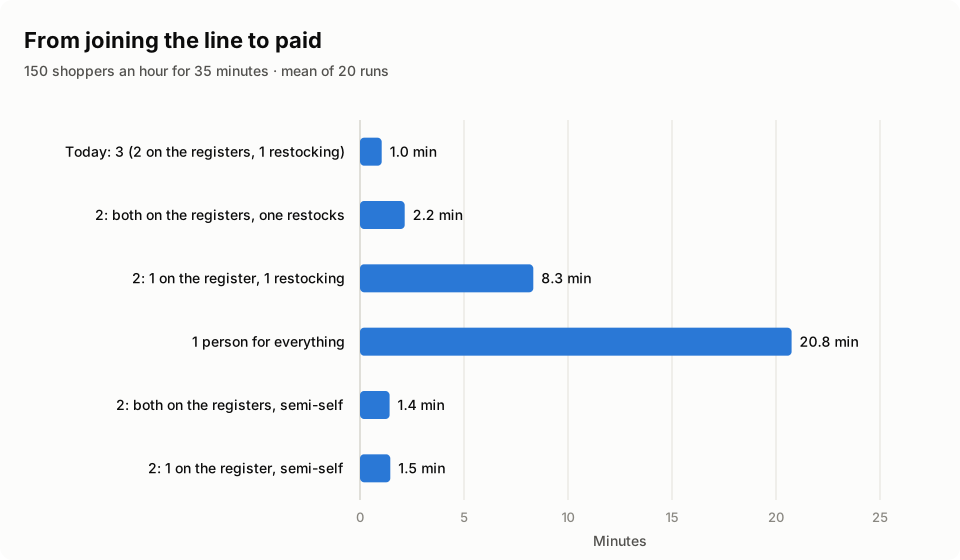
Today (two cashiers and the restocking clerk, three in all), a shopper takes 1.0 min on average from joining the line to paid.
At 150 shoppers an hour, the registers have 87.5 minutes of work an hour (150 × 35 s), more than one cashier’s 60. With semi-self registers, the clerk’s part is 20 s a shopper, 50 minutes an hour (the 20 s a shopper pays at the machine take none of the clerk’s time).
3. How many people
| Who is on | From joining the line to paid | Against today | Waiting before the line (at most) |
|---|---|---|---|
| 3: 2 on the registers, 1 restocking (today) | 1.0 min | – | 0.2 |
| 2: both on the registers, one steps away to restock | 2.2 min | +1.1 min (95 % interval +0.8 to +1.4 min) | 3.5 |
| 2: 1 on the register, 1 restocking | 8.3 min | +7.3 min (+6.4 to +8.2 min) | 19.9 |
| 1 for everything | 20.8 min | +19.7 min (+18.6 to +20.8 min) | 45.3 |
- With two people, putting both on the registers and letting one step away to restock is far shorter than splitting them into one cashier and one restocker: 2.2 min against 8.3. The restocking comes 3 times in the 35 minutes, and only then is one register short.
- With one cashier, the registers’ work (87.5 minutes an hour) is more than one person has, and through the peak the line keeps growing. At most 19.9 on average wait in the aisle, the line in front of the counter (8 people) full.
- With one person for everything, nobody is on the registers while restocking: 20.8 min.
4. Semi-self registers
| Who is on | Today’s registers | Semi-self registers |
|---|---|---|
| 3: 2 on the registers, 1 restocking (today) | 1.0 min | 1.4 min |
| 2: both on the registers, one steps away to restock | 2.2 min | 1.4 min |
| 2: 1 on the register, 1 restocking | 8.3 min | 1.5 min |
| 1 for everything | 20.8 min | 9.8 min |
- With semi-self registers, one cashier gives 1.5 min: the clerk only scans and moves on, and serves the other register while a shopper pays at the machine.
- With three people, semi-self registers take a little longer (1.4 min against 1.0): a shopper’s time at the register grows from today’s 35 s to 40 s (a 20 s scan and a 20 s payment).
- With one person for everything, semi-self registers still give 9.8 min: nobody is on the registers while restocking.
5. The payment time
| A shopper’s payment | 2 cashiers | 1 cashier |
|---|---|---|
| 25 s | 0.7 min | 2.4 min |
| 35 s (today) | 1.0 min | 8.3 min |
| 45 s | 2.0 min | 15.3 min |
- If payment takes 25 s (cashless payment, for example), one cashier gives 2.4 min (the registers’ work is 62.5 minutes an hour, a little more than one person’s 60). At 45 s, one cashier gives 15.3 min.
6. How to use these numbers
- Give your AI your own shoppers every 15 minutes (from the till records), payment time, and restocking rounds and times: the numbers here are the example’s assumptions, and so are the semi-self registers’ scan and payment times.
- Choose the rota with the wait and the wages together: a shorter wait alone does not show more sales.
- Not calculated: shoppers who leave on seeing the line, moving the restocking before or after the peak, the counter’s hot food, parcel and bill payments at the counter, staff breaks, sales.