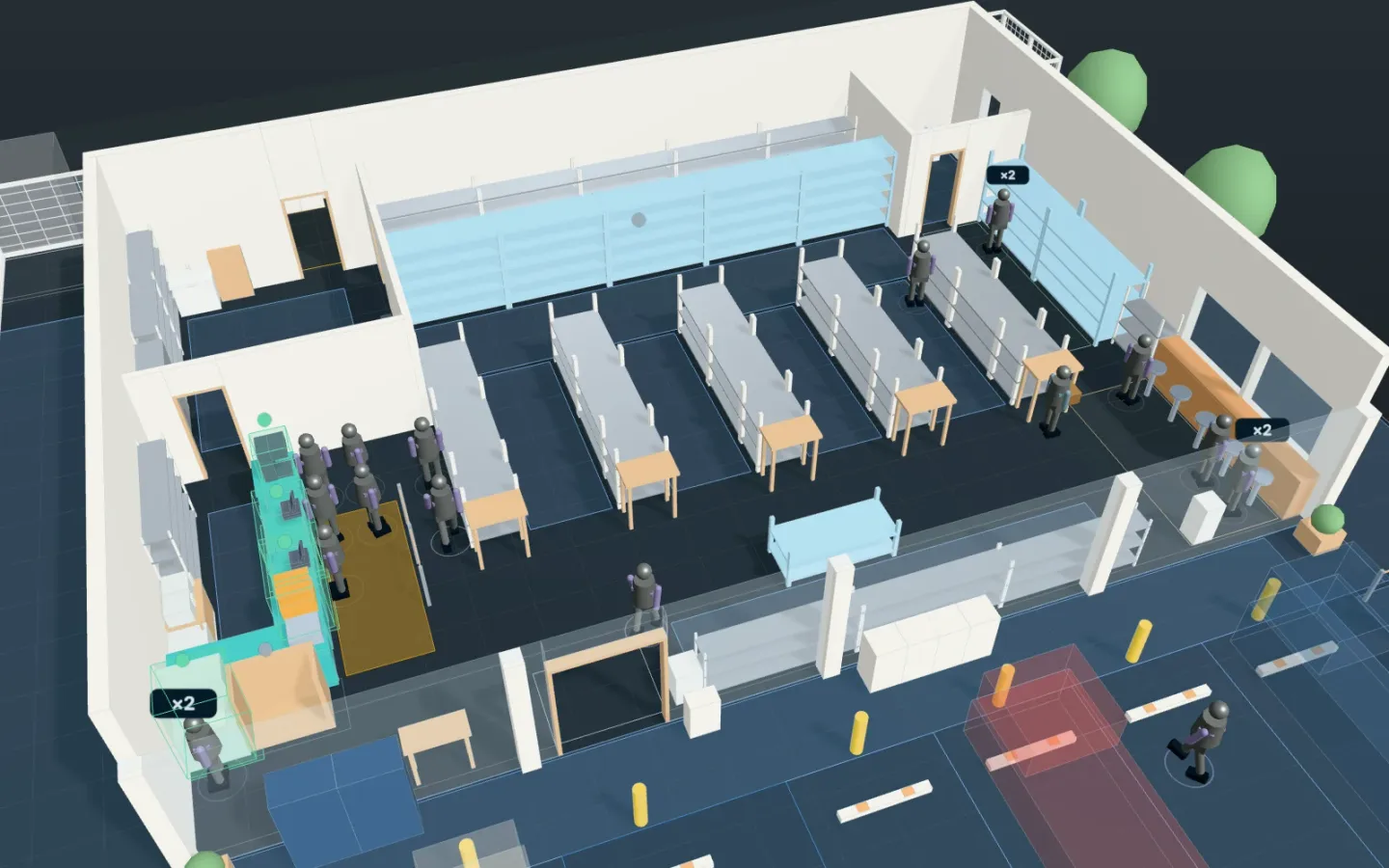
Open the convenience store model (no account needed; running the simulation needs Pro). Which shelf face should carry the product you want to sell? A floor heatmap shows where shoppers walk, but where they walk and how long a shelf face is in front of them are not the same thing. In this article, on a simulated convenience store, the AI runs the saved lunch rush scenario as it is and, assuming each shopper looks where it walks, counts how long every shelf face was in the shoppers’ view. It used the same tools an AI calls over MCP; every figure and picture below is their result.
1. What was counted
The convenience store’s saved lunch rush: for 35 minutes shoppers come from the car park at a rate of 150 an hour, pick up items at the shelves, the drinks coolers, the bento chiller or the magazines, queue and pay. In this one run of the hour, 85 shoppers came.
The AI ran the scenario (run_process_scenario) and counted with get_visibility’s attention, for the shoppers (not the clerk or the delivery driver):
- Every second, each shopper stands where playback draws it and is assumed to look where it walks. Standing still, it keeps the direction it last walked.
- The view is 60° either side of the walking direction (120°), 60° up or down, within 6 m.
- When a point of a shelf face (at 1.2 m) is in that view, the face faces the shopper and no shelf or wall stands between, that second is added to the face.
- Per face: shopper-seconds (shoppers × seconds) and how many shoppers had it in view at least once.
The 88 faces counted: the two long sides of shelves, gondolas and coolers, and all four sides of a unit nearly square (such as a gondola’s end unit). The ice cream freezer island (0.9 m high) has no face at 1.2 m and was left out (a height of 0.8 m would count it).
2. The faces in view the longest
| Rank | Shelf | Face | Shopper-seconds | Shoppers |
|---|---|---|---|---|
| 1 | Tobacco and lottery shelf (behind the registers) | East | 5,887 | 85 (100%) |
| 2 | Gondola: chocolate | West | 2,540 | 85 (100%) |
| 3 | Gondola: candy and gum | West | 2,513 | 85 (100%) |
| 4 | Magazine rack | North | 1,957 | 85 (100%) |
| 5 | Magazine rack | North | 1,833 | 84 (98.8%) |
| 6 | Magazine rack | North | 1,818 | 61 (71.8%) |
| 7 | Bread and pastries | West | 1,516 | 47 (55.3%) |
| 8 | Gondola: snacks | West | 1,416 | 74 (87.1%) |
| 9 | Bento and onigiri chiller | West | 1,277 | 35 (41.2%) |
| 10 | Gondola: gifts | West | 1,268 | 54 (63.5%) |
- The longest is the tobacco and lottery shelf behind the registers. All 85 shoppers had it in view, 69 seconds each on average: shoppers wait in the line facing the registers, and this shelf is in front of them all the while.
- Next come the gondola ends beside the line (chocolate, candy and gum), both in view of all 85.
- The magazine racks by the window are in view of almost everyone too.
3. Faces never in view
Of the 88 faces, 25 were never in any shopper’s view:
- the stock shelving and the roll cages in the back room and the delivery yard (where shoppers do not go);
- faces with their back to a wall (the east side of the bento and sandwich chillers and of the bread, the north side of the stock shelving in the walk-in cooler, and others);
- faces against the next gondola (the north side of snacks, seasonings, nuts and jerky, health and gifts);
- the west side of the tobacco and lottery shelf (inside the counter).
None of them is a selling face. If a face you mean to sell from is in this list, shoppers do not see it.
4. When the assumption changes
The same run, counted again with another assumed view:
- The tobacco and lottery shelf stays first under each one (3,272 shopper-seconds with a 60° view, 4,326 with 3 m instead of 6 m).
- Of the first five faces, 4 stay among the first five with a 60° view, and 3 with 3 m.
- With 3 m, the magazine racks fall out of the first five: they were in view from further away.
The details of the order change with the assumption. Compare plans under the same assumption, and check that a few assumptions lead to the same conclusion.
5. The plan
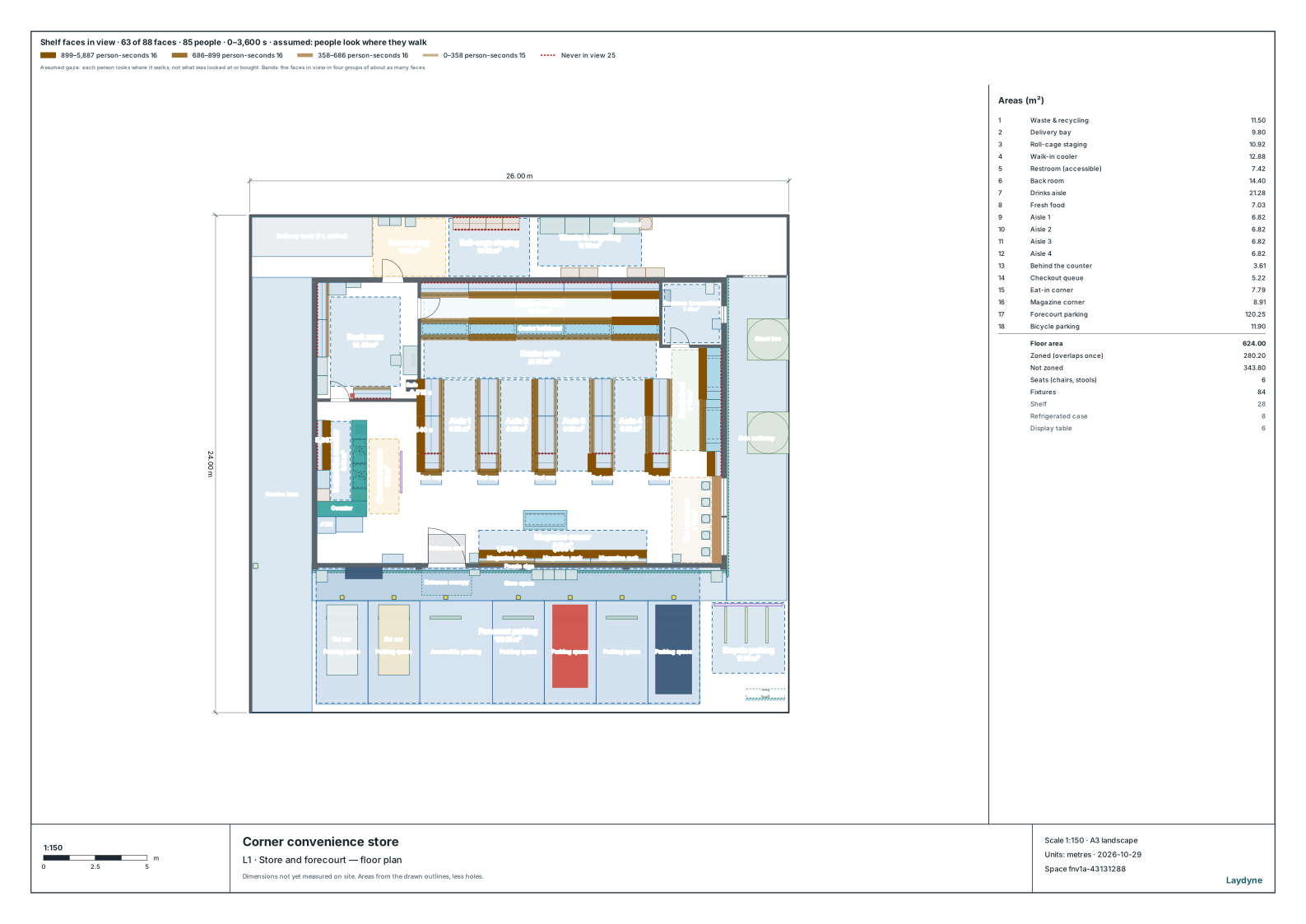
get_view_image’s attention draws the same figures on the plan: the faces in view in four groups of about as many faces, thicker and darker the longer, the faces never in view dashed, and the five longest with their figures.
6. How to use it, and what it does not tell
- Choose the faces for promotions. The faces in front of and beside the line (the tobacco and lottery shelf, the gondola ends) are in front of shoppers all the while they wait.
- Compare shelf layouts. Run the same scenario on a plan with shelves turned or moved and count under the same assumption, to compare which faces come into view for longer.
What it does not tell:
- It counts the time a face was in view, not whether shoppers looked at it, picked something up or bought it.
- Shoppers are assumed to look where they walk, without turning their heads.
- Shoppers hiding shelves from each other are not counted.
- It is one run (a fixed random seed).
Tools used
run_process_scenario: runs the saved lunch rush scenario as it isget_visibility(attention): counts, for each shelf face, how long and by how many shoppers it was in viewget_view_image(attention): draws the same on the plan