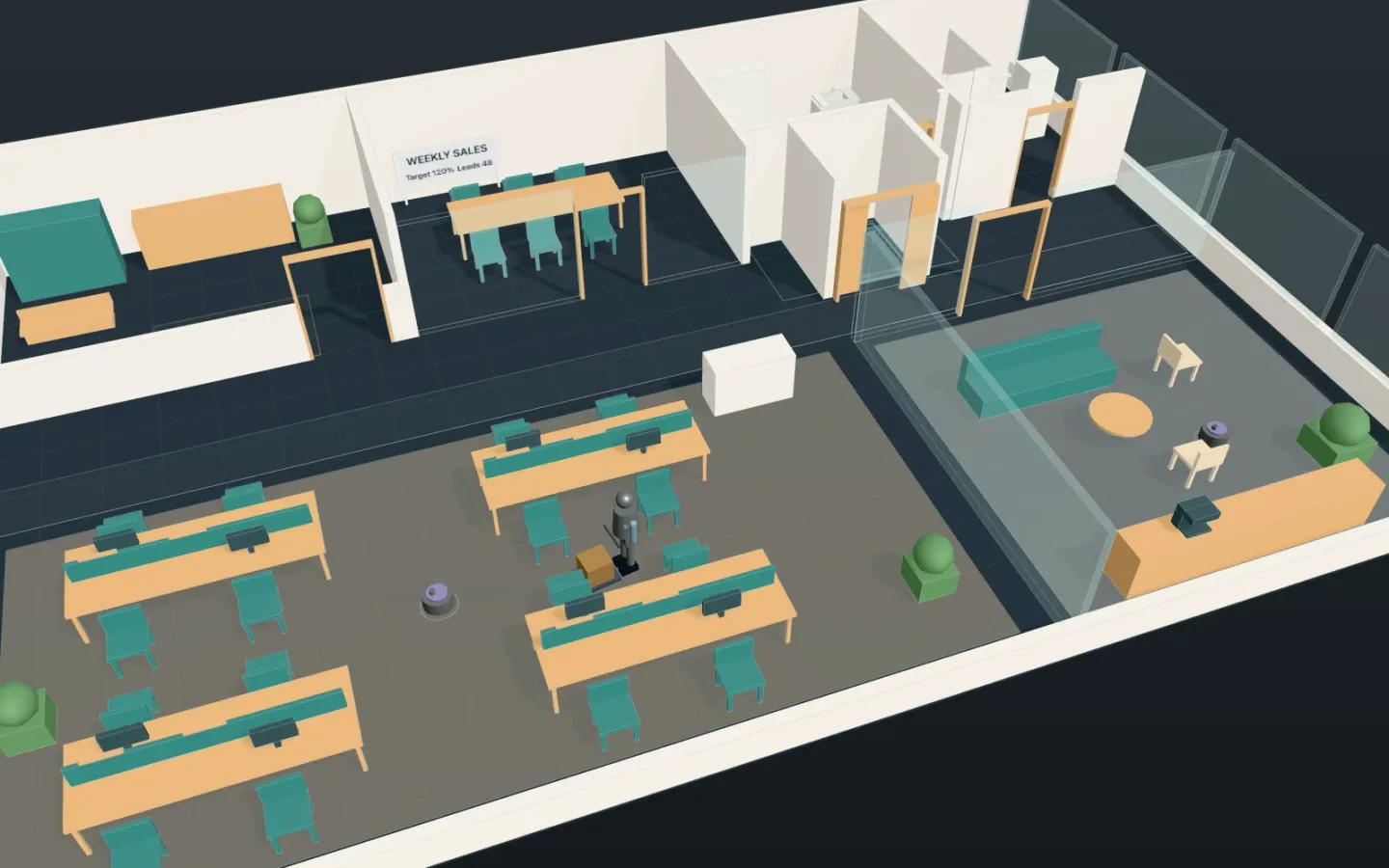
Open the office night cleaning (no account needed to open it; running simulations takes Pro). With robot vacuums on the night shift, when is the cleaning done, and how many staff hours does it save? With the same list of jobs, your AI changes the cleaners and robots and compares them in a simulation. This article runs on a synthetic building with the same tools your AI calls over MCP. Every number below comes from that run.
1. The building and the night’s work
The synthetic building is a three-storey office. Cleaning starts at 22:00, and the building opens at 07:00.
- All the jobs are listed at 22:00, top floor first: bins and desks, washrooms, meeting rooms, coffee points, parcel rooms, bin bags down to the waste cage, and 548 m² of vacuuming. The nearest free cleaner takes the next job with a cart.
- Robots, if any, take all the vacuuming (with none, the cleaners vacuum). Cleaners vacuum 400 m² an hour, robots 250 m². Other jobs take fixed minutes (15 minutes a washroom, and so on). There is one lift, and everyone rides it one at a time.
- Staff hours, as this model counts them: the cleaners × the time the last one is back in the store (from 22:00).
- Every time is fixed and nothing is drawn at random, so one run is the answer (every run gives the same).
2. Robots and cleaners together
Your AI ran the saved scenario’s parameters, the cleaners and the robots, at every combination with sweep_process_parameters. When every job is done, the robots’ vacuuming included:
| Robot vacuums | 1 cleaner | 2 | 3 |
|---|---|---|---|
| None | 3:04 | 0:33 | 23:43 |
| 1 | 1:14 | 0:41 | 0:41 |
| 2 | 1:15 | 23:40 | 23:21 |
| 3 | 1:15 | 23:40 | 23:11 |
Staff hours:
| Robot vacuums | 1 cleaner | 2 | 3 |
|---|---|---|---|
| None | 5.06 | 5.10 | 5.17 |
| 1 | 3.24 | 3.32 | 3.52 |
| 2 | 3.25 | 3.35 | 3.54 |
| 3 | 3.26 | 3.36 | 3.56 |
- Without robots, the staff hours stay about 5.1 whatever the crew: the work is the same, and more cleaners only finish sooner.
- With the vacuuming left to robots, they come to 3.2 to 3.6.
- Today’s two cleaners without robots (done at 0:33, 5.10 staff hours) become one cleaner and two robots: done at 1:15, with 3.25 staff hours, 36 % fewer. That is well before the building opens at 07:00.
3. With one robot, the cleaners leave first
- With two cleaners and one robot, the cleaners are back at 23:40, but the robot vacuums the 548 m² alone (over two hours at 250 m² an hour) and is done at 0:41. Two robots are done at 23:22, before the cleaners.
- With one cleaner, the cleaner’s own work is the longer (1:14), and one robot (done at 0:40) keeps up.
4. A faster robot
With the two cleaners, your AI changed how fast the robots vacuum. When every job is done:
| Robot rate | 1 robot | 2 robots |
|---|---|---|
| 250 m² an hour | 0:41 | 23:40 |
| 350 m² an hour | 0:00 | 23:40 |
| 450 m² an hour | 23:40 | 23:40 |
- At 450 m² an hour, even one robot is done with the cleaners at 23:40. With two, it is 23:40 at any rate: the cleaners’ work sets the end.
5. How to use these numbers
- Give your AI the minutes each job takes in your own building, and the vacuuming rate of the robot measured on your floors; also how the lift can be used at night, and the shift’s hours.
- Fewer staff hours lower cost only if the paid hours fall.
- Not counted: how well each square metre is cleaned, chairs moved, robot charging and battery ageing, spills, people in the building.