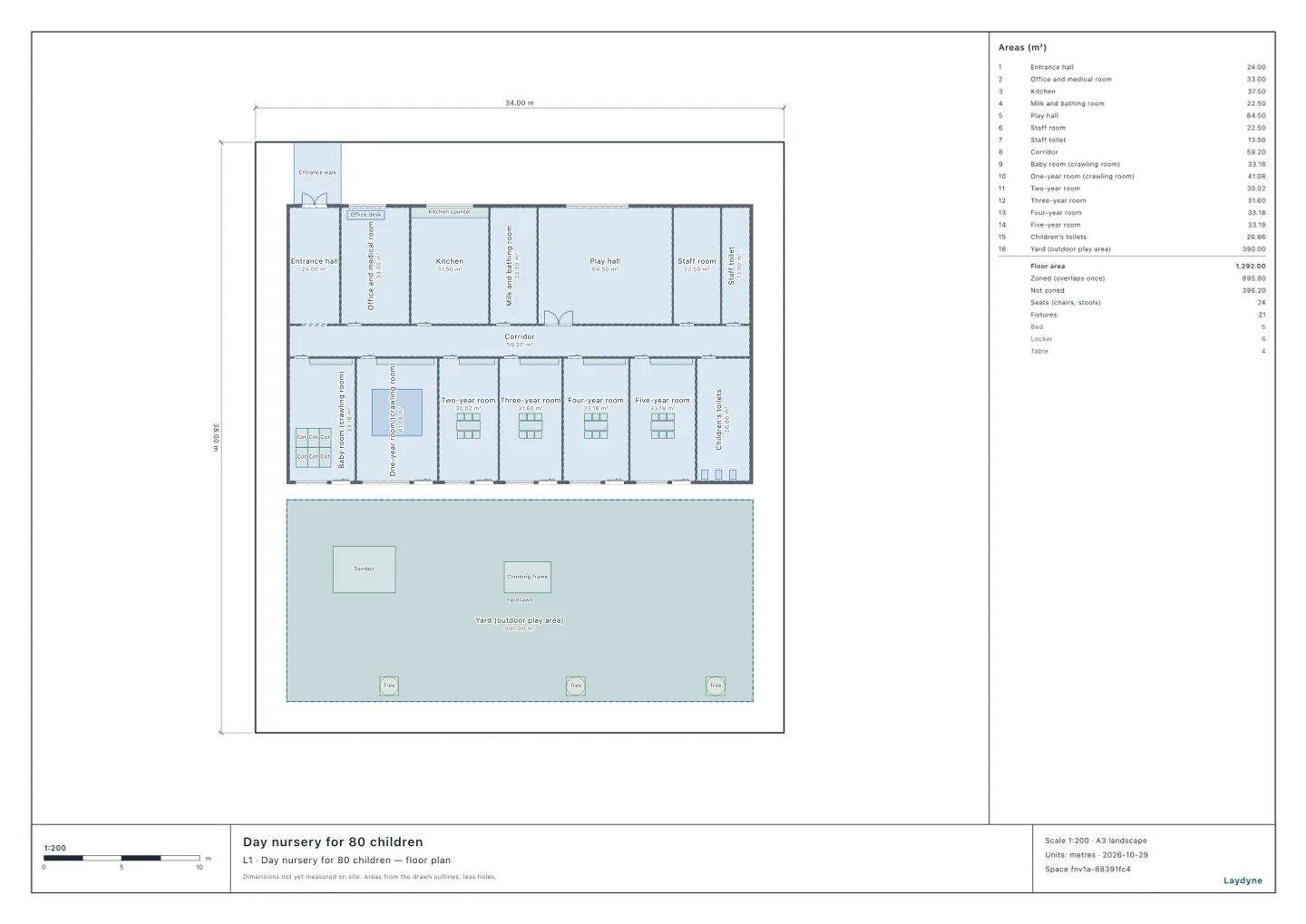
Start from the day nursery model (80 children) (free sign-up; running a simulation is Pro). The morning drop-off crowds into the 8 o’clock hour, and parents leave their children on their way to work. In this article, in the members’ day nursery model, your AI simulates the morning drop-off. It ran the same tools an AI calls over MCP. Every figure and number below comes from that run.
1. The nursery and the morning
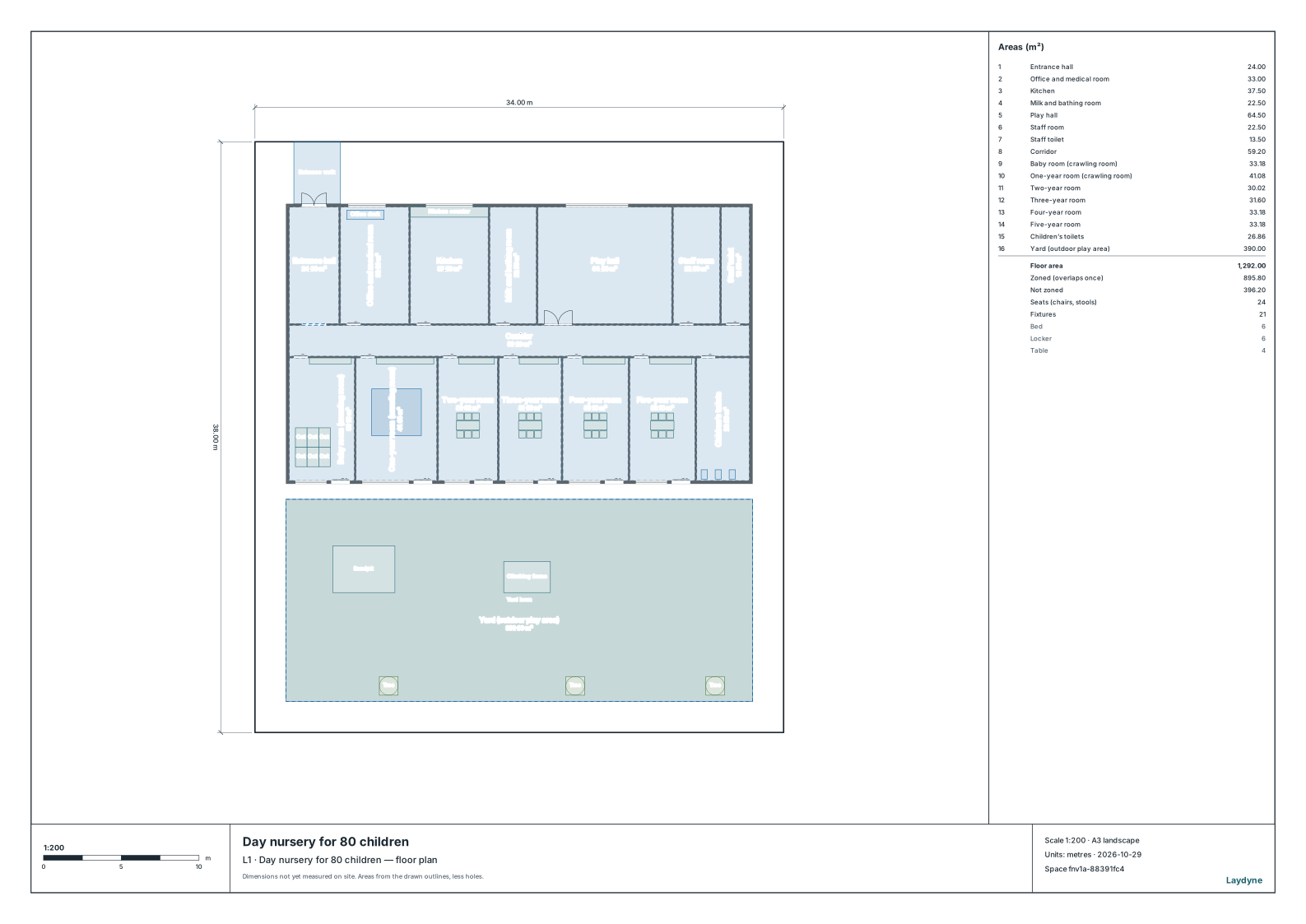
- A day nursery for 80 (9 babies, 12 one-year-olds, 12 two-year-olds, 15 three-year-olds, 16 four-year-olds and 16 five-year-olds).
check_spacefinds nothing.
The AI wrote this flow as a scenario (put_process_scenario).
- From 7:00 to 9:30, parents bring their children one by one in at the main entrance (at random): 10 % in the first half hour, then 15, 30, 30 and 15 % a half hour.
- In the entrance hall they take off their shoes (30 seconds to 1.5 minutes, most often 45 seconds) and hand the child over in the child’s room to the class teacher. The temperature and the notebook take 2 to 5 minutes (most often 3) for the babies and the one-year-olds, 1 to 3 minutes (most often 1.5) for the others.
- When the children are taken in together in the entrance hall, the staff there take them over in the same times and walk them to their rooms.
- Then the parents put on their shoes (30 seconds) and leave.
- Every number and time is an assumption. Put in your own nursery’s records.
2. Where the children are taken in, and the staff in the entrance hall
The AI changed where the children are taken in (each room, the entrance hall) and the staff in the entrance hall (1, 2, 3) (sweep_process_parameters), 20 runs each. “Entrance to leaving” is a parent’s mean; the longest wait is the mean over the 20 runs of the longest wait to hand over (in the rooms, the room where it was longest).
| Taken in | Parents of babies and one-year-olds: entrance to leaving | Parents of the two- to five-year-olds: entrance to leaving | Longest wait |
|---|---|---|---|
| In each room (a class teacher each) | 5.9 min | 4.5 min | 3.6 min |
| In the entrance hall (1) | 28.2 min | 27.4 min | 52.9 min |
| In the entrance hall (2) | 6.7 min | 5.1 min | 6.8 min |
| In the entrance hall (3) | 5.1 min | 3.6 min | 2.0 min |
- With the class teachers taking the children in their rooms, a parent is out in 5.9 minutes on average for the babies and one-year-olds, 4.5 for the others.
- With one member of staff in the entrance hall it is 28.2 and 27.4 minutes, and 24.4 parents wait at the most.
- With two in the entrance hall it is 6.7 and 5.1 minutes: about the same as in the rooms, with two staff taking the children in instead of the six class teachers.
3. A shorter hand-over
With one member of staff in the entrance hall, the AI changed the time of a hand-over (as now, down to 60 %, say with the notebook on an app) and where the children are taken in.
| Taken in | Hand-over | Parents of babies and one-year-olds: entrance to leaving | Parents of the two- to five-year-olds: entrance to leaving | Longest wait |
|---|---|---|---|---|
| In each room | As now | 5.9 min | 4.5 min | 3.6 min |
| In each room | Down to 60 % | 4.2 min | 3.6 min | 1.5 min |
| In the entrance hall (1) | As now | 28.2 min | 27.4 min | 52.9 min |
| In the entrance hall (1) | Down to 60 % | 8.1 min | 7.1 min | 12.2 min |
- With the hand-over down to 60 %, even one member of staff in the entrance hall gets the parents out in 8.1 and 7.1 minutes. The longest wait is 12.2 minutes.
4. How to use this check
- Draw your own nursery (from a PDF of the drawings or photos too), and tell your AI the children of each class, when they come, where and how long a hand-over takes and the staff taking them in. Your AI also puts a moved entrance or shoe racks on the drawing and checks them.
- Not checked: parents bringing brothers and sisters together, the car park and the bicycle racks, changing clothes on rainy days, a crowded corridor, the staff’s time walking the children from the entrance to their rooms, and the afternoon pick-up.