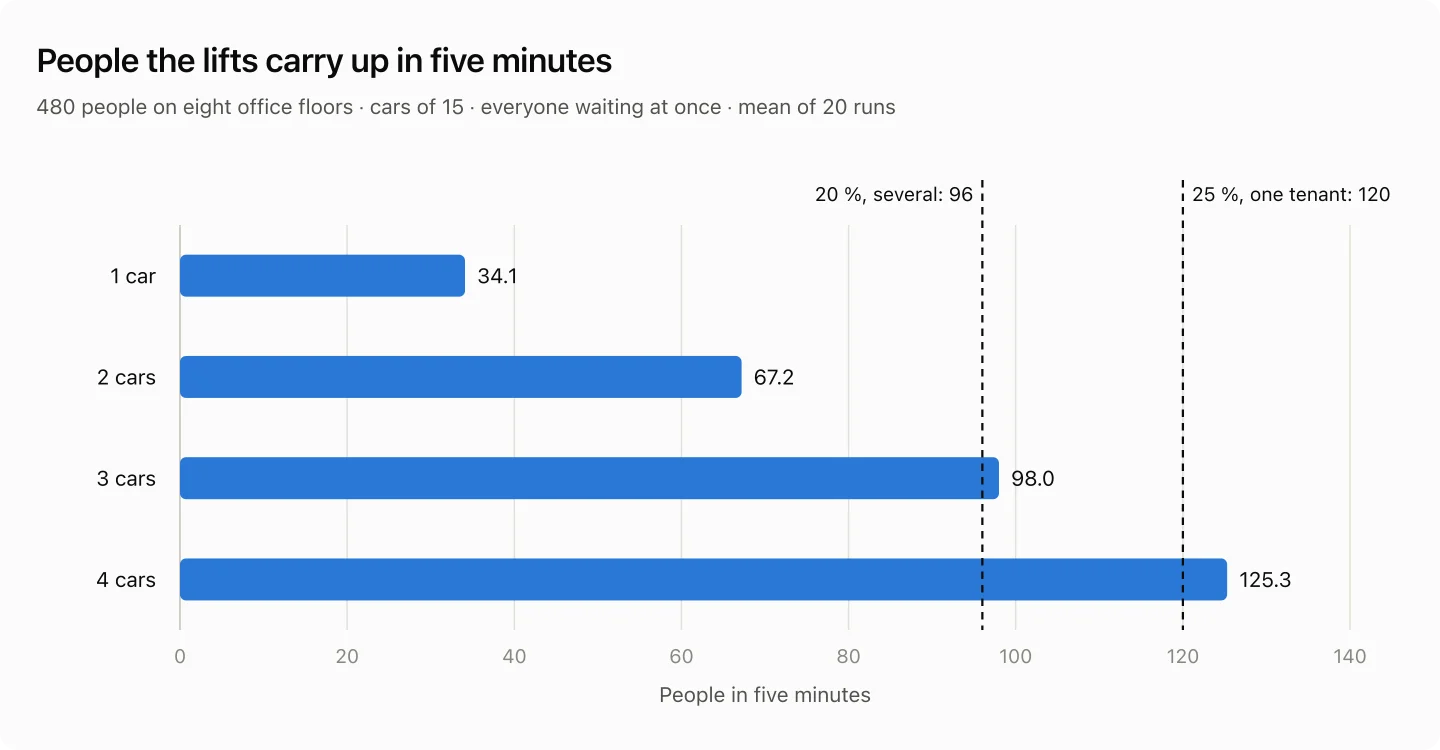
Start from the office building model (free sign-up; running a simulation is Pro). The “lift input” chapter of NILIM document No. 702 (Japan’s National Institute for Land and Infrastructure Management: the technical notes to the low-carbon building criteria, on the program that works out a building’s primary energy) sets a standard handling capacity for lifts. It is 0.25 for a building used mainly as offices by one tenant, and 0.20 when not by one tenant. The design handling capacity is the people the lifts carry in five minutes divided by those who use them; the five minutes’ people are 300 × passengers × cars ÷ round trip seconds. In this article, on a mock office building, your AI writes the morning up the lifts and checks what they carry in five minutes and how long people wait, by the cars. It ran the same tools an AI calls over MCP. Every figure and number below comes from that run.
1. The building and its lifts
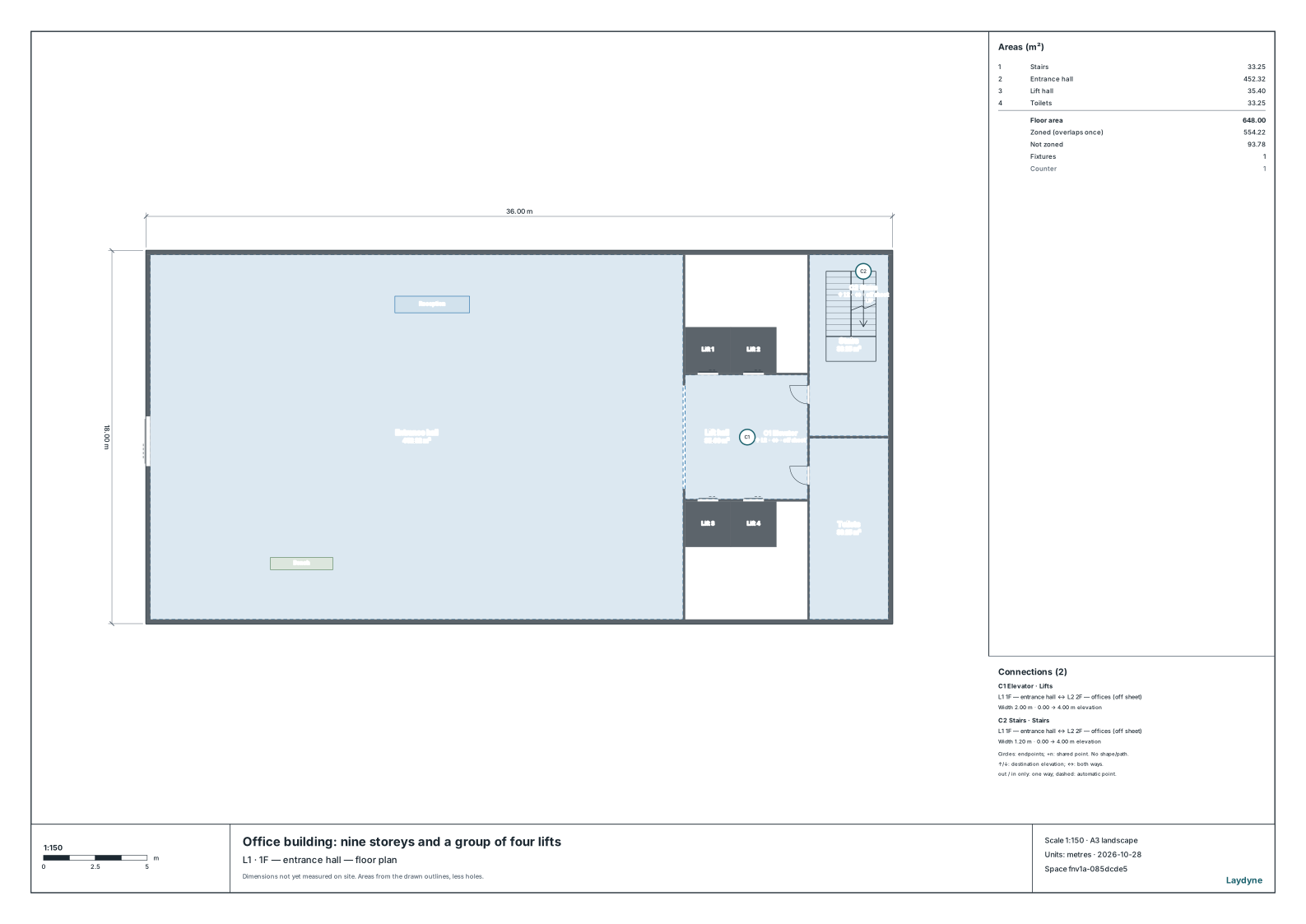
The mock building has nine storeys of 36 × 18 m. Sixty people work on each of the eight office floors, 2 to 9: 480 in all. The lifts are one group, and a car’s floor is 1.6 × 1.5 m = 2.4 m².
- By the table of article 129-5(2) of Japan’s building standard order, the car carries 9,810 N (4,900 N a square metre over 1.5 m² for 0.9 m², plus 5,400 N). At 65 kg a person (article 129-6, item 5), it holds 15 people at most.
- The speed (105 m a minute), the doors’ 4 seconds to open and close, their 2 seconds held open, an acceleration of 0.9 m/s² and a second for each person getting in or out are assumptions. The cars run by Laydyne’s fixed collective rules, not a maker’s group control.
- A quarter of 480 is 120; a fifth is 96.
2. What the lifts carry in five minutes
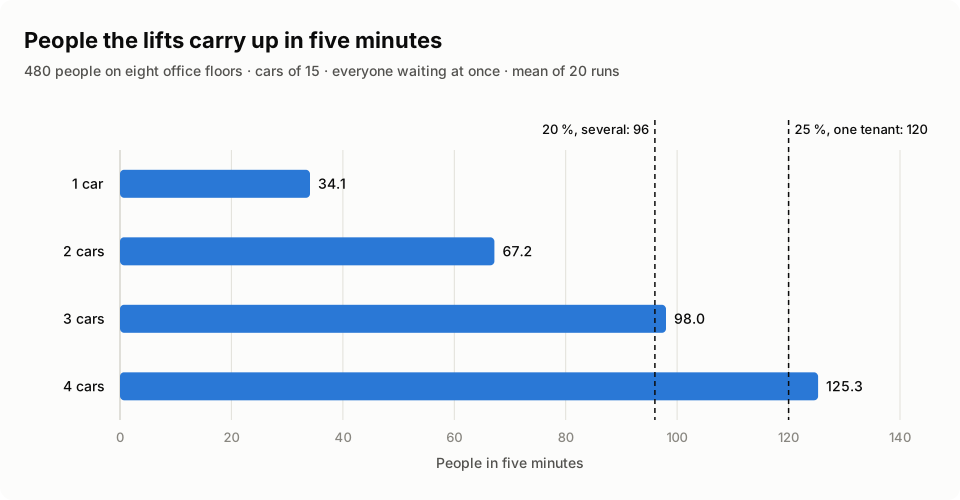
Your AI writes a scenario in which all 480 wait on the ground floor at once (put_process_scenario), stops it after 300 seconds and counts those who reached their floor. It sweeps the cars (sweep_process_parameters), 20 runs each.
| Cars | People in five minutes (mean of 20 runs) | 95 % interval |
|---|---|---|
| 1 | 34.1 | 32.9–35.2 |
| 2 | 67.2 | 66.1–68.2 |
| 3 | 98.0 | 96.4–99.6 |
| 4 | 125.3 | 123.4–127.2 |
- A quarter (120) for one tenant takes four cars (125.3).
- A fifth (96) for a building not of one tenant takes three cars (98.0). The interval’s bottom, 96.4, is only just over it.
3. The morning, as people come in
In a second scenario, your AI has the 480 come in on the ground floor at the same rate over a set time: over 20 minutes, 120 every five minutes (a quarter); over 25 minutes, 96 every five minutes (a fifth). It sweeps the cars and the time, 20 runs each.
Coming in over 20 minutes (120 every five minutes)
| Cars | Mean wait | Longest wait | Most waiting | Everyone up |
|---|---|---|---|---|
| 2 | 426.1 s | 885.5 s | 205.4 | 35.9 min |
| 3 | 107.8 s | 231.7 s | 80.3 | 25.0 min |
| 4 | 17.3 s | 61.7 s | 27.6 | 21.9 min |
Coming in over 25 minutes (96 every five minutes)
| Cars | Mean wait | Longest wait | Most waiting | Everyone up |
|---|---|---|---|---|
| 2 | 291.5 s | 617.2 s | 142.4 | 36.3 min |
| 3 | 32.0 s | 97.2 s | 33.7 | 27.2 min |
| 4 | 10.1 s | 43.1 s | 17.5 | 26.5 min |
- With 120 coming every five minutes, three cars keep people waiting 107.8 seconds on average and 231.7 seconds at the longest. Four cars make it 17.3 seconds on average.
- With 96 every five minutes, three cars make it 32.0 seconds on average.
- A wait is from calling a car to getting in; the most waiting and everyone up (from the first coming in) are means of the 20 runs. When the lifts carry fewer in five minutes than come in (two cars), the line keeps growing.
4. Using the check
- Tell your AI your building’s storeys, the people on each floor, and the cars’ capacity and speed (the maker’s figures). Whether one tenant or several changes the yardstick.
- Not checked: optimised group control (destination dispatch and the like), people going down or between floors, visitors, those taking the stairs, and the lunchtime rush. Before planning, check with the maker’s traffic calculation.