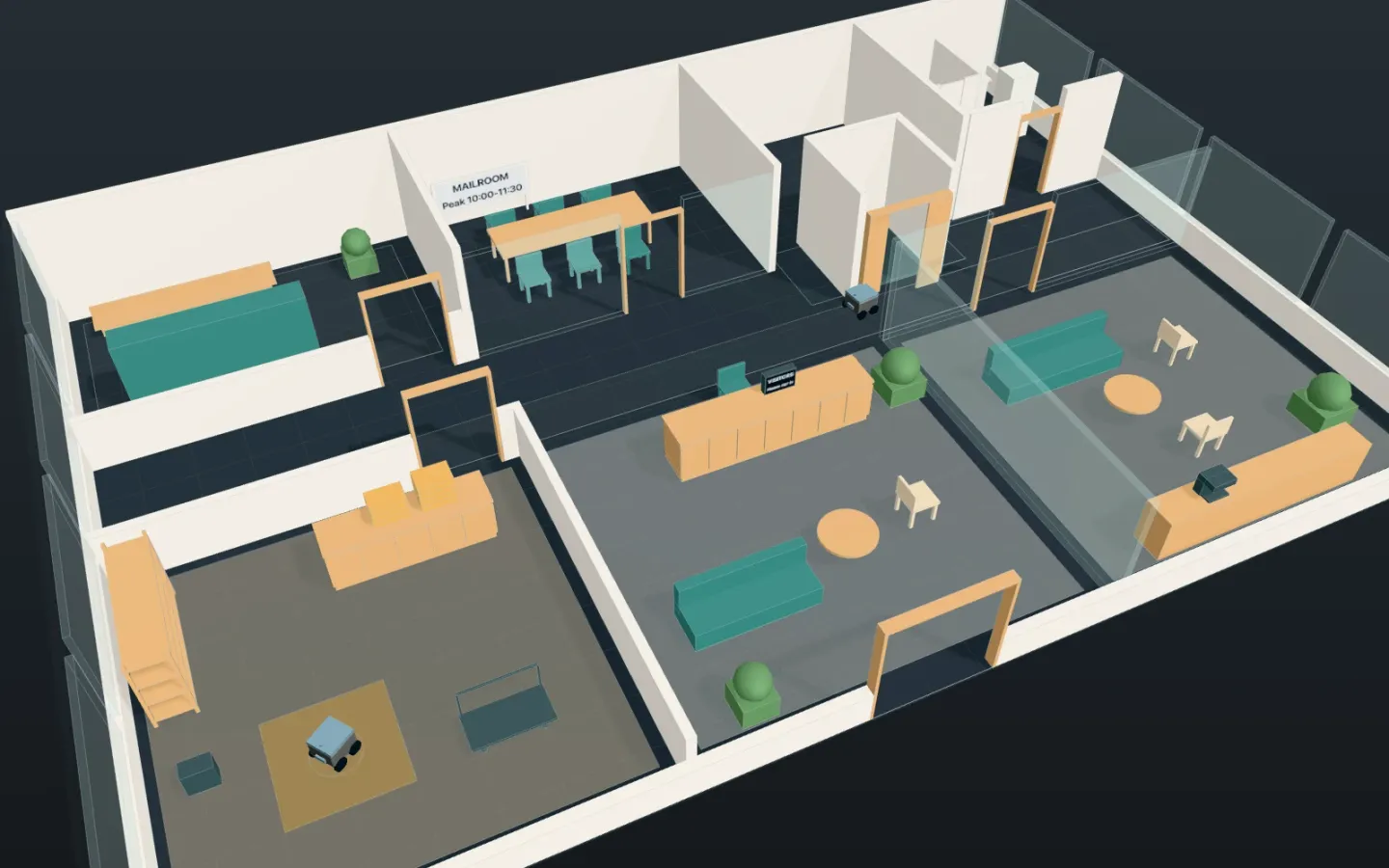
Open the office parcel deliveries (no account needed to open it; running simulations takes Pro). When a batch of parcels reaches the mailroom, how many delivery robots get them to the offices soonest, and does each robot added still help with only one lift? With the same parcels and routes, your AI changes the robots and the lift and compares them in a simulation. This article runs on a synthetic building with the same tools your AI calls over MCP. Every number below comes from that run.
1. The building and the parcels
The synthetic building is a three-storey office with the mailroom on the ground floor.
- There are 24 parcels, 12 for each of the two office floors, each floor’s coming out of the mailroom one every 20 seconds (all of them in 3 minutes 40 seconds).
- A parcel waits for a robot, is loaded in 8 seconds, rides the lift up and is handed over in 15 seconds. A parcel is delivered at the handover; the robot comes back empty before it takes the next. Robots go 1 m a second.
- There is one lift, and a car takes one robot (0.8 m a second, 4 seconds of doors and a 2-second wait at each stop). The car runs on fixed collective rules, not a lift maker’s dispatch.
- Every time in it is fixed and nothing is random, so one run gives the answer (the tool refuses more runs).
- Not counted: robots passing each other, people getting in and out, charging, failures.
2. The robots
In the saved scenario the number of robots (2) is not a parameter. Your AI saved a copy with the robots and the robots a car takes as parameters (put_process_scenario, the saved scenario left as it was) and compared them with sweep_process_parameters.
| Robots | Last parcel handed over | Parcel delivered (mean) | Parcel waits for a robot (mean) | Wait for the lift (mean, longest) |
|---|---|---|---|---|
| 1 | 44.2 min | 20.8 min | 19.7 min | 0.0 s, 0.0 s |
| 2 (today) | 25.3 min | 11.2 min | 10.0 min | 8.5 s, 20.8 s |
| 3 | 17.0 min | 7.2 min | 5.9 min | 9.0 s, 30.3 s |
| 4 | 13.7 min | 5.5 min | 4.2 min | 12.6 s, 51.0 s |
| 6 | 10.7 min | 4.1 min | 2.4 min | 20.4 s, 81.3 s |
- Going from two robots to four, the last parcel is handed over at 13.7 minutes instead of 25.3.
- The more robots, the longer they wait for the lift (20.4 seconds on average with six, 81.3 at most). Even with six, a parcel waits longer for a robot (2.4 minutes on average): most of the delay is set by the number of robots.
- Each robot added saves less (8.3 minutes from two to three, 3.0 from four to six).
3. If a car takes two robots
Your AI let a car take two robots. When the last parcel is handed over:
| Robots | One a car (today) | Up to two a car |
|---|---|---|
| 2 | 25.3 min | 25.3 min |
| 3 | 17.0 min | 16.9 min |
| 4 | 13.7 min | 14.1 min |
| 6 | 10.7 min | 11.6 min |
- With two a car the last parcel comes only 4 seconds sooner with two robots and 7 with three, and 24 seconds later with four and 54 with six. In this model the number of robots matters more than the size of the lift.
4. A day with twice the parcels
Your AI made it 24 parcels a floor (48). The last parcel is handed over at 51.3 minutes with two robots and 27.3 with four. Two robots are then busy 86 % of the hour.
5. How to use these numbers
- Give your AI the number of parcels and when they reach the mailroom, the loading and handover times, the robots’ speed, the lift’s speed and door times, and how people use the lift at that hour, measured in your own building.
- The lift control here is not your building’s. Where the robots’ wait for the lift grows, check it against the lift maker’s dispatch.
- Not counted: robots passing each other, people getting in and out, charging, failures.