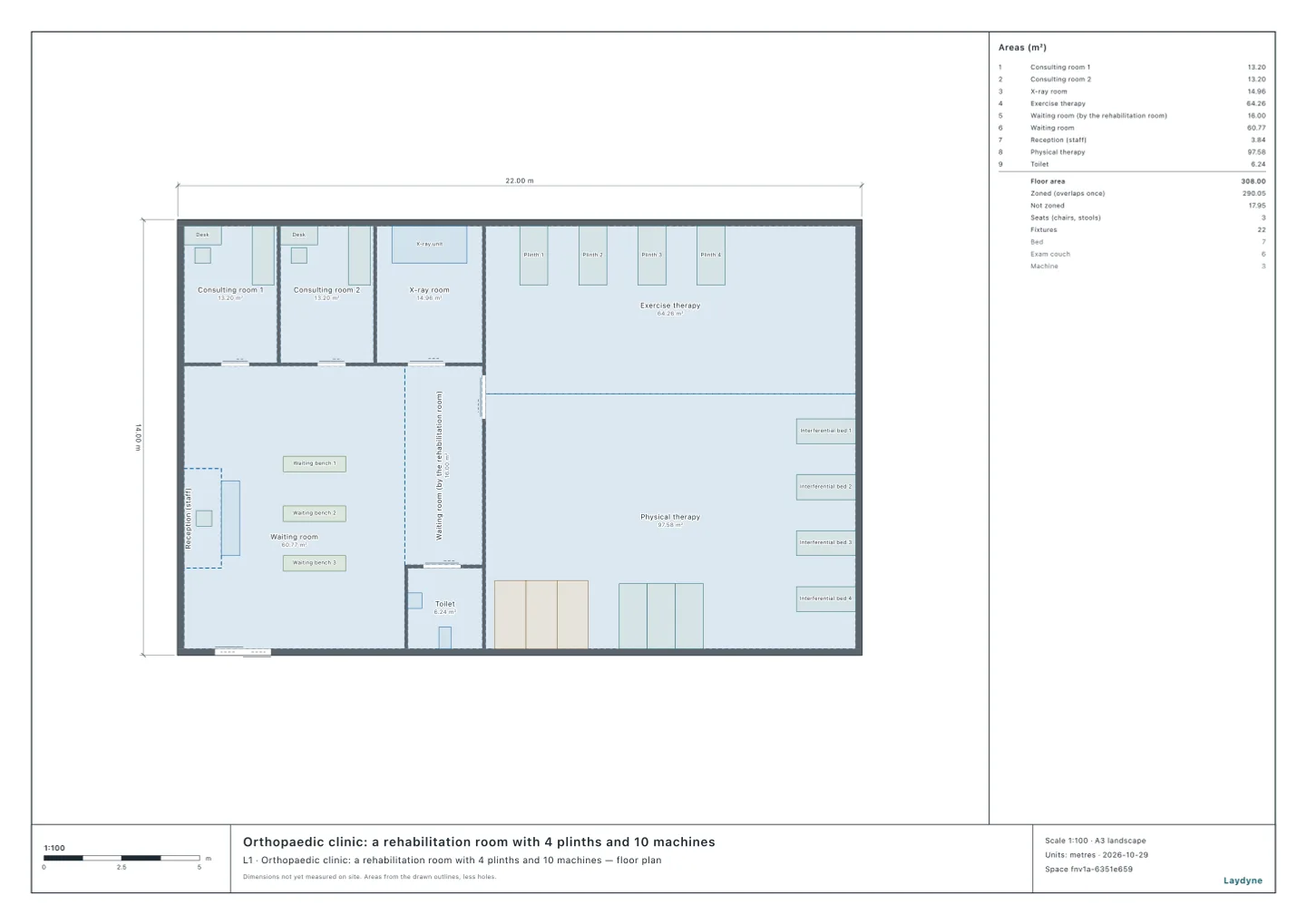
Start from the orthopaedic clinic model (free sign-up; running a simulation is Pro). At an orthopaedic clinic, patients for rehabilitation gather in the morning and wait for the physical therapy machines and the physiotherapists. In this article, in the members’ new model of an orthopaedic clinic, your AI simulates a morning of rehabilitation. It ran the same tools an AI calls over MCP. Every figure and number below comes from that run.
1. The clinic and the morning
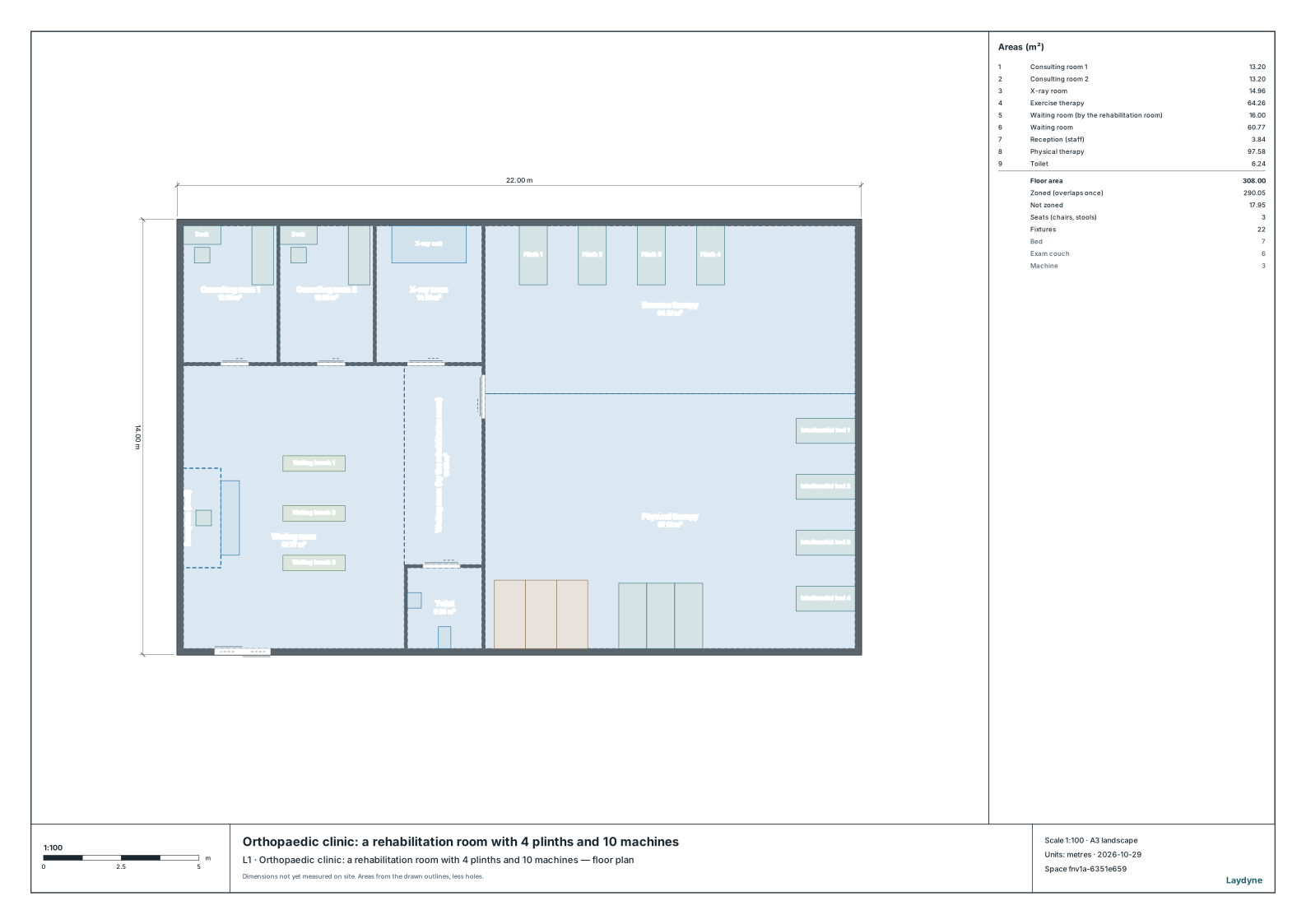
- A clinic of 22 × 14 m with two consulting rooms, the X-ray room, the reception and waiting room, and the rehabilitation room. The rehabilitation room has four plinths for exercise therapy and ten physical therapy machines (3 traction units, 3 water beds, 4 interferential beds).
check_spacefinds nothing.
The AI wrote this flow as a scenario (put_process_scenario).
- From 9:00 to 12:00, 100 patients come in at random: 45 % in the first hour, then 33 and 22 %. Checking in takes 1 minute.
- 40 % first see the doctor (3 to 8 minutes, most often 4). A fifth of them have an X-ray (3 to 6 minutes), and 60 % of those who see the doctor go on to rehabilitation. The others come for rehabilitation only.
- In rehabilitation, each has one of traction (35 %), a water bed (30 %) or interferential current (35 %) for 10 to 15 minutes (most often 12). In use are 2 traction units, 2 water beds and 4 interferential beds.
- Then 20 % step away from the machine, wait for the first free of the 2 physiotherapists and have exercise therapy at a plinth (18 to 25 minutes, most often 20). Then they leave by the entrance.
- Every number and time is an assumption. Put in your own clinic’s records.
2. The traction units and the water beds
The AI changed the traction units (2, 3) and the water beds (2, 3) in use (sweep_process_parameters), 20 runs each. There are 4 interferential beds. The longest wait is the mean over the 20 runs of each run’s longest. “To leaving” is the mean time from the waiting room to leaving, of those who have rehabilitation.
| Traction units | Water beds | Traction: wait (mean) | Traction: longest wait | Water bed: wait (mean) | Water bed: longest wait | To leaving |
|---|---|---|---|---|---|---|
| 2 | 2 | 11.2 min | 28.2 min | 11.6 min | 27.2 min | 28.6 min |
| 2 | 3 | 11.2 min | 28.2 min | 1.9 min | 10.2 min | 25.5 min |
| 3 | 2 | 1.7 min | 9.6 min | 11.6 min | 27.2 min | 25.2 min |
| 3 | 3 | 1.7 min | 9.6 min | 1.9 min | 10.2 min | 22.1 min |
- With two of each, the wait for traction is 11.2 minutes on average and for a water bed 11.6. The 4 interferential beds keep their wait to 0.4 minutes. About the same share use each, but the line forms at the machines there are half as many of.
- With 3 traction units, the wait for traction is 1.7 minutes. With 3 of both, the time to leaving goes from 28.6 minutes to 22.1.
- Those who see the doctor wait 27.2 minutes on average for the one doctor (this article does not change the doctors).
3. The interferential beds
With 2 traction units and 2 water beds, the AI changed the interferential beds in use (2, 3, 4).
| Interferential beds | Wait (mean) | Longest wait | Waiting (most) | To leaving |
|---|---|---|---|---|
| 2 | 12.7 min | 30.0 min | 5.3 | 32.8 min |
| 3 | 2.0 min | 10.1 min | 2.7 | 29.1 min |
| 4 | 0.4 min | 4.5 min | 1.4 | 28.6 min |
- With 2 interferential beds, their wait is 12.7 minutes on average: about the same as 2 traction units or 2 water beds.
- With 3 it is 2.0 minutes.
4. The physiotherapists and exercise therapy
The AI changed the physiotherapists (2, 3, 4) and the share who have exercise therapy (10 %, 20 %, 30 %).
| Exercise therapy | Who had it | Physiotherapists | Wait (mean) | Longest wait | To leaving |
|---|---|---|---|---|---|
| 10 % | 7.5 | 2 | 1.0 min | 4.4 min | 23.3 min |
| 10 % | 7.5 | 3 | 0.0 min | 0.4 min | 23.2 min |
| 10 % | 7.5 | 4 | 0.0 min | 0.0 min | 23.2 min |
| 20 % | 16.9 | 2 | 12.2 min | 31.9 min | 28.6 min |
| 20 % | 16.9 | 3 | 2.1 min | 11.0 min | 26.1 min |
| 20 % | 16.9 | 4 | 0.4 min | 3.5 min | 25.7 min |
| 30 % | 26.1 | 2 | 43.7 min | 88.0 min | 42.7 min |
| 30 % | 26.1 | 3 | 8.9 min | 26.1 min | 31.1 min |
| 30 % | 26.1 | 4 | 2.1 min | 11.1 min | 28.7 min |
- When 20 % have exercise therapy, the wait is 12.2 minutes on average with 2 physiotherapists and 2.1 with 3.
- At 30 %, 2 make it 43.7 minutes on average and the longest 88.0. With 4 it is 2.1.
5. How to use this check
- Draw your own clinic (from a PDF of the drawings or photos too), and tell your AI the patients each hour, the shares who see the doctor and have rehabilitation, the share and time of each machine, and the physiotherapists. Your AI also puts extra machines on the drawing and checks them.
- Not checked: booked times, one patient using two or more machines, hot packs, microwave and other machines, changing clothes, paying, the doctors’ and staff’s breaks, and the afternoon.