Start from the dispensing pharmacy model (free sign-up; running a simulation needs Pro). When the clinic next door ends its morning, prescriptions arrive all at once and the waiting area fills. The wait comes from the pharmacists on duty, the time each prescription takes, and who does what. In this article, your AI writes a morning at a mock dispensing pharmacy and compares the number of pharmacists and medicines gathered by someone who is not a pharmacist. It ran the same tools an AI calls over MCP. Every figure and number below comes from that run.
1. The pharmacy and the morning’s prescriptions
The mock pharmacy is 96 m²: the entrance, the waiting area with the over-the-counter shelves, the dispensing counter, and behind it the counter area, the dispensing room and the stock room. Your AI reads the dispensing counter (where a patient stands on the waiting side) with get_space, and writes this scenario (put_process_scenario):
- From 9:00 to 13:00, patients with a prescription come in at random: 8 an hour on average, twice as many from 11:30 to 12:30 (39.8 prescriptions on average over the 20 runs).
- At the counter a clerk takes the prescription and enters it (1 to 3 min), and the patient waits in the waiting area.
- A pharmacist gathers the medicines (1 to 10 min, most often 3). One prescription in ten also needs powders, liquids or ointments weighed and mixed (3 to 12 min, most often 5), which only a pharmacist may do.
- A pharmacist checks the medicines (0.5 to 1.5 min) and counsels the patient at the counter (1 to 6 min, most often 2), and the clerk takes the payment (0.5 to 1.5 min).
- Two pharmacists and one clerk are on duty. Twenty runs, with different random numbers.
In Japan, a pharmacy must have at least as many pharmacists engaged in dispensing as its daily average of prescriptions divided by 40 (at least one, and any fraction counts as one: the ordinance on the system of pharmacies, store-based and household distribution sellers, Article 1, item 2; eye, ear-nose-throat and dental prescriptions count as two thirds). If its afternoons are like its mornings, this pharmacy fills about 80 a day: 80 ÷ 40 = 2 pharmacists.
The pharmacists, who gathers the medicines (a pharmacist, an assistant, or whoever is free), the share of prescriptions to mix and the prescriptions an hour are the scenario’s parameters. With sweep_process_parameters, your AI runs the same twenty random runs at each combination.
2. How long the patients wait today
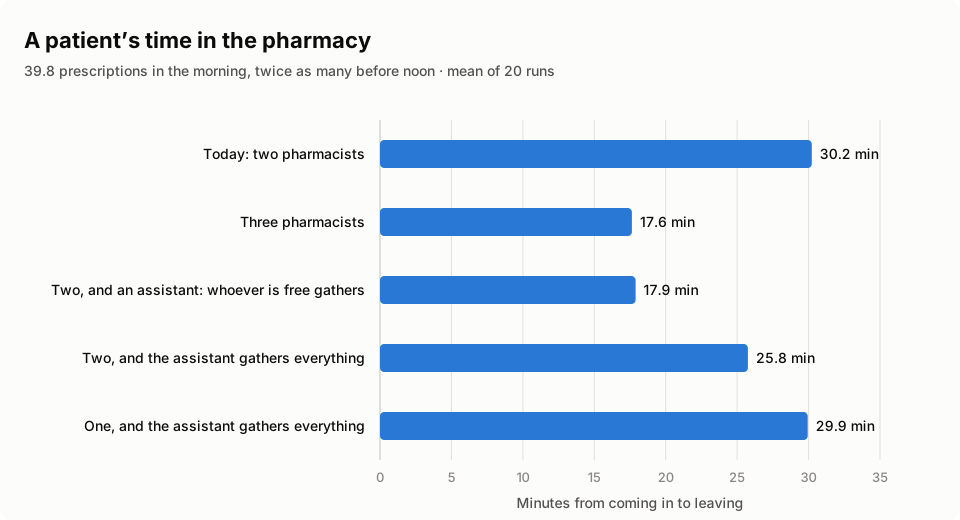
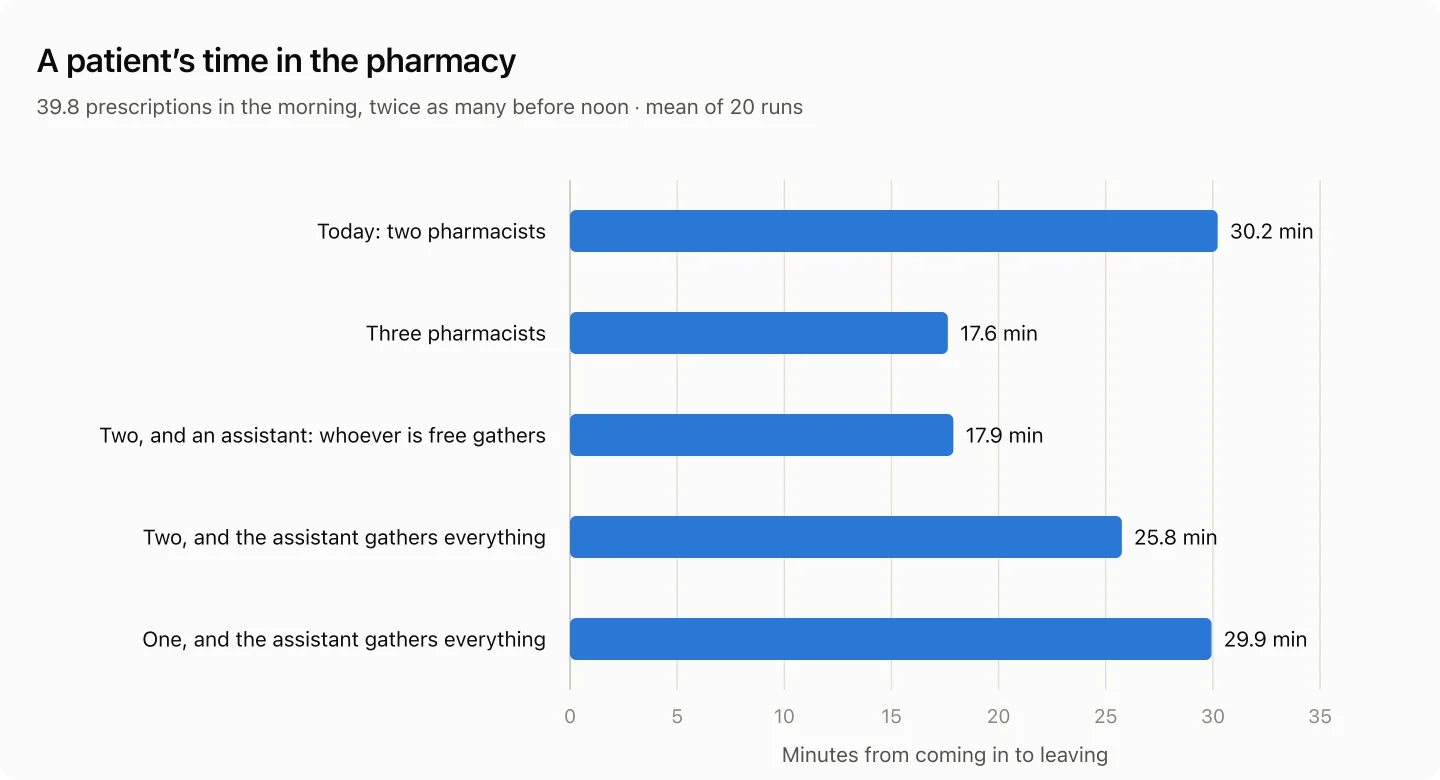
With two pharmacists, a patient spends 30.2 min on average from coming in to leaving (95 % interval 24.0 to 36.4 min).
- A prescription takes a pharmacist 9.3 min on average (4.7 to gather, 6.7 to mix for one in ten, 1.0 to check and 3.0 to counsel). At 8 an hour that is 74.7 minutes, 62 % of two pharmacists’ 120.
- But the hour before noon brings 16, which take 149.3 minutes, more than two pharmacists have (120). The wait builds in that hour.
3. Pharmacists, and who gathers the medicines
A 2019 notice of Japan’s health ministry (on how dispensing work is done, No. 0402-1 of the Pharmaceutical Safety and Environmental Health Bureau’s General Affairs Division) set out that, at a pharmacist’s direction and within the pharmacist’s sight, someone who is not a pharmacist may gather the required amount of medicines still in their PTP sheets. The pharmacist makes the final check, and only a pharmacist may weigh and mix powders, liquids and ointments. Written procedures and training are required.
| Staffing | From coming in to leaving | Against today |
|---|---|---|
| Two pharmacists (today) | 30.2 min | – |
| Three pharmacists | 17.6 min | −12.6 min (95 % interval −17.1 to −8.1 min) |
| Two pharmacists and an assistant: whoever is free gathers | 17.9 min | −12.3 min (−16.9 to −7.8 min) |
| Two pharmacists and an assistant: the assistant gathers everything | 25.8 min | −4.5 min (−6.9 to −2.1 min) |
| One pharmacist and an assistant: the assistant gathers everything | 29.9 min | −0.3 min (−1.8 to 1.2 min) |
| One pharmacist | 93.4 min* | 63.1 min (47.5 to 78.8 min) |
- In 14 of the 20 runs not every patient had left by 15:00: the mean of those who had.
- With an assistant, and whoever is free gathering the medicines, two pharmacists do about as well as three: 17.9 min. The pharmacists are left for the checks, the counselling and the mixing.
- With the assistant gathering everything, it is 25.8 min, less good than whoever is free: before noon the queue forms at the assistant (the wait to have the medicines gathered is 11.0 min on average).
- Even one pharmacist, with the assistant gathering everything, gives 29.9 min, a difference from two pharmacists within the noise. One pharmacist alone gives 93.4 min.
4. The share of prescriptions to mix
| Prescriptions to mix | Two pharmacists | Two pharmacists and an assistant (whoever is free gathers) |
|---|---|---|
| 0 % | 25.6 min | 16.5 min |
| 10 % (today) | 30.2 min | 17.9 min |
| 30 % | 40.1 min | 21.6 min |
Where many prescriptions have powders, liquids or ointments (near a paediatric or a dermatology clinic, for example), only pharmacists can mix them, so the pharmacists’ time grows: even with an assistant, 30 % gives 21.6 min.
5. The number of prescriptions
| Prescriptions an hour (twice before noon) | In the morning | Two pharmacists | Three pharmacists |
|---|---|---|---|
| 6 | 30.2 | 20.2 min | 14.8 min |
| 8 (today) | 39.8 | 30.2 min | 17.6 min |
| 10 | 49.6 | 40.4 min | 20.4 min |
6. How to use these numbers
- The prescriptions in each hour come from the reception times in your dispensing system. Give your AI your own times to gather, check and counsel.
- When an assistant gathers medicines, keep within the notice (the pharmacist’s direction and sight, medicines still in their PTP sheets, the pharmacist’s check) and its procedures and training. This article compares the time that work takes; it is not a legal opinion.
- Not calculated: queries to the prescribing doctor, ordering medicines not in stock, one-dose packaging, phone and home-care work, the pharmacists’ breaks, revenue.