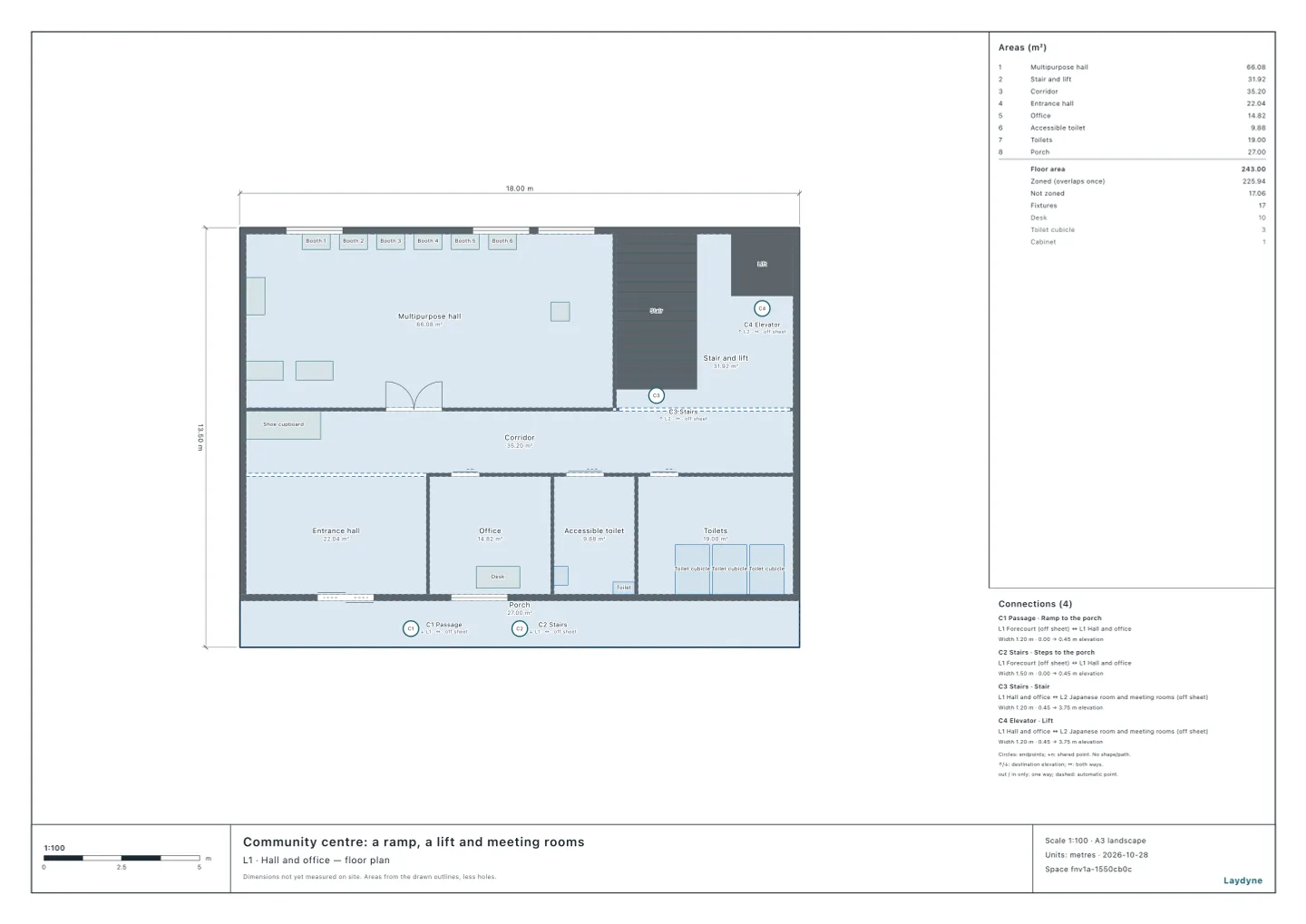
Start from the community centre model (free sign-up; running a simulation is Pro). Article 40 of Japan’s Public Offices Election Act opens polling stations at 7 a.m. and closes them at 8 p.m. In the busy part of those thirteen hours, too few register desks or booths make a line. In this article, in a mock community centre’s multipurpose hall, your AI sets the desks out as a polling station and checks its busiest hour. It ran the same tools an AI calls over MCP. Every figure and number below comes from that run.
1. The hall as a polling station
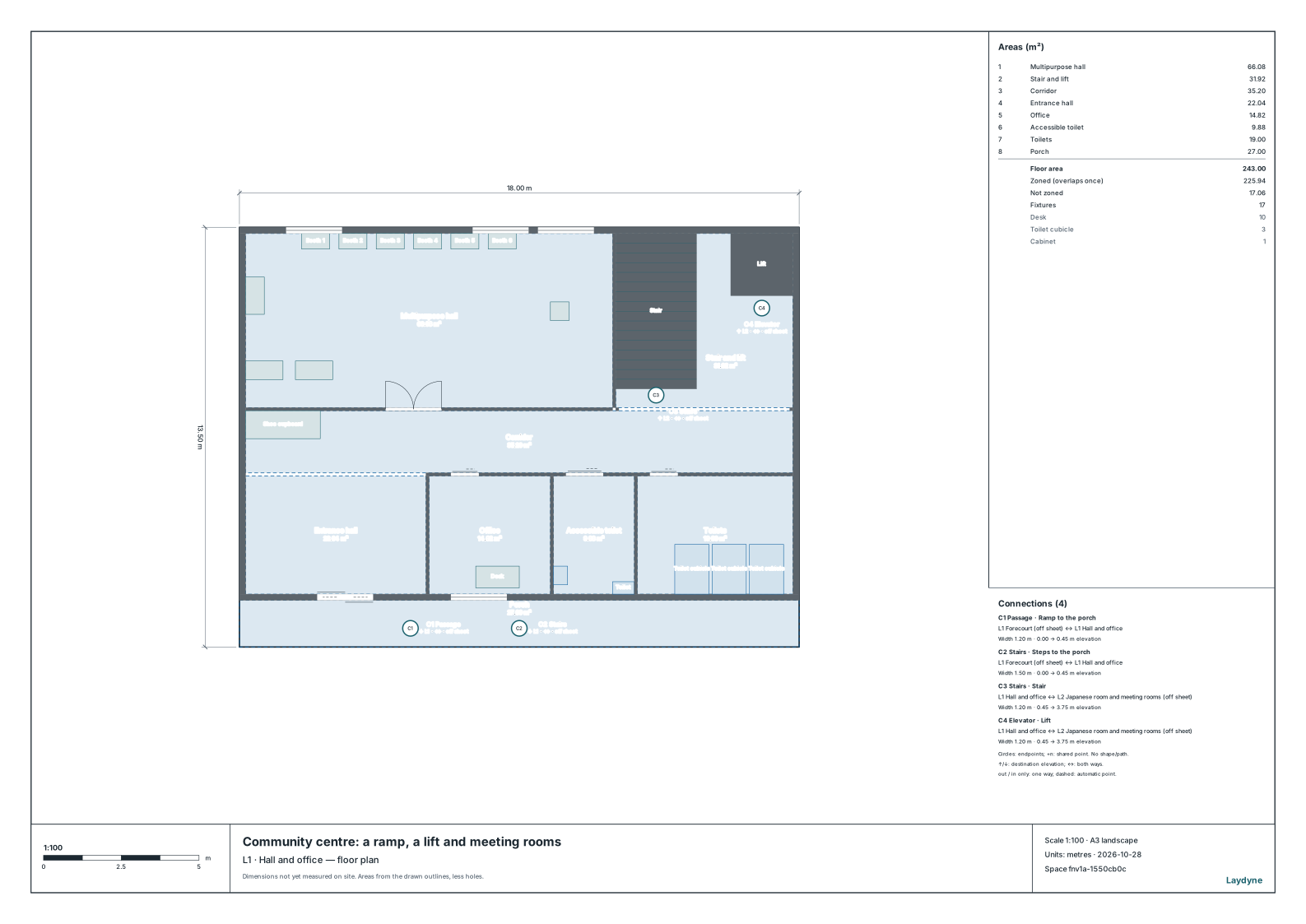
In one change (edit_space) your AI takes out the hall’s four tables and sixteen chairs and puts in two register desks by the door, the ballot paper desk on the west wall, six writing booths along the north wall and the ballot box to the east. check_space finds nothing.
Your AI writes the flow as a scenario (put_process_scenario).
- In the busiest hour, a set number of voters an hour come in at random. From the entrance they line up before the register desks in the hall and have the register checked at a free one (15 to 35 seconds).
- They take the ballot paper (5 to 12 seconds), write it at a free booth (30 to 120 seconds, most often 45), put it in the box (3 to 8 seconds) and leave.
- Every time is an assumption, to swap for the station’s own.
With 180 an hour, one register desk is 125 % busy and two 63 %; four booths are 81 % busy.
2. The desks and the booths
Your AI sweeps the register desks (one or two) and the booths (three, four or six) with sweep_process_parameters, at 180 voters an hour, 20 runs each.
| Desks | Booths | Time in the station | Waiting for a desk | Waiting for a booth |
|---|---|---|---|---|
| 1 | 3–6 | — | — | a line left in 6 runs of 20 |
| 2 | 3 | 419.5 s | 11.1 s | 267.4 s |
| 2 | 4 | 176.3 s | 11.1 s | 24.0 s |
| 2 | 6 | 152.9 s | 11.1 s | 0.4 s |
- With one desk the line keeps growing, whatever the booths.
- With two desks, three booths keep voters waiting nearly four and a half minutes for one; four make it 24.0 seconds, six 0.4.
3. The voters an hour
With two desks, your AI sweeps the voters an hour (120, 180, 240) and the booths (four or six).
| An hour | Booths | Time in the station | Waiting for a desk | Waiting for a booth |
|---|---|---|---|---|
| 120 | 4 | 147.5 s | 3.9 s | 3.3 s |
| 120 | 6 | 144.5 s | 3.9 s | 0.1 s |
| 240 | 4 | 419.8 s | 51.2 s | 226.9 s |
| 240 | 6 | 194.5 s | 51.2 s | 1.3 s |
- At 240 an hour, four booths keep voters in nearly seven minutes; six make it 194.5 seconds.
- Times and waits are means of 20 runs, given only where everyone was out in time.
4. Using the check
- Draw your polling station’s room (from a PDF drawing or photos as well), and tell your AI last time’s voters by the hour and the register and writing times.
- Not checked: early voting, voting by proxy or in braille, the observers’ seats, a booth for wheelchair users, and separate ways in and out.