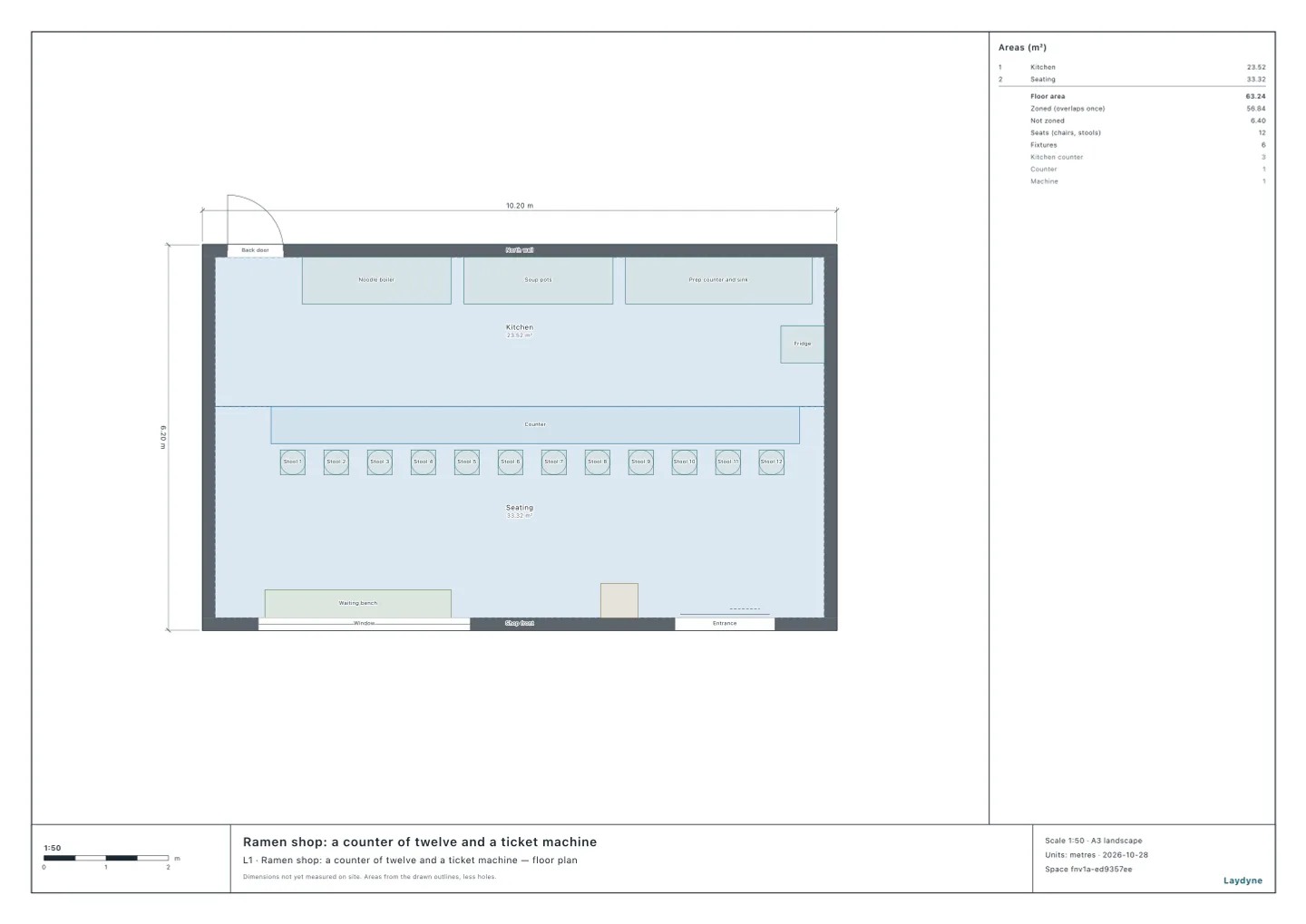
Start from the ramen shop model (free sign-up; running a simulation is Pro). In a counter-only ramen shop, customers crowd into the lunch hour and wait by the door for a stool. In this article, in the members’ ramen shop, your AI simulates a weekday lunch. It ran the same tools an AI calls over MCP. Every figure and number below comes from that run.
1. The shop and the lunch
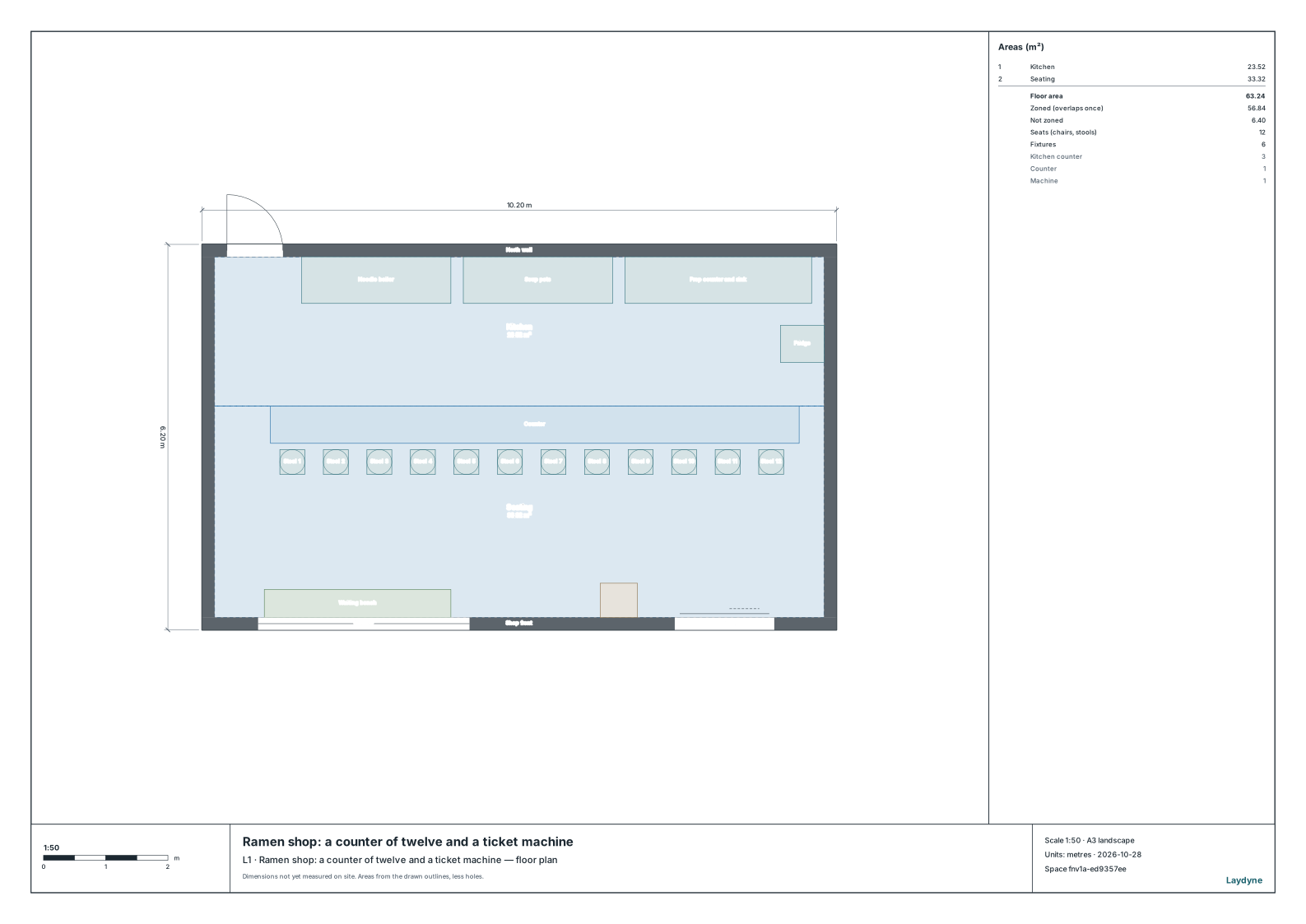
check_space finds nothing. Your AI writes the lunch as a scenario (put_process_scenario).
- From 11:00 to 14:00 parties come in at random: half an hour at a time from 11:00, 50, 90, 100, 100, 70 and 40 % of the parties from 12:00 to 13:00, the busiest hour.
- 70 % come alone, 25 % in twos and 5 % in threes.
- A party buys its tickets at the machine (20 to 40 seconds a person) and looks for stools by the waiting bench. With enough free and nobody waiting, it sits down; otherwise it waits there up to 20 minutes, then leaves.
- Seated, each bowl takes a basket in the noodle boiler (the noodles 3 to 5 minutes, most often 3.5), then 1 minute to serve.
- Eating takes 8 to 18 minutes alone (most often 12), and 12 to 22 minutes (15) for a party. A party of two or three takes free stools, side by side or not.
- Every time is an assumption, to swap for your own.
2. The parties and the stools
Your AI sweeps the parties from 12:00 to 13:00 (20, 30, 40) and the stools (10, 12) with sweep_process_parameters, 20 runs each. The wait for stools is over every party (0 for those who sat down at once, until they left for those who left).
| 12:00 to 13:00 | Stools | Parties | Waited | Left | Wait for stools | Longest line |
|---|---|---|---|---|---|---|
| 20 | 10 | 47.9 | 18.3 | 0.4 | 2.5 min | 5.0 |
| 20 | 12 | 47.9 | 9.0 | 0.0 | 0.9 min | 3.4 |
| 30 | 10 | 70.6 | 54.6 | 7.3 | 9.7 min | 12.9 |
| 30 | 12 | 70.6 | 43.7 | 1.9 | 5.8 min | 9.9 |
| 40 | 10 | 92.4 | 80.5 | 22.4 | 13.4 min | 18.6 |
| 40 | 12 | 92.4 | 74.1 | 13.1 | 11.3 min | 17.4 |
- With 30 parties from 12:00, even twelve stools keep 43.7 of 70.6 parties (61.9 %) waiting, 5.8 minutes on average. Ten stools make it 9.7 minutes, and those who leave rise from 1.9 to 7.3.
- With 40 parties from 12:00, even twelve stools lose 13.1 parties (14.2 % of those who came).
3. The noodle boiler’s baskets
With twelve stools, your AI changes the noodle boiler’s baskets (3, 4, 6) and the parties from 12:00 (30, 40). “Until the bowls” runs from sitting down to the bowls on the counter, and “wait for baskets” is a party’s wait for the boiler’s baskets; both are over every party.
| 12:00 to 13:00 | Baskets | Until the bowls | Wait for baskets | Wait for stools | Left |
|---|---|---|---|---|---|
| 30 | 3 | 5.9 min | 63.3 s | 7.2 min | 2.8 |
| 30 | 4 | 5.2 min | 18.9 s | 6.2 min | 2.2 |
| 30 | 6 | 4.9 min | 1.6 s | 5.8 min | 1.9 |
| 40 | 3 | 5.9 min | 65.7 s | 11.9 min | 15.7 |
| 40 | 4 | 5.2 min | 23.3 s | 11.5 min | 13.2 |
| 40 | 6 | 4.9 min | 2.2 s | 11.3 min | 13.1 |
- With three baskets the bowls take 5.9 minutes (4.9 with six), the stools stay taken that much longer, and the wait outside grows from 5.8 to 7.2 minutes.
- Four baskets and six differ little: the bowls change by only 0.3 minutes. Whether the kitchen’s hands run short before the baskets do is not in this scenario.
4. Using the check
- Draw your shop (from a PDF drawing or photos as well), and tell your AI the parties at lunch and their sizes, the time to eat and the noodles’ time.
- Not checked: the kitchen staff and the order of their work, takings and spend per head, table seating, and where the line forms outside and the neighbours.