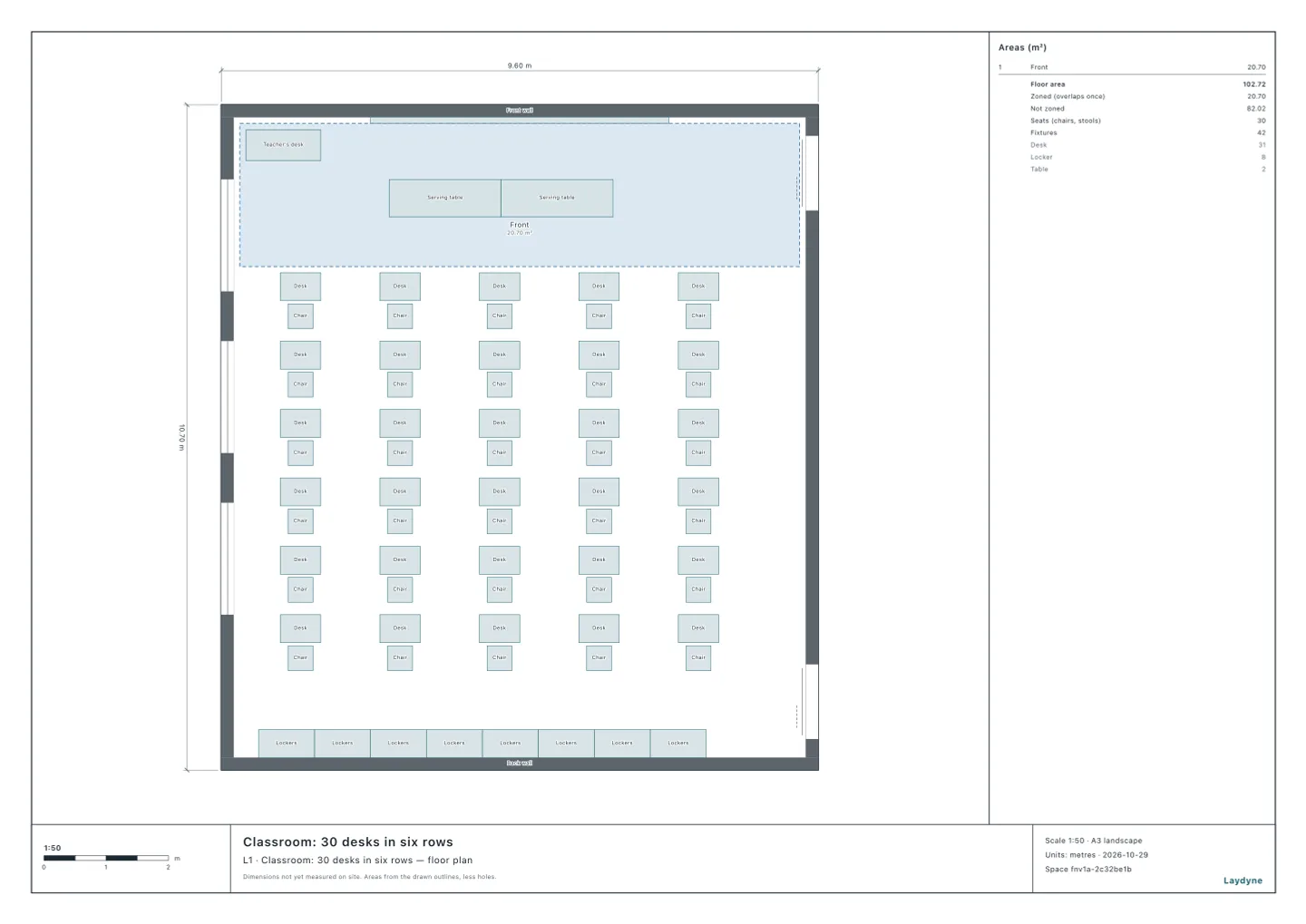
Start from the classroom model (30 desks) (free sign-up; running a simulation is Pro). From the end of the fourth period to “itadakimasu”, getting lunch ready takes time. In this article, in the members’ classroom model, your AI puts a serving table in and simulates serving lunch to 30. It ran the same tools an AI calls over MCP. Every figure and number below comes from that run.
1. The classroom and serving lunch
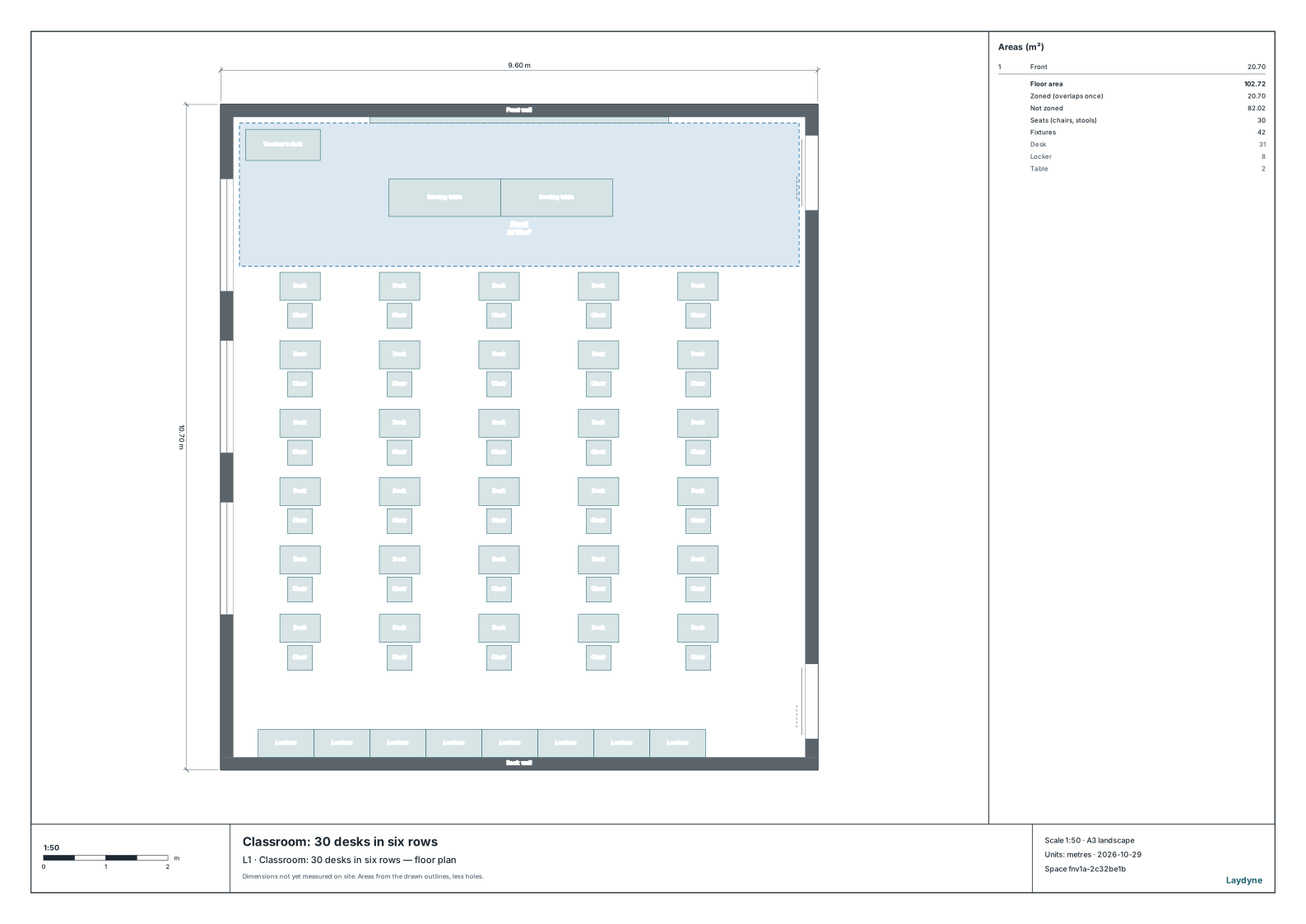
- A classroom of 30 desks (five columns, six rows). In one change (
edit_space), your AI moves the teacher’s desk to the window corner and puts a serving table of two tables (3.6 m) at the front.check_spacefinds nothing.
The AI wrote this flow as a scenario (put_process_scenario).
- When the fourth period ends, the servers fetch the lunch, and it is on the serving table 5 minutes later.
- The 30 students get their desks ready and wash their hands at their own pace (1 to 4 minutes, most often 2), and queue in the aisle by the windows.
- At the serving table they take a tray, chopsticks and milk themselves (5 seconds), are served the rice (6 to 15 seconds, most often 8), the main dish (8 to 20, most often 10) and the soup (10 to 25, most often 15), and go back to their desks. No one passes the one ahead: they move on when the next dish is free.
- Every number and time is an assumption. Put in your own class’s records.
2. The servers of the soup and the main dish
The AI changed the servers of the soup (1, 2) and of the main dish (1, 2) (sweep_process_parameters), 20 runs each (one server for the rice). Everyone at their desks is the time from the end of the fourth period; the wait in the queue is a student’s mean.
| Servers of the soup | Servers of the main dish | Everyone at their desks | Wait in the queue (mean) |
|---|---|---|---|
| 1 | 1 | 14.6 min | 6.6 min |
| 1 | 2 | 14.4 min | 6.3 min |
| 2 | 1 | 12.7 min | 5.8 min |
| 2 | 2 | 11.0 min | 5.1 min |
- With one server each, everyone is at their desk 14.6 minutes after the fourth period, 9.6 minutes after the lunch arrives.
- The soup, the slowest dish, sets the pace of the queue. With two servers of the soup it is 12.7 minutes, 1.9 sooner. Two servers of the main dish alone give 14.4 minutes: hardly any change. Two of each give 11.0 minutes.
3. All at once, or a row at a time
With one server each, and with two of the soup, the AI compared queuing as soon as hands are washed with calling five students, a row at a time from the front, every 75 seconds once the lunch has arrived (those called have washed their hands and wait at their desks).
| Queuing | Servers of the soup | Everyone at their desks | Wait in the queue (mean) | Queuing (most at once) |
|---|---|---|---|---|
| All at once | 1 | 14.6 min | 6.6 min | 30.0 |
| All at once | 2 | 12.7 min | 5.8 min | 30.0 |
| A row at a time | 1 | 14.6 min | 0.8 min | 6.5 |
| A row at a time | 2 | 13.2 min | 0.3 min | 4.0 |
- Queuing all at once, the students queue before the lunch arrives: all 30 are in the queue, waiting 6.6 minutes on average.
- Called a row at a time, 6.5 queue at the most, waiting 0.8 minutes on average. With one server of the soup, everyone is at their desk at the same 14.6 minutes.
- With two servers of the soup, calling every 75 seconds is slower than they serve: everyone is at their desk at 13.2 minutes, 0.5 later than all at once. Call them as fast as they are served.
4. How to use this check
- Draw your own classroom (from a PDF of the drawings or photos too), and tell your AI the class size, how long the lunch takes to arrive, the time to serve each dish, the servers and how the class queues. Your AI also puts a moved serving table on the drawing and checks it.
- Not checked: the servers changing and walking to the kitchen and back, second helpings, allergies, returning the dishes and clearing up, and a crowded aisle.