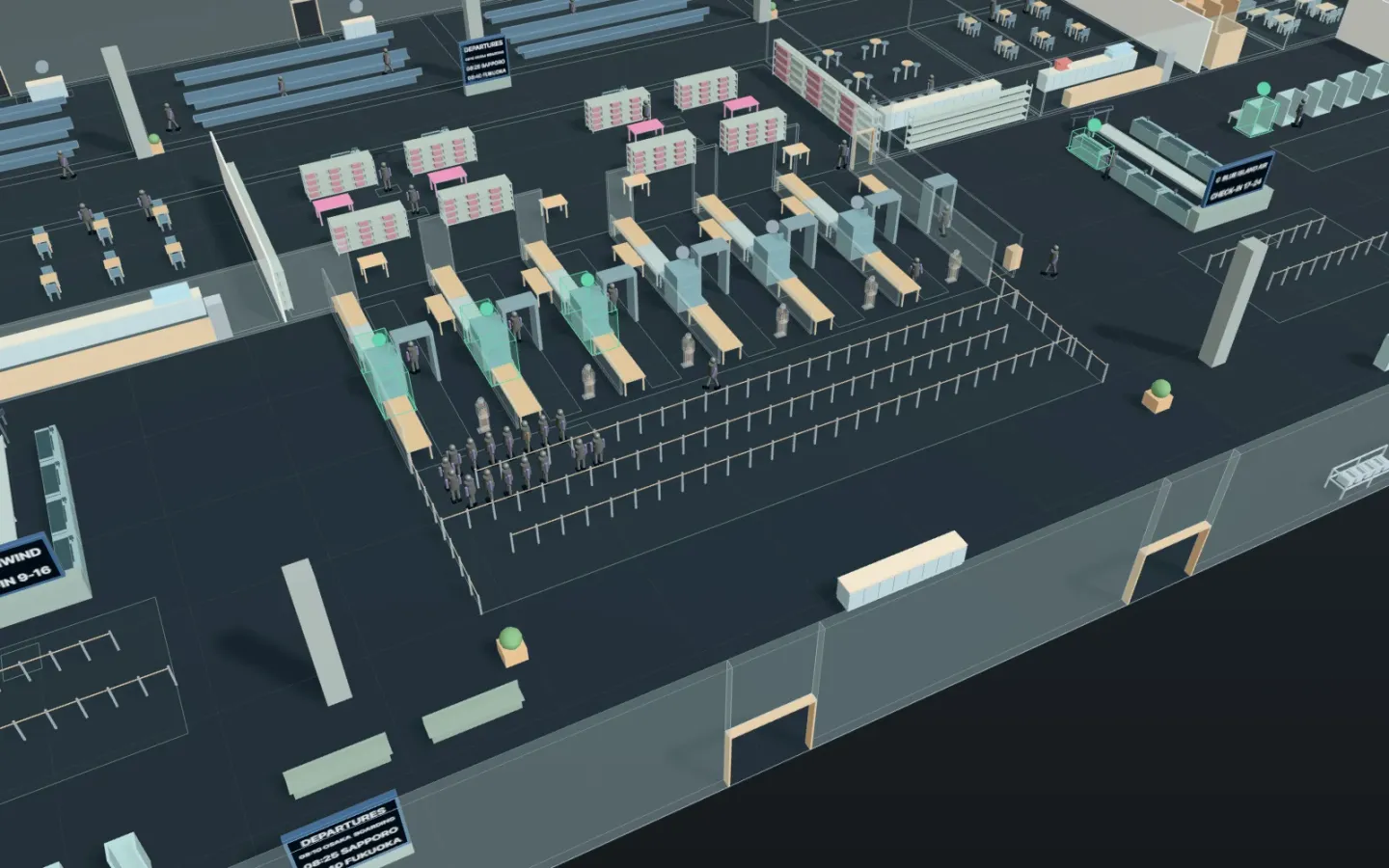
Open the airport morning departures (no account needed to open it; running simulations takes Pro). For the morning bank of departures, how many security lanes must be open, and how long does the queue get? With the same passengers, your AI changes the lanes and the passenger numbers and compares them in a simulation. This article runs on a synthetic airport with the same tools your AI calls over MCP. Every number below comes from that run.
1. The airport and the morning departures
The synthetic airport’s 30-minute morning bank of departures.
- Passengers arrive at random at a rate that changes through the bank (twice the base from 6 to 25 minutes, four times from 11 to 21). 60 % check a bag, at a check-in island of four desks or a self bag drop.
- Everyone waits for a staffed security lane: the open lanes are what can screen, and each passenger takes a free one. 15 % have fast track and are screened first. Then some stop at duty free, a café, the bar or the lounge, and wait at a gate.
- Two arriving flights (baggage reclaim and customs) run at the same time. Security sees 85.6 standard and 16.1 fast-track passengers on average over the 20 runs.
- Not counted: crowd physics. Gates board after a random wait, not to a timetable.
2. Open lanes
Your AI ran the saved scenario’s parameter, the open lanes, at each value with sweep_process_parameters, twenty runs each on the same random numbers. The time at security is from joining the queue to being screened, on average.
| Open lanes | Standard passengers | Fast track | Longest wait | Longest queue | Lanes busy (over the hour) |
|---|---|---|---|---|---|
| 2 | 11.2 min | 1.5 min | 18.7 min | 42.7 | 72 % |
| 3 (today) | 5.1 min | 1.4 min | 8.2 min | 26.5 | 49 % |
| 4 | 2.7 min | 1.3 min | 3.7 min | 15.5 | 37 % |
| 5 | 1.7 min | 1.3 min | 1.6 min | 8.9 | 31 % |
- With today’s 3 lanes, a standard passenger takes 5.1 minutes and the queue reaches 26.5. With 4 it is 2.7 minutes (2.4 minutes less, 95 % interval 2.1 to 2.8), with 5, 1.7.
- Over the hour the 3 lanes are busy only 49 % of the time, but the queue builds in the ten minutes when passengers come at four times the base. The peak, not the average, decides the lanes.
3. A morning 25 % busier
Your AI raised the base rate from 90 to 112.5 an hour (the peak grows in the same proportion).
| Open lanes | Standard passengers | Longest wait | Longest queue |
|---|---|---|---|
| 3 | 8.3 min | 13.5 min | 44.9 |
| 4 | 4.6 min | 7.3 min | 30.5 |
| 5 | 2.8 min | 4.0 min | 20.1 |
- To keep a 25 % busier morning about as quick as a usual one (5.1 minutes with 3 lanes) takes 4 lanes (4.6 minutes).
4. More fast-track passengers
Your AI raised the fast-track share from 15 % to 30 %.
| Open lanes | 15 % fast track: standard | fast track | 30 % fast track: standard | fast track |
|---|---|---|---|---|
| 3 | 5.1 min | 1.4 min | 5.9 min | 1.4 min |
| 4 | 2.7 min | 1.3 min | 3.0 min | 1.3 min |
- With twice the fast track, fast-track passengers still take 1.4 minutes, but standard passengers take 0.8 minutes longer with 3 lanes (95 % interval 0.7 to 1.0). When selling more fast track, watch the standard queue too.
5. How to use these numbers
- Give your AI the show-up times by flight (from booking data), the share checking bags, measured screening and check-in times, and the lanes and desks staffed by hour.
- Weigh the waits against the screener hours each option costs and your own service target; the run does not show missed flights, retail spend or passenger satisfaction.
- Not counted: crowd physics, boarding to a timetable.