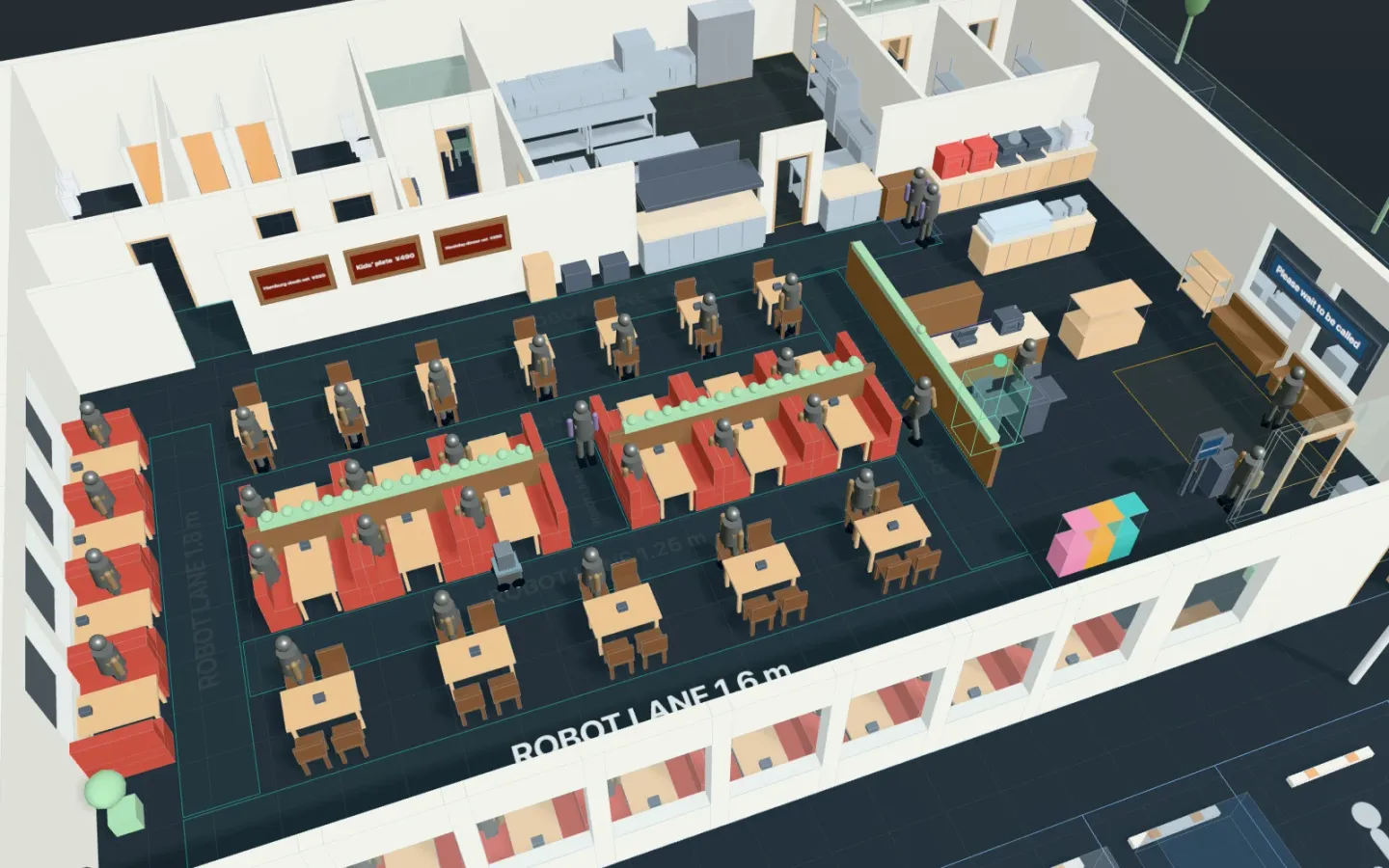
Open the family restaurant (no account needed to open it; running simulations takes Pro). Is one serving robot enough, is a second worth it, or would another member of the floor staff do more? With the same evening’s guests, your AI changes the robots and staff and compares them in a simulation. This article runs on a synthetic restaurant with the same tools your AI calls over MCP. Every number and picture below comes from that run.
1. The restaurant and the evening
The synthetic restaurant is a 134-seat roadside family restaurant. At a weekday dinner (17:30 to 22:00) 73 parties come: 14 an hour at 17:30, 36 an hour from 18:30 to 19:30.
- After the kitchen’s time (5 to 13 minutes) the plates are on the pass, and a serving robot (0.6 m/s, one table’s plates a trip) takes them to the table. Plates that have waited a minute for a robot are run by a floor server instead.
- After the meal a robot takes the used dishes to the dish return, or a server does once they have waited three minutes. The servers also wipe and reset the tables.
- Not counted: cooking, call buttons, water, take-out. Robots and people pass through each other (no waiting to pass).
2. Robots and floor staff together
Your AI ran the saved scenario’s parameters, the robots and the floor staff, at every combination with sweep_process_parameters, twenty runs each on the same random numbers. With three floor staff:
| Serving robots | Plates the servers ran (of 73 parties) | Used dishes the servers cleared | Plates on the table after the pass | The servers’ walking (three together) | The robots busy |
|---|---|---|---|---|---|
| 1 | 30.2 | 27.5 | 99 s | 3.99 km | 55 % |
| 2 | 7.5 | 4.7 | 87 s | 2.55 km | 41 % |
| 3 | 1.0 | 0.4 | 75 s | 2.21 km | 30 % |
“Plates on the table after the pass” is the mean time from the plates reaching the pass to the guests taking them at their table.
- With one robot, the minute often ran out while the robot was at another table: the servers ran 30 of the 73 parties’ plates. A second robot cuts that to 7.5, and the servers’ walking from 3.99 km to 2.55 km.
- A third robot leaves the servers about one party’s plates, but their walking falls only from 2.55 km to 2.21 km. The robots are busy 30 % of the time.
3. Another robot, or another server?
Plates on the table after the pass:
| Serving robots | 2 floor staff | 3 | 4 |
|---|---|---|---|
| 1 | 108 s | 99 s | 97 s |
| 2 | 88 s | 87 s | 87 s |
| 3 | 75 s | 75 s | 75 s |
- From one robot and three staff, a second robot brings the plates 11.4 s sooner (95 % interval 12.7 to 10.0 s sooner). A fourth member of staff brings them 1.3 s sooner (1.7 to 0.8 s).
- More staff do not change the plates the servers run (30.2) or how far they walk (3.99 km): the one-minute rule decides which plates go to them. What changes is how busy each is: they worked 21 % of the time with three, 15 % with four.
- With only two staff, two robots still bring the plates in 88 s.
4. How long should plates wait for the robot?
With one robot and three staff, your AI changed how long plates wait for the robot before a server runs them.
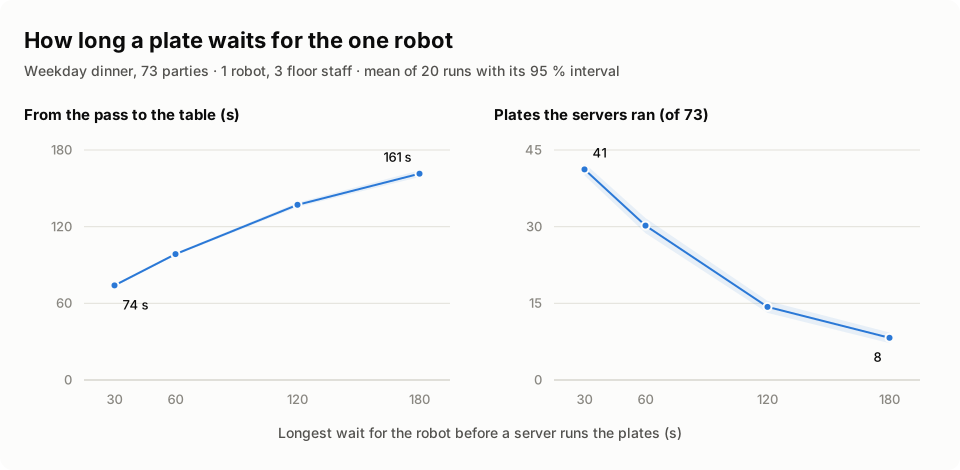
| Longest wait for the robot | Plates the servers ran | Used dishes the servers cleared | Plates on the table after the pass |
|---|---|---|---|
| 30 s | 41.2 | 21.9 | 74 s |
| 60 s (the model) | 30.2 | 27.5 | 99 s |
| 120 s | 14.3 | 35.8 | 137 s |
| 180 s | 8.3 | 39.1 | 161 s |
- The longer plates wait, the more the robot carries, but the later they reach the table: 161 s with three minutes.
- With the robot busy with plates, the servers clear more used dishes: 21.9 parties’ with 30 s, 39.1 with three minutes. So their walking falls only from 4.1 km to 3.7 km.
5. How to use these numbers
- Parties by the half hour and the kitchen and dining times are in your POS. Give your AI the speed and loading time of the robot you would use.
- Less walking frees staff time, but cuts payroll only if their hours change. Weigh the robots against their cost and the staff’s time.
- Not counted: robots and people passing and queueing, guest satisfaction, sales.
- In the saved scenario you can also move the robots’ chargers or a row of tables and run it again.