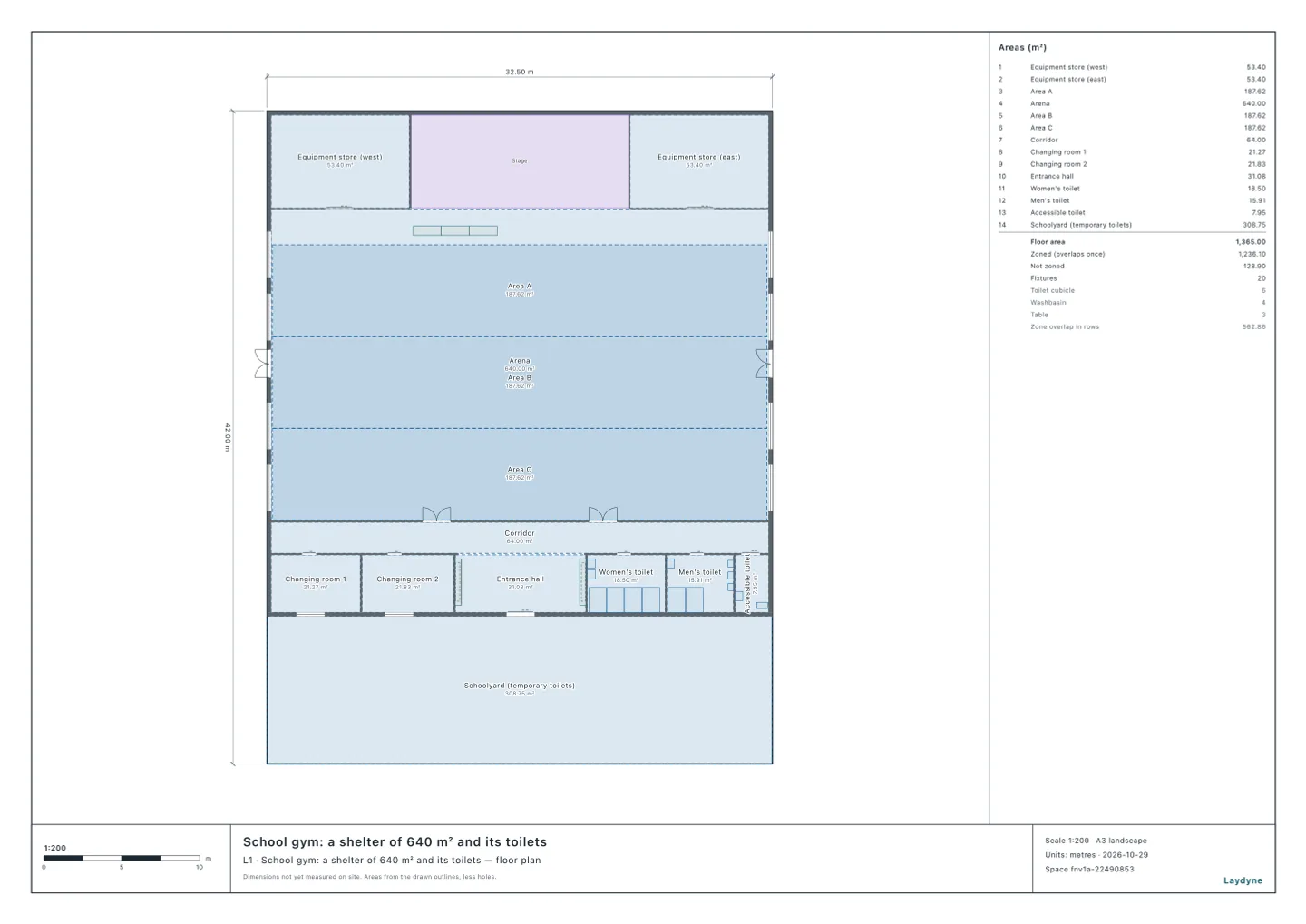
Start from the school gym shelter model (free sign-up; running a simulation is Pro). When meals or supplies are handed out at a shelter, a long queue forms and blocks the gym’s aisles. In this article, in the members’ school gym model, your AI puts tables for the meals in and simulates handing out to 150. It ran the same tools an AI calls over MCP. Every figure and number below comes from that run.
1. The gym and handing out the meals
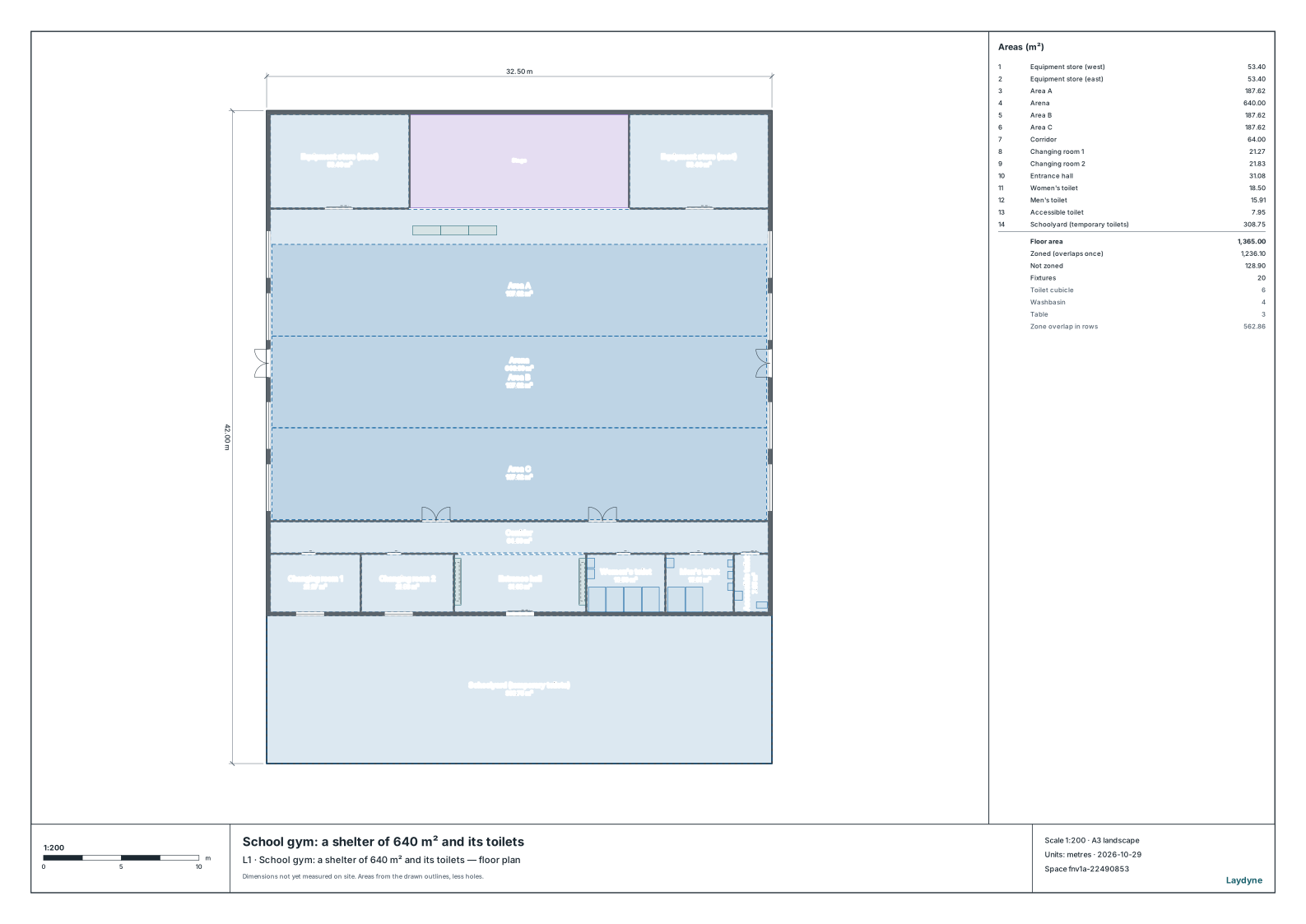
- A gym with an arena of 640 m². In one change (
edit_space), your AI puts three tables for the meals in front of the stage and divides the arena front to back into three areas, A, B and C (187.62 m² each).check_spacefinds nothing.
The AI wrote this flow as a scenario (put_process_scenario).
- 150 evacuees live on the arena, 50 in each area (3.75 m² each).
- When the meals are ready, everyone comes for their own, or one of each household of two comes for both, within five minutes of the call.
- They queue in one line for the tables, give their name at a free one and take the meals (10 to 30 seconds for one, most often 15; 15 to 45 for two, most often 25), then go back to their place.
- Every number and time is an assumption. Put in your own shelter’s list and records.
2. The tables, and who comes
The AI changed the tables open (1 to 3) and who comes (everyone, one of each household) (sweep_process_parameters), 20 runs each. The wait is a person’s mean, the longest wait and those queuing are means over the 20 runs, and all handed out is the time from the call.
| Who comes | Tables | Wait in the line (mean) | Longest wait | Queuing (most at once) | All handed out |
|---|---|---|---|---|---|
| Everyone (150) | 1 | 22.0 min | 44.0 min | 133.9 | 49.9 min |
| Everyone (150) | 2 | 9.7 min | 19.4 min | 118.1 | 25.3 min |
| Everyone (150) | 3 | 5.8 min | 11.7 min | 104.0 | 17.6 min |
| One of each household (75) | 1 | 15.9 min | 31.8 min | 64.4 | 37.8 min |
| One of each household (75) | 2 | 6.6 min | 13.3 min | 54.2 | 19.3 min |
| One of each household (75) | 3 | 3.6 min | 7.4 min | 44.5 | 13.4 min |
- With everyone coming for their own and one table, the wait is 22.0 minutes on average, the longest 44.0, and all is handed out after 49.9 minutes. At the most 133.9 queue at once: more than the 94 who fit, 0.6 m apart, on the line your AI drew three times down the gym (about 56 m).
- With one of each household coming for two, half as many queue, and even one table hands everything out after 37.8 minutes, 12.2 sooner.
- With two tables, even everyone coming is all handed out after 25.3 minutes.
3. Calling area by area
With everyone coming for their own, the AI compared calling everyone at once with calling an area every 8 minutes from area A, with one table and with two.
| Calling | Tables | Wait in the line (mean) | Longest wait | Queuing (most at once) | All handed out |
|---|---|---|---|---|---|
| All at once | 1 | 22.0 min | 44.0 min | 133.9 | 49.9 min |
| All at once | 2 | 9.7 min | 19.4 min | 118.1 | 25.3 min |
| An area every 8 min | 1 | 13.9 min | 28.0 min | 85.2 | 49.9 min |
| An area every 8 min | 2 | 1.7 min | 3.6 min | 22.2 | 25.4 min |
- With two tables and an area at a time, at the most 22.2 queue at once, the wait is 1.7 minutes on average, and all is handed out after 25.4 minutes, about the same. Two tables hand out an area of 50 in about 7.6 minutes, so calling every 8 minutes keeps up.
- One table takes about 15.3 minutes for an area, so every 8 minutes does not keep up: the wait is 13.9 minutes and 85.2 queue. Call as fast as the tables hand out.
4. How to use this check
- Draw your own shelter (from a PDF of the drawings or photos too), and tell your AI the evacuees and their areas, the tables, how the meals are handed out and the time for one. Your AI also puts other places for the tables and the line on the drawing and checks them.
- Not checked: evacuees not on the list or staying at home, allergies and special diets, those who take meals to people who need care, crowded aisles, and queuing outside on a rainy day.