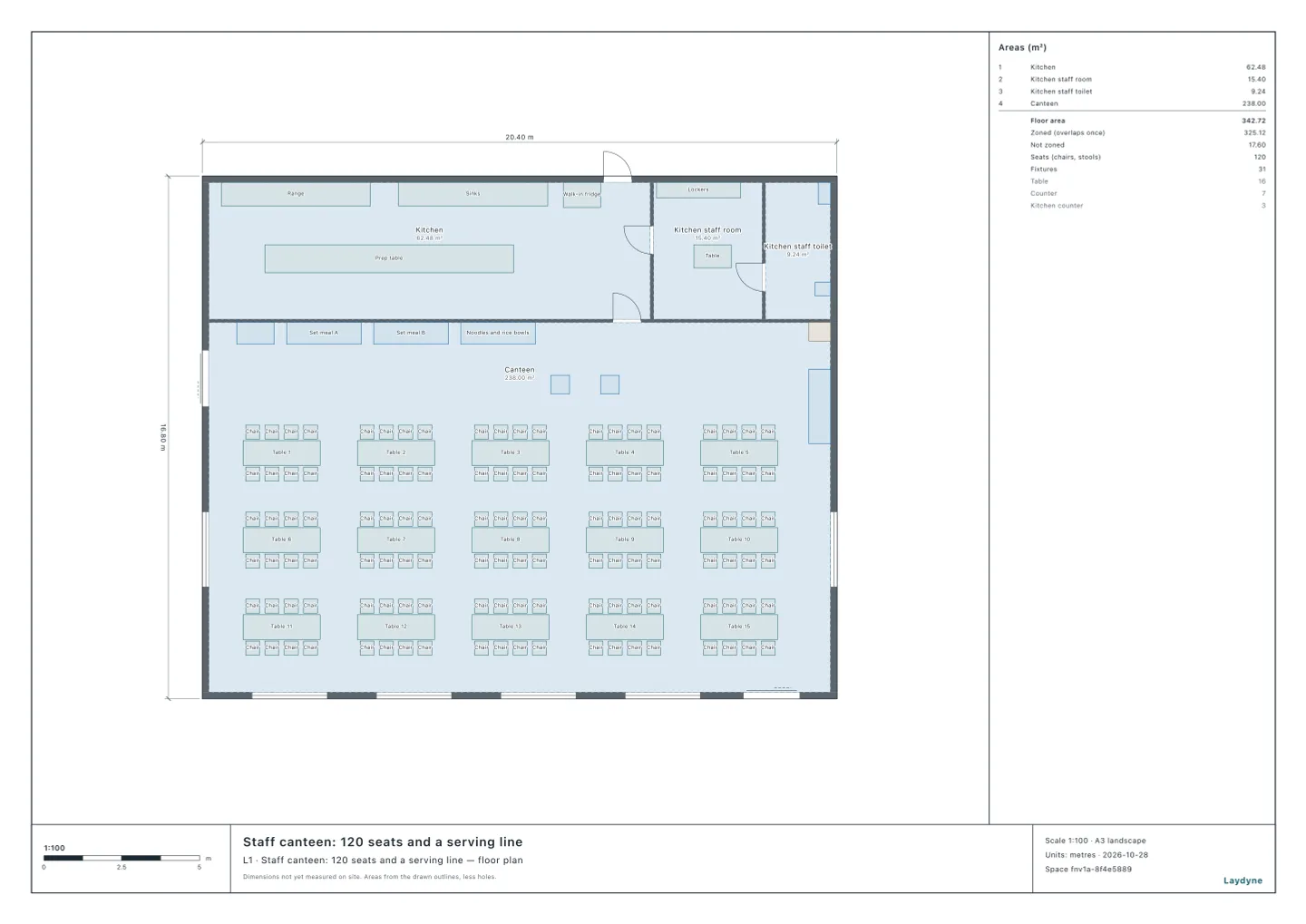
Start from the staff canteen model (free sign-up; running a simulation is Pro). Article 630 of Japan’s Industrial Safety and Health Regulations holds a workplace’s canteen to at least 1 m² of floor for each person eating at a time. The same article asks for the canteen apart from the kitchen, tables and chairs, and a rest room and a toilet for the kitchen staff only. In this article, in the members’ staff canteen, your AI checks the floor and simulates the lines and the seats when 240 come to eat at lunch. It ran the same tools an AI calls over MCP. Every figure and number below comes from that run.
1. The canteen’s floor
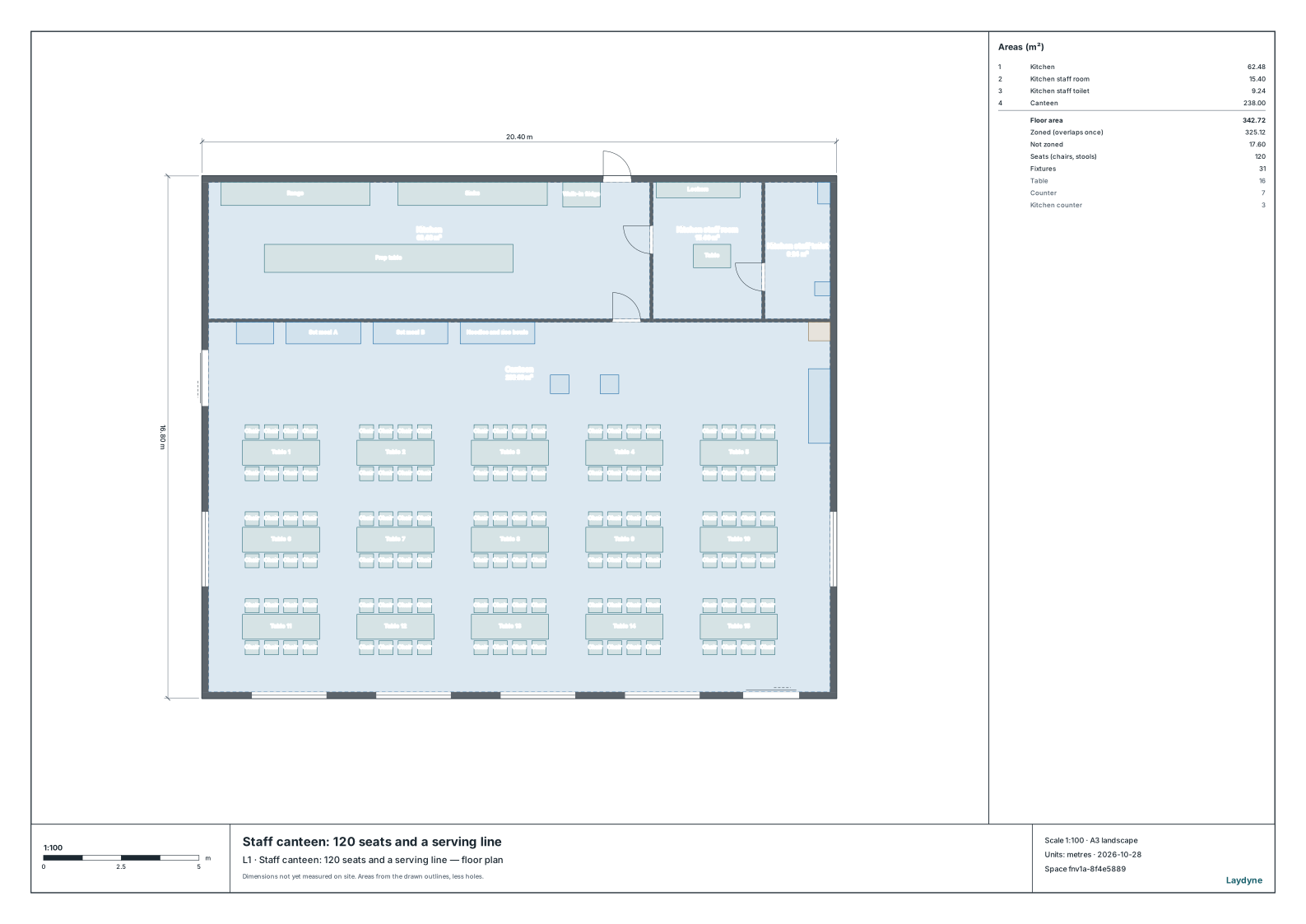
The model parts the kitchen from the canteen with a partition, with the kitchen staff’s rest room and toilet behind the kitchen. The canteen has fifteen tables of eight, 120 seats.
Your AI checks the floor with check_space, which finds nothing. The canteen’s floor (areaPerPerson, 1 m² a person) is 238 m²: 120 seats need 120 m². At 1 m² a person, 238 could eat there at a time.
It serves 240 meals at a sitting, so Article 632’s “100 or more meals at a time” applies: the employer is to try to have a dietitian or a registered dietitian.
2. The lunch hour
Your AI writes the flow as a scenario (put_process_scenario).
- 240 come to eat. With the break not split, all from 12:00; split in two, half from 12:00 and half from 12:30; in three, a third each from 11:30, 12:00 and 12:30.
- They reach the way in 0 to 10 minutes after their break starts (most often 2), take a tray and line up at the counter for set meal A (four in ten), set meal B (three in ten) or noodles and rice bowls (three in ten).
- They pay at one of two IC-card registers and take the nearest free seat. With none free, they stand with the tray until one is. Having eaten, they take the tray back and leave by the way out.
- The counter 8 to 25 seconds (most often 12), the register 3 to 10 seconds, eating 10 to 25 minutes (most often 15): every time is an assumption.
3. The breaks and the seats
Your AI sweeps how the break is split (one, two or three) and the seats in use (80, 100, 120) with sweep_process_parameters, for 240 diners, 20 runs each.
| Break | Seats | In the line to paying | Waiting for a seat (mean) | Found no seat | Standing (most) |
|---|---|---|---|---|---|
| Not split | 80 | 438.2 s | 583.0 s | 160.0 | 107.8 |
| Not split | 100 | 438.2 s | 337.5 s | 140.0 | 87.2 |
| Not split | 120 | 438.2 s | 181.8 s | 120.0 | 67.2 |
| Two | 80 | 151.4 s | 172.7 s | 93.3 | 44.8 |
| Two | 100 | 151.4 s | 55.1 s | 41.3 | 24.5 |
| Two | 120 | 151.4 s | 3.1 s | 5.1 | 4.4 |
| Three | 80 | 75.7 s | 9.8 s | 6.8 | 5.8 |
| Three | 100 | 75.7 s | 0.0 s | 0.0 | 0.0 |
| Three | 120 | 75.7 s | 0.0 s | 0.0 | 0.0 |
- With everyone from 12:00, the line to paying takes 438.2 seconds on average, more than seven minutes. The busiest is set meal A’s counter, chosen by four in ten, with 499.9 seconds of waiting.
- More seats do not shorten the line. Even with 120 seats, everyone from the 121st on waited for a seat in all 20 runs.
- With everyone from 12:00, the last diner leaves at 12:52 with 120 seats and at 13:07 with 80, past the end of the break at 13:00.
- With the break in two, the line takes 151.4 seconds and, with 120 seats, the wait for a seat 3.1. In three, even 100 seats keep nobody waiting.
4. The diners
With 120 seats in use, your AI changes the diners (180, 240, 300) and the break (not split or in two).
| Diners | Break | In the line to paying | Waiting for a seat (mean) | Found no seat |
|---|---|---|---|---|
| 180 | Not split | 289.5 s | 102.7 s | 60.0 |
| 180 | Two | 90.7 s | 0.0 s | 0.0 |
| 240 | Not split | 438.2 s | 181.8 s | 120.0 |
| 240 | Two | 151.4 s | 3.1 s | 5.1 |
| 300 | Not split | 586.6 s | 280.5 s | 180.0 |
| 300 | Two | 220.0 s | 50.2 s | 61.1 |
- With the break not split, even of 180 the 60 beyond the seats wait for one. In two, 180 do not wait, and of 300 61.1 do.
5. Using the check
- Draw your canteen (from a PDF drawing or photos as well), and tell your AI the diners, the break times and the menus’ shares and times.
- Not checked: dishes selling out, those bringing a lunch box or eating out, the rise on rainy days, more counters or registers, and how closely people sit.