Start from the classroom model (30 desks) (free sign-up; running a simulation is Pro). From the end of the school day, students fill a cram school’s study room. Before exams the seats run out and some go home without one. In this article, using the members’ classroom model as a study room, your AI simulates an evening at the study room. It ran the same tools an AI calls over MCP. Every figure and number below comes from that run.
1. The study room and the evening
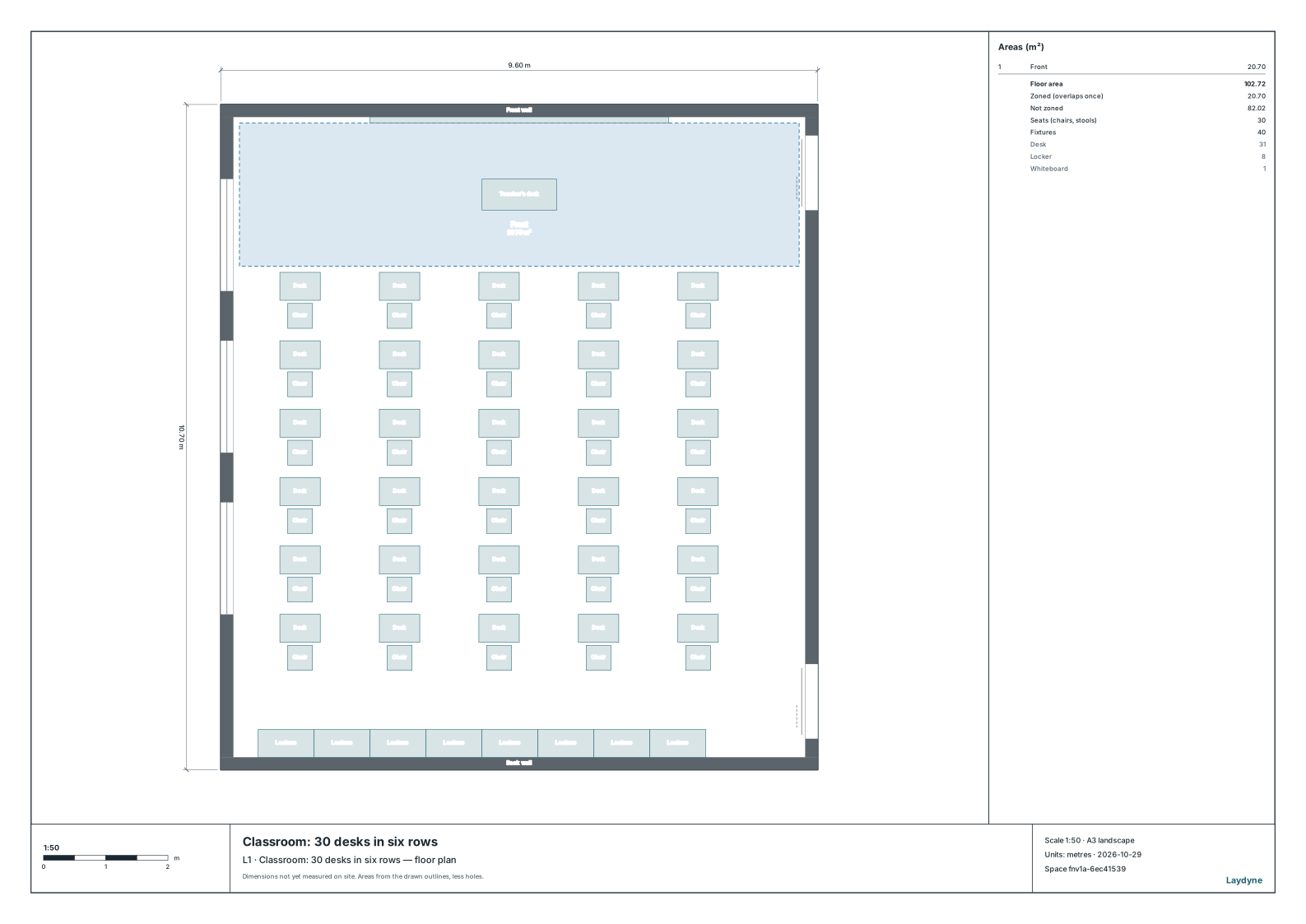
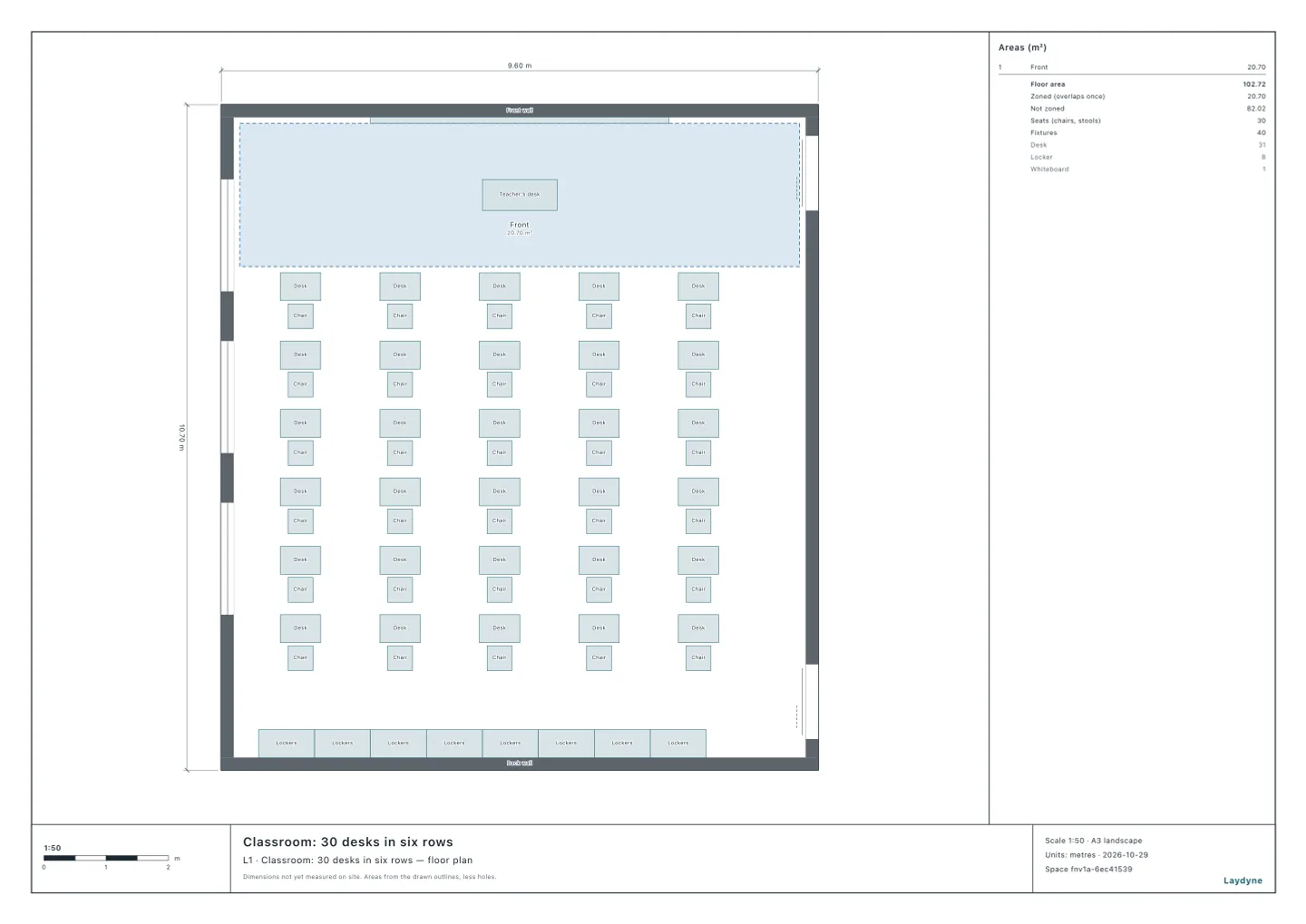
- A classroom of 30 desks (5 columns by 6 rows). In one change (
edit_space), the AI tagged the 30 chairs.check_spacefinds nothing.
The AI wrote this flow as a scenario (put_process_scenario).
- From 16:00 to 20:00, 60 students come in at the back door at random: 15 % in the first hour, then 30, 35 and 20 %.
- Each waits by the door at most 10 minutes for a free seat, and goes home if none comes free.
- At a seat each studies for 60 minutes to 3 hours (most often 90 minutes) and leaves.
- Every number and time is an assumption. Put in your own study room’s records.
2. The students and a two-hour limit
The AI changed the students in the evening (40, 60, 80, 100) and a time limit (none, two hours) (sweep_process_parameters), 20 runs each. There are 30 seats. With the two-hour limit, a student studies for 60 minutes to 2 hours (most often 90 minutes).
| Students | Time limit | Who came | Went home without a seat | Wait for a seat (mean) | Waiting (most) |
|---|---|---|---|---|---|
| 40 | None (up to 3 hours) | 41.7 | 0.1 | 0.0 min | 0.2 |
| 40 | 2 hours | 41.7 | 0.0 | 0.0 min | 0.0 |
| 60 | None (up to 3 hours) | 60.7 | 6.5 | 1.9 min | 5.0 |
| 60 | 2 hours | 60.7 | 2.2 | 0.9 min | 3.3 |
| 80 | None (up to 3 hours) | 80.6 | 16.9 | 3.5 min | 8.0 |
| 80 | 2 hours | 80.6 | 10.2 | 2.7 min | 6.9 |
| 100 | None (up to 3 hours) | 101.4 | 33.8 | 5.5 min | 10.5 |
| 100 | 2 hours | 101.4 | 24.4 | 4.7 min | 9.7 |
- With the usual 60, 6.5 students on average go home without a seat (about one in ten who came). With the two-hour limit, 2.2.
- When 80 come before exams, 16.9 find no seat, and 10.2 even with the two-hour limit. With 100 it is 33.8 and 24.4.
3. The seats
With no time limit, the AI changed the seats in use (24, 30) and the students (60, 80).
| Seats | Students | Went home without a seat | Wait for a seat (mean) | Waiting (most) |
|---|---|---|---|---|
| 30 | 60 | 6.5 | 1.9 min | 5.0 |
| 24 | 60 | 12.9 | 3.3 min | 6.2 |
| 30 | 80 | 16.9 | 3.5 min | 8.0 |
| 24 | 80 | 26.3 | 5.1 min | 8.5 |
- A room of 24 seats leaves 12.9 of 60 students without a seat: about twice as many as 30 seats.
4. How to use this check
- Draw your own study room (from a PDF of the drawings or photos too), and tell your AI the students each hour, how long they study, how long they would wait and the room’s rules. Your AI also puts extra desks on the drawing and checks them.
- Not checked: bookings or assigned seats, students before and after their classes, breaks away from the seat, the closing time, and weekends and the holidays.