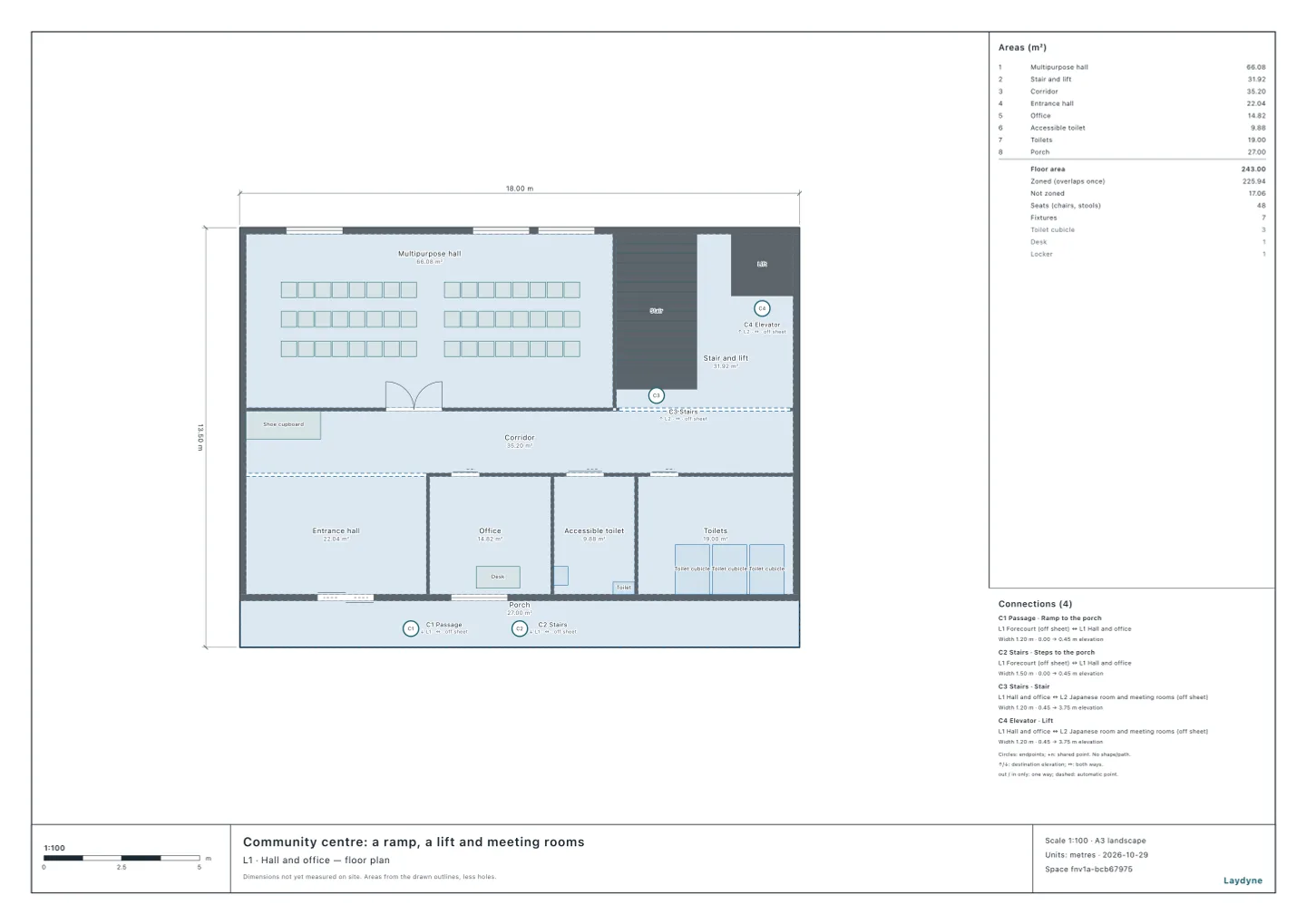
Start from the community centre model (free sign-up; running a simulation is Pro). In the interval of a talk or a recital the toilets queue, and the second half tends to start late. In this article, in the members’ community centre model, your AI sets out the chairs in the hall and simulates the toilets in the interval. It ran the same tools an AI calls over MCP. Every figure and number below comes from that run.
1. The community centre and the interval
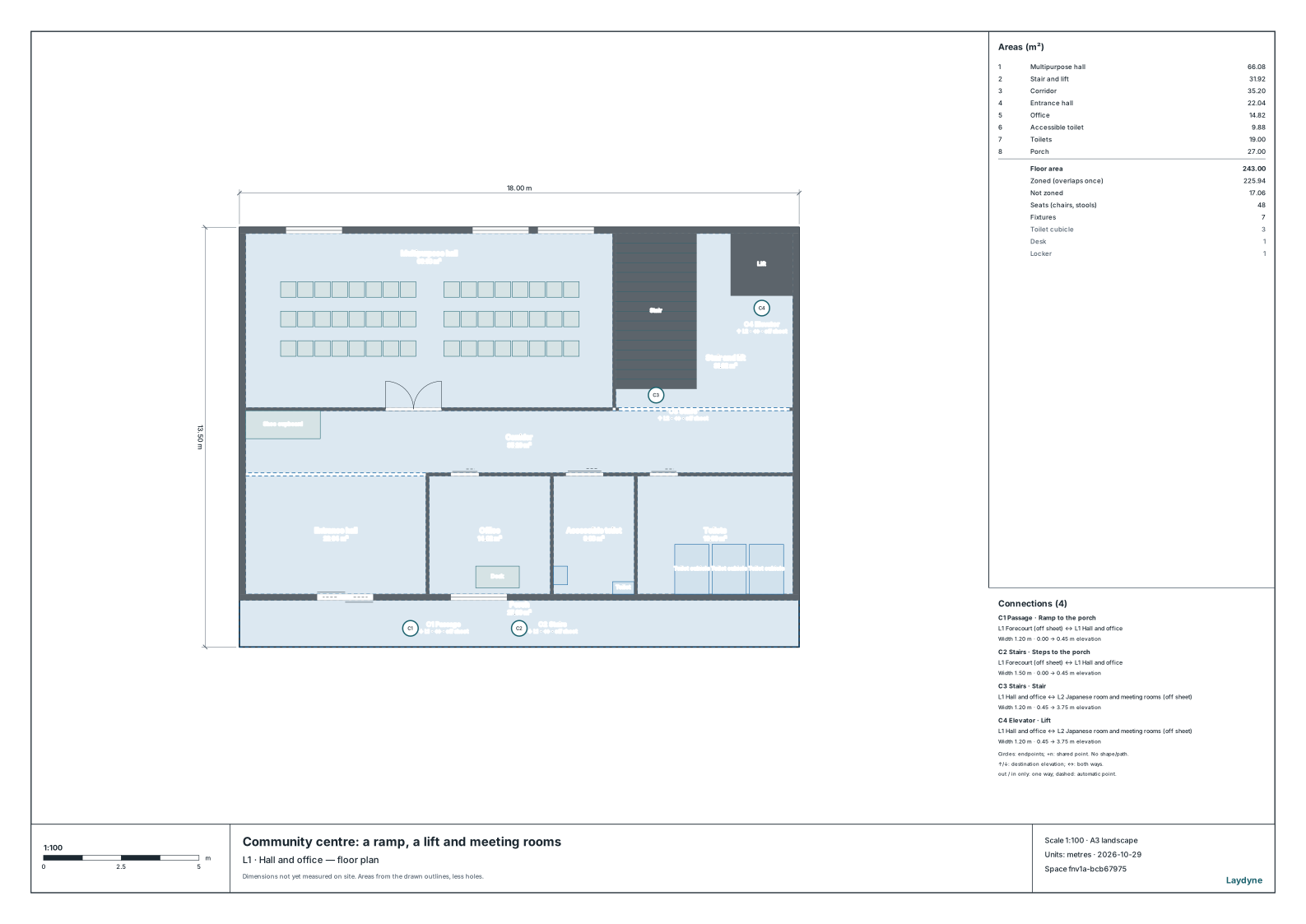
- A community centre on two floors. The ground floor’s toilets have three cubicles, the first floor’s two. With
suggest_arrangement, your AI takes out the hall’s 20 tables and chairs and sets out 48 chairs facing the front (two blocks of three rows of eight).check_spacefinds nothing.
The AI wrote this flow as a scenario (put_process_scenario).
- When the interval starts, those of the 48 who go to the toilets (30, 50 or 70 %) leave their seats, queue in one line in the ground floor’s toilets and take a free cubicle. A visit takes 1 to 3 minutes (most often 1.5, 1 minute 50 seconds on average).
- When they are sent upstairs as well, the one at the head of the line also goes up the stair to the first floor’s two cubicles.
- Then they go back to their seats.
- Every number and time is an assumption. Put in your own venue’s and event’s records.
2. Those who go, and the toilets upstairs
The AI changed the share of the audience who go (30, 50, 70 %) and sending them upstairs as well (sweep_process_parameters), 20 runs each. Seat to seat and the wait in the line are a person’s mean, the longest wait the mean over the 20 runs, and the last one back is the time from the start of the interval.
| Go to the toilets | First floor’s toilets | Seat to seat (mean) | Wait in the line (mean) | Longest wait | Last one back |
|---|---|---|---|---|---|
| 30 % | Not used | 5.9 min | 3.5 min | 7.5 min | 10.1 min |
| 30 % | Sent up | 4.3 min | 1.8 min | 4.2 min | 6.9 min |
| 50 % | Not used | 8.7 min | 6.4 min | 13.3 min | 15.8 min |
| 50 % | Sent up | 6.0 min | 3.6 min | 7.9 min | 10.5 min |
| 70 % | Not used | 11.7 min | 9.3 min | 19.2 min | 21.7 min |
| 70 % | Sent up | 7.9 min | 5.4 min | 11.5 min | 14.2 min |
- With half the audience (23.7) going and the ground floor’s three cubicles only, the last one is back 15.8 minutes after the interval starts. At the most 20.7 wait at once, the line running into the corridor. With a ten-minute interval, the second half starts 5.8 minutes late.
- Sending them upstairs as well, the last one is back after 10.5 minutes, and the wait in the line comes down from 6.4 to 3.6 minutes on average.
- The last one back comes to about those going times a visit (1 minute 50 seconds) divided by the cubicles, plus the walk. At 30 % even the ground floor alone takes 10.1 minutes; at 70 %, even sending them upstairs takes 14.2 minutes, a fifteen-minute interval.
3. How to use this check
- Draw your own venue (from a PDF of the drawings or photos too), and tell your AI the audience, the share who go to the toilets in the interval, the time of a visit, and the toilets and where they are. Your AI also runs and compares separate toilets for men and women, or two intervals instead of one.
- Not checked: separate toilets for men and women and urinals, the accessible toilet, the queue at the basins, drinks or talking in the foyer in the interval, and those taking the lift upstairs.