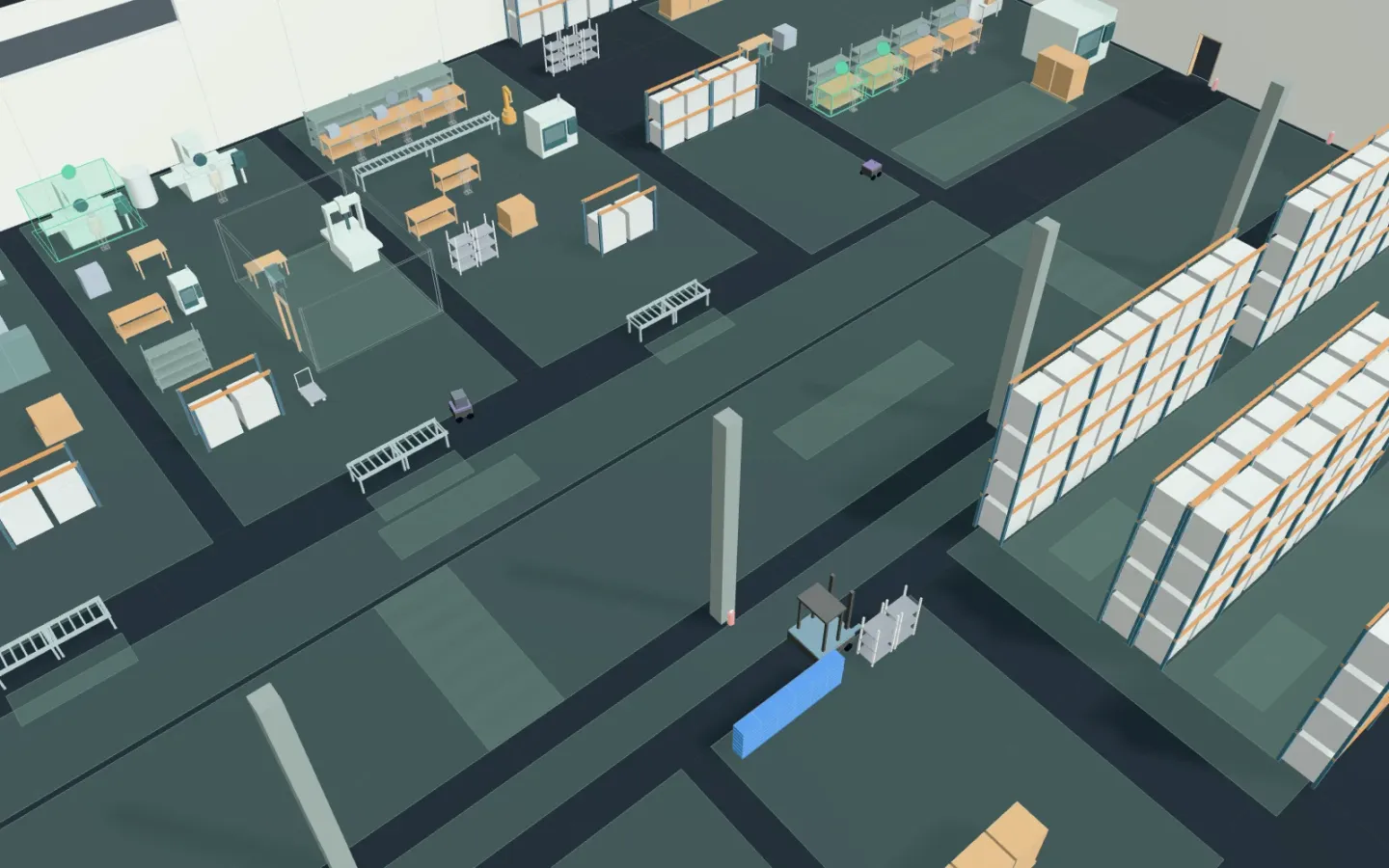
Open the components factory (no account needed to open it; running simulations takes Pro). To cut the time trucks spend at the docks, should the factory add an AMR (autonomous mobile robot) or a forklift? With the same trucks and production, your AI changes the vehicles and compares them in a simulation. This article runs on a synthetic factory with the same tools your AI calls over MCP. Every number below comes from that run.
In Japan, shippers are asked to keep a truck’s waiting and loading time within two hours in all, and once within two hours, to aim for one (guideline of the ministries of economy, agriculture and transport, June 2023). This factory is small and a truck spends tens of minutes, but finding what sets that time works the same way.
1. The factory and the morning’s trucks
The synthetic factory’s morning, 6:00 to 8:00 and an hour to finish.
- Six inbound trucks bring 6 pallets each, and three outbound trucks take 6 each. Each truck stays at its dock until its work is done.
- Forklifts make every pallet move: unloading, putting away after inspection (1 to 4 minutes), refilling the line-side supermarket every 10 minutes, storing finished pallets, and loading trucks (20 s for each pick-up and set-down).
- Two of four AMRs take 48 totes to a free one of five cells (6.4 to 11.2 minutes) and on to packing (six cartons a pallet).
- Not counted: traffic avoidance, charging, stock, breakdowns, breaks. The figures are assumed.
2. AMRs and forklifts
Your AI ran the saved scenario’s parameters, the AMRs and the forklifts, at every combination with sweep_process_parameters, twenty runs each on the same random numbers. A truck’s time is from reaching its dock to leaving, on average.
| AMRs | Forklifts | Inbound trucks (6) | Outbound trucks (3) | Forklifts busy | Last job done |
|---|---|---|---|---|---|
| 2 (today) | 1 (today) | 17.9 min | 23.1 min | 85 % | 8:40 |
| 3 | 1 | 17.9 min | 23.1 min | 85 % | 8:40 |
| 2 | 2 | 6.1 min | 8.6 min | 43 % | 8:14 |
| 3 | 2 | 6.1 min | 8.6 min | 43 % | 8:14 |
- A third AMR leaves the trucks’ time as it was (at every dock the difference run by run takes in 0). Every pallet move falls on the forklift, and jobs wait 14.4 minutes for it on average.
- A second forklift cuts the inbound trucks from 17.9 to 6.1 minutes (66 % less) and the outbound from 23.1 to 8.6 (63 % less), and the wait for a forklift to 1.8 minutes.
3. More pallets a truck
With 7 pallets a truck:
| Forklifts | 6 pallets: inbound | outbound | 7 pallets: inbound | outbound |
|---|---|---|---|---|
| 1 | 17.9 min | 23.1 min | 23.1 min | 29.9 min |
| 2 | 6.1 min | 8.6 min | 6.7 min | 9.5 min |
- With one forklift, a single pallet more makes the inbound trucks 23.1 minutes and the outbound 29.9, and the forklift is busy 96 % of the time. With two, 6.7 and 9.5.
4. How to use these numbers
- Give your AI your truck appointments and pallets a truck, the forklifts’ pick-up, set-down and driving times, the inspection times, the production orders and cell times, and the AMRs’ speed and routes on your floor.
- Shorter dock times save money only if detention charges, overtime or leased vehicles actually fall.
- Not counted: vehicle traffic and avoidance, AMR charging, stock, breakdowns, breaks.