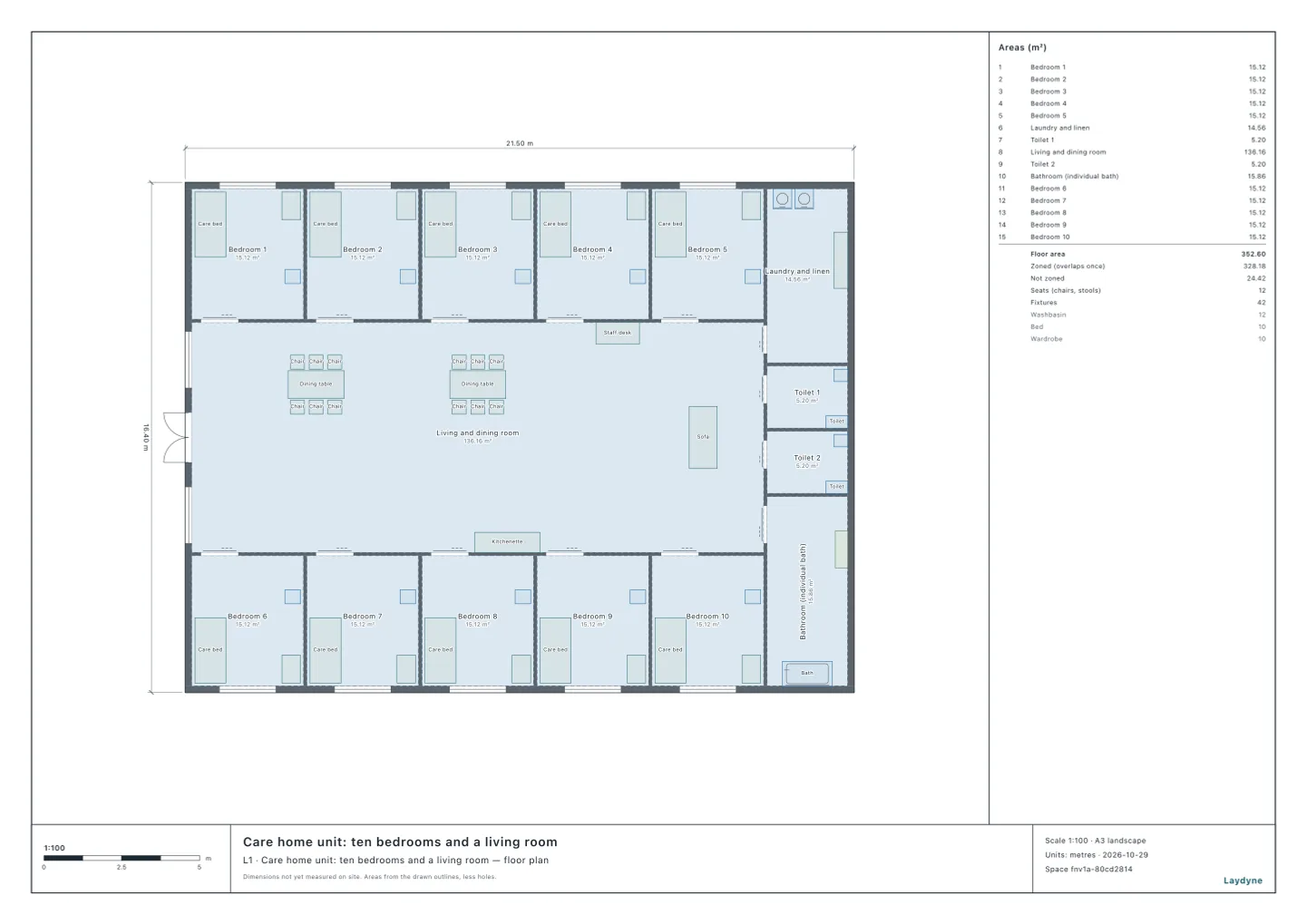
Start from the care home unit model (free sign-up; running a simulation is Pro). In a unit-type special nursing home, the residents eat in the unit’s living and dining room. A resident who needs full help keeps a member of staff with them, and others wait longer to be taken to the table. In this article, in the members’ model of one unit of a special nursing home, your AI simulates lunchtime. It ran the same tools an AI calls over MCP. Every figure and number below comes from that run.
1. The unit and lunch
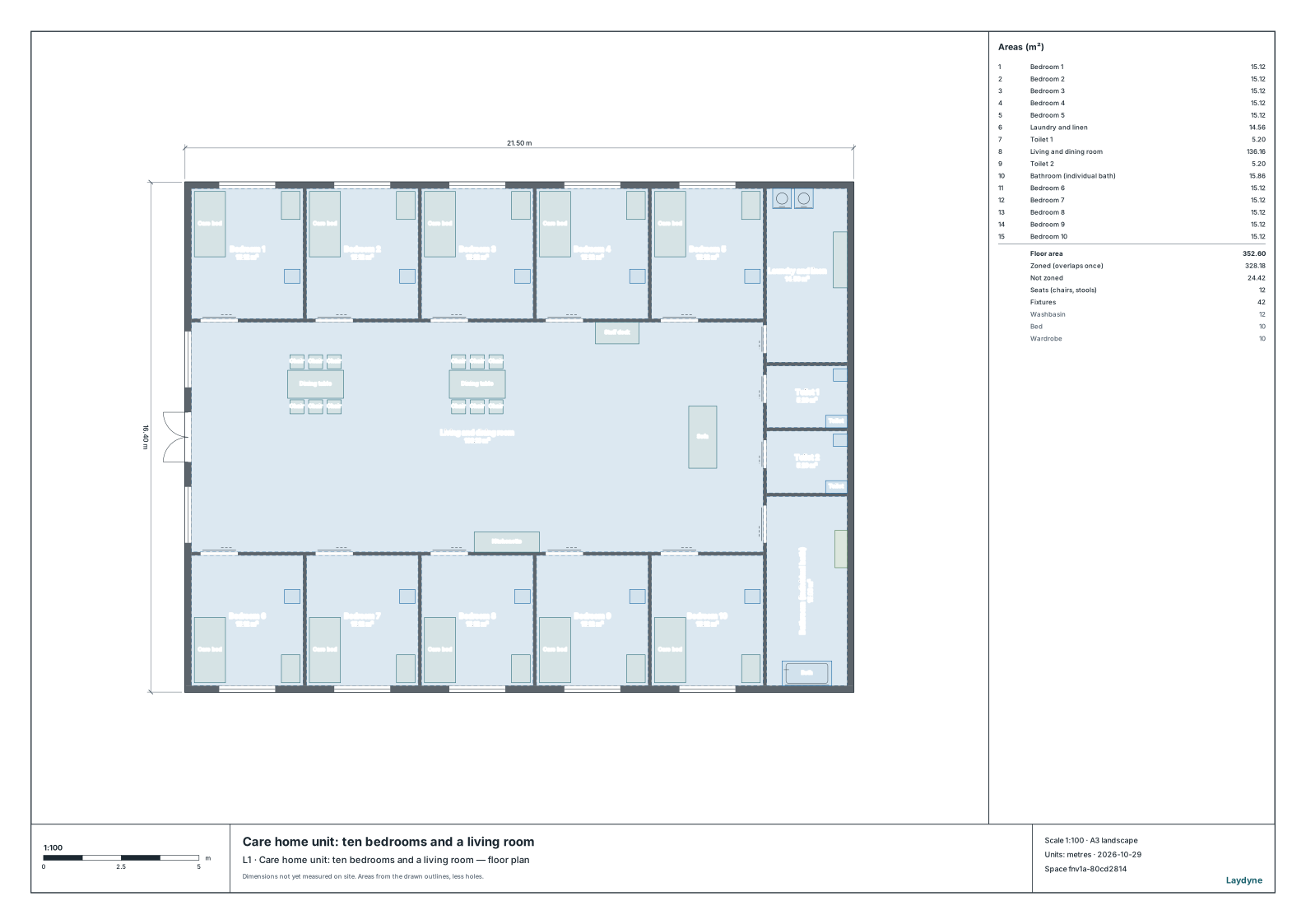
- Between the ten bedrooms is the living and dining room, with 12 chairs at two dining tables. In one change (
edit_space), the AI tagged the 12 dining chairs.check_spacefinds nothing.
The AI wrote this flow as a scenario (put_process_scenario).
- At 12:00, the 10 residents go from their bedrooms to lunch.
- For the 3 who need full help, a member of staff moves them from the bed to a wheelchair (3 to 8 minutes, most often 5), takes them to the table and helps them eat (25 to 40 minutes, most often 30). Meanwhile that member of staff helps nobody else.
- The 3 who need help to the table are taken there and settled by a member of staff (1 to 3 minutes, most often 2), then eat on their own (25 to 40 minutes, most often 30).
- The other 4 walk to the table and eat on their own (20 to 35 minutes, most often 25).
- The 2 staff go to residents in the order asked, those who need help to the table first.
- Every number and time is an assumption. Put in your own unit’s records.
Japan’s standard for special nursing homes asks a unit-type home to have, in the daytime, at least one care worker or nurse in each unit at all times (第40条第2項第1号), and to allow the time needed for residents to eat on their own as far as they can (第38条第3項) (e-Gov, the version in force from 1 April 2025).
2. The staff and the residents who need full help
The AI changed the staff at lunch (1, 2, 3) and the residents who need full help (2, 3, 4) (sweep_process_parameters), 20 runs each. Three need help to the table. “To finish” is the mean time from 12:00 to the end of their lunch. The longest wait is the mean over the 20 runs of each run’s longest wait for a member of staff.
| Full help | Staff | Full help: to finish | Help to the table: to finish | Longest wait for staff | The last finishes |
|---|---|---|---|---|---|
| 2 | 1 | 61.6 min | 36.7 min | 43.1 min | 13:20 |
| 2 | 2 | 40.0 min | 35.1 min | 4.0 min | 12:42 |
| 2 | 3 | 38.8 min | 34.5 min | 2.1 min | 12:41 |
| 3 | 1 | 80.0 min | 36.1 min | 80.0 min | 13:57 |
| 3 | 2 | 51.7 min | 34.6 min | 38.1 min | 13:15 |
| 3 | 3 | 39.1 min | 34.0 min | 2.4 min | 12:42 |
| 4 | 1 | 98.7 min | 35.8 min | 117.2 min | 14:35 |
| 4 | 2 | 58.6 min | 34.3 min | 42.0 min | 13:20 |
| 4 | 3 | 47.7 min | 33.7 min | 36.4 min | 13:14 |
- With 3 who need full help and 2 staff, the last finishes at 13:15. The one who waits longest for a member of staff waits 38.1 minutes.
- With 1 member of staff (the standard’s least), the last finishes at 13:57. With 3 it is 12:42.
- When more need full help than there are staff, someone waits for a member of staff. With 4 who need full help, even 3 staff leave the longest wait at 36.4 minutes.
3. Whom the staff go to first
With 3 who need full help, the AI changed whether the staff go first to those who need help to the table or to those who need full help.
| Go first to | Staff | Full help: to finish | Help to the table: to finish | Wait for staff (mean) | The last finishes |
|---|---|---|---|---|---|
| Help to the table | 1 | 80.0 min | 36.1 min | 22.5 min | 13:57 |
| Help to the table | 2 | 51.7 min | 34.6 min | 7.7 min | 13:15 |
| Full help | 1 | 73.8 min | 147.0 min | 74.9 min | 14:30 |
| Full help | 2 | 48.7 min | 74.6 min | 26.2 min | 13:17 |
- When 2 staff go first to those who need full help, the time to finish of those who need help to the table goes from 34.6 minutes to 74.6. Those who need full help gain only from 51.7 to 48.7.
- Taking someone to the table takes about 2 minutes, so settling them first and then staying with those who need full help leaves fewer waiting.
4. How to use this check
- Draw your own unit (from a PDF of the drawings or photos too), and tell your AI how much help each resident needs, how long the help and the meal take, and the staff at lunch. Your AI also puts the tables and chairs where you want them on the drawing and checks them.
- Not checked: serving and clearing, medicines, oral care, toilet trips, different textures of meals, the staff’s breaks, and when help from another unit arrives.