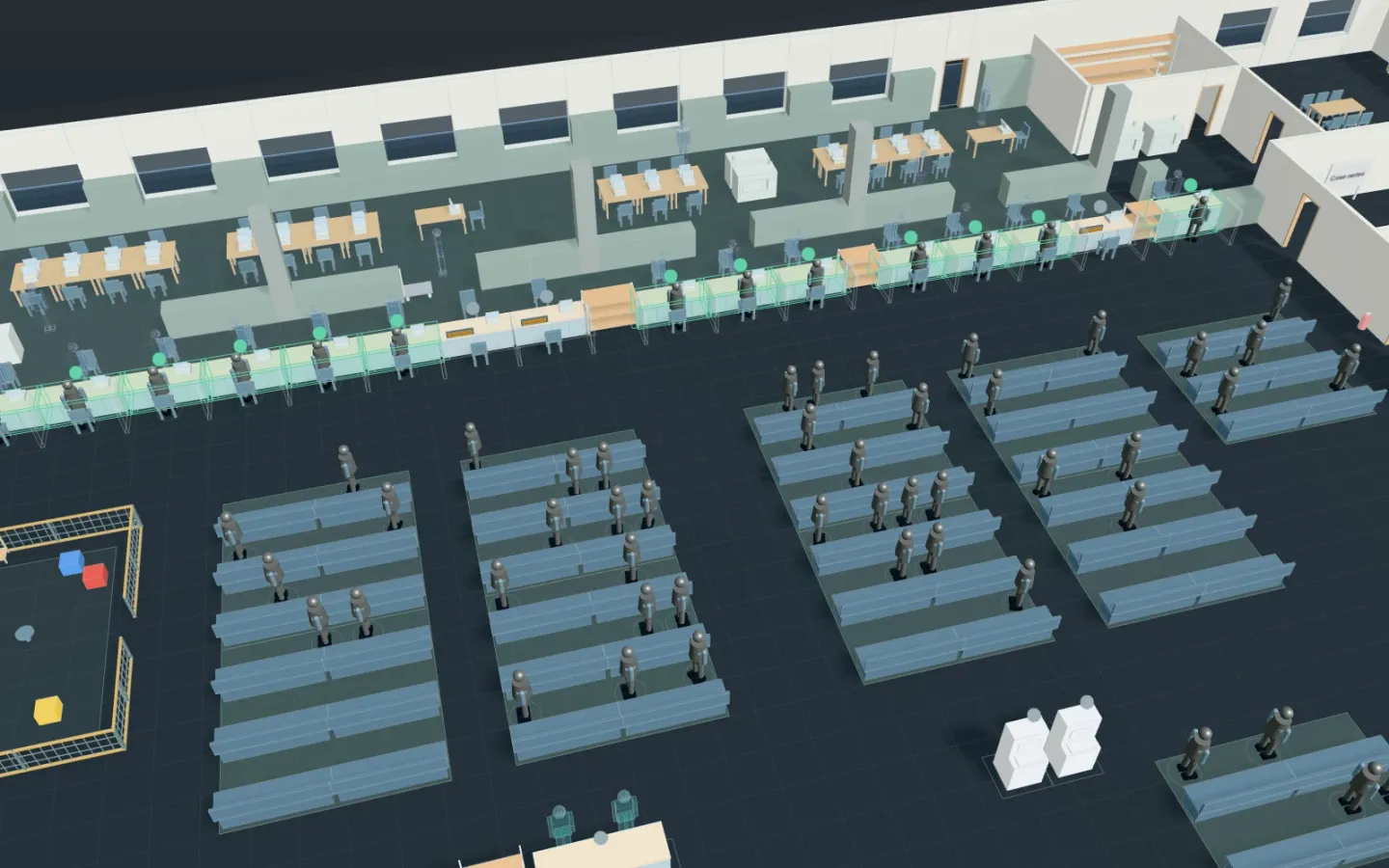
Open the ward office (no account needed to open it; running simulations takes Pro). To cut the moving-season wait, should the office open more counters or shorten each visit? With the same residents, your AI changes the counters and the visit times and compares them in a simulation. This article runs on a synthetic ward office with the same tools your AI calls over MCP. Every number below comes from that run.
1. The counters and the residents
The synthetic ward office’s residents’ service floor, on a Monday morning of the March–April moving season.
- Twenty residents wait at the doors when they open at 8:30; then about 70 an hour come for three hours (15 % more from 9:00 to 10:00). The morning brings 226.6 residents on average.
- About one in three asks the floor guide first. Those moving in, out or within the ward fill in the form at a writing table, certificate seekers a request form; everyone takes a numbered ticket and sits down until called.
- Each purpose has one line of numbers, first come, first served: moving in/out (counters 1 to 8), certificates (9 to 11), National Health Insurance (12 to 15). After a moving registration, 35 % are sent on to health insurance and 20 % for a certificate. Certificates are printed in the back office and collected at the cashier (16).
- Today 13 counters are open, with the busy-season counters 7, 8 and 15 closed (moving 6, certificates 3, health insurance 3, cashier 1). A moving registration takes 13 minutes on average.
- The visit times are assumed distributions, not measurements. Not counted: crowd physics, residents who give up and come back another day, online and postal procedures, staff breaks.
2. More moving in/out counters
Your AI ran the saved scenario’s parameters, the counters and the visit times, at each value with sweep_process_parameters, twenty runs each on the same random numbers. A wait is from taking the ticket to being called; the time in the building is from coming in to leaving.
| Moving counters | Moving wait | Health insurance wait | Everyone’s mean wait | Time in the building |
|---|---|---|---|---|
| 6 (today’s 13 counters) | 43.9 min | 9.9 min | 27.4 min | 48.6 min |
| 7 | 26.3 min | 14.5 min | 20.3 min | 41.5 min |
| 8 | 13.7 min | 19.3 min | 15.6 min | 36.8 min |
- Today the wait at the moving counters is 44 minutes, and its line reaches 36.3 (mean of the 20 runs).
- With 8 moving counters that wait falls to 13.7 minutes, but the health insurance wait rises from 9.9 to 19.3 minutes: residents done sooner at moving reach health insurance sooner.
3. A shorter visit
With the 6 moving counters, your AI shortened the mean moving registration (from 13 to 9 minutes, say, with forms filled in beforehand).
| Moving registration | Moving wait | Health insurance wait | Everyone’s mean wait | Time in the building |
|---|---|---|---|---|
| 13 min (today) | 43.9 min | 9.9 min | 27.4 min | 48.6 min |
| 11 min | 26.1 min | 15.0 min | 20.4 min | 40.5 min |
| 9 min | 9.7 min | 21.6 min | 14.6 min | 33.7 min |
- At 9 minutes the moving wait is 9.7 minutes with no more counters: shorter than with 8 counters (13.7).
- Here too the line moves on to health insurance, to 21.6 minutes, so health insurance needs the next counter. With 9-minute visits and 4 health insurance counters, its wait is 4.0 minutes, everyone’s mean wait 8.1 minutes, and the time in the building 27.3 minutes.
4. 14 counters against 16
Your AI copied the scenario with 4 health insurance counters (the saved one kept), and compared the moving counters and visit times together, on the same twenty runs.
| Plan | Counters | Everyone’s mean wait | Time in the building |
|---|---|---|---|
| The busy-season 16 (moving 8, 13-minute visits) | 16 | 9.9 min | 31.1 min |
| 9-minute visits (moving 6) | 14 | 8.1 min | 27.3 min |
| Both (moving 8, 9-minute visits) | 16 | 4.4 min | 23.5 min |
- With 9-minute visits, 14 counters gave a mean wait 1.8 minutes shorter than 16 (the difference run by run, 95 % interval 1.4 to 2.1 minutes shorter).
- Both together give 4.4 minutes, and 23.5 minutes in the building: less than half of today’s 48.6.
5. How to use these numbers
- The residents come from last year’s ticket-machine log, by purpose and quarter hour. Give your AI the measured time of each procedure and the shares sent on to other counters; and how short a change really makes the visit is best measured after a trial.
- The waits are planning numbers for comparing, not a promise. Weigh each plan against the staff hours and temporary staff it needs.
- Not counted: crowd physics, residents who give up and come back another day, online and postal procedures, staff breaks.