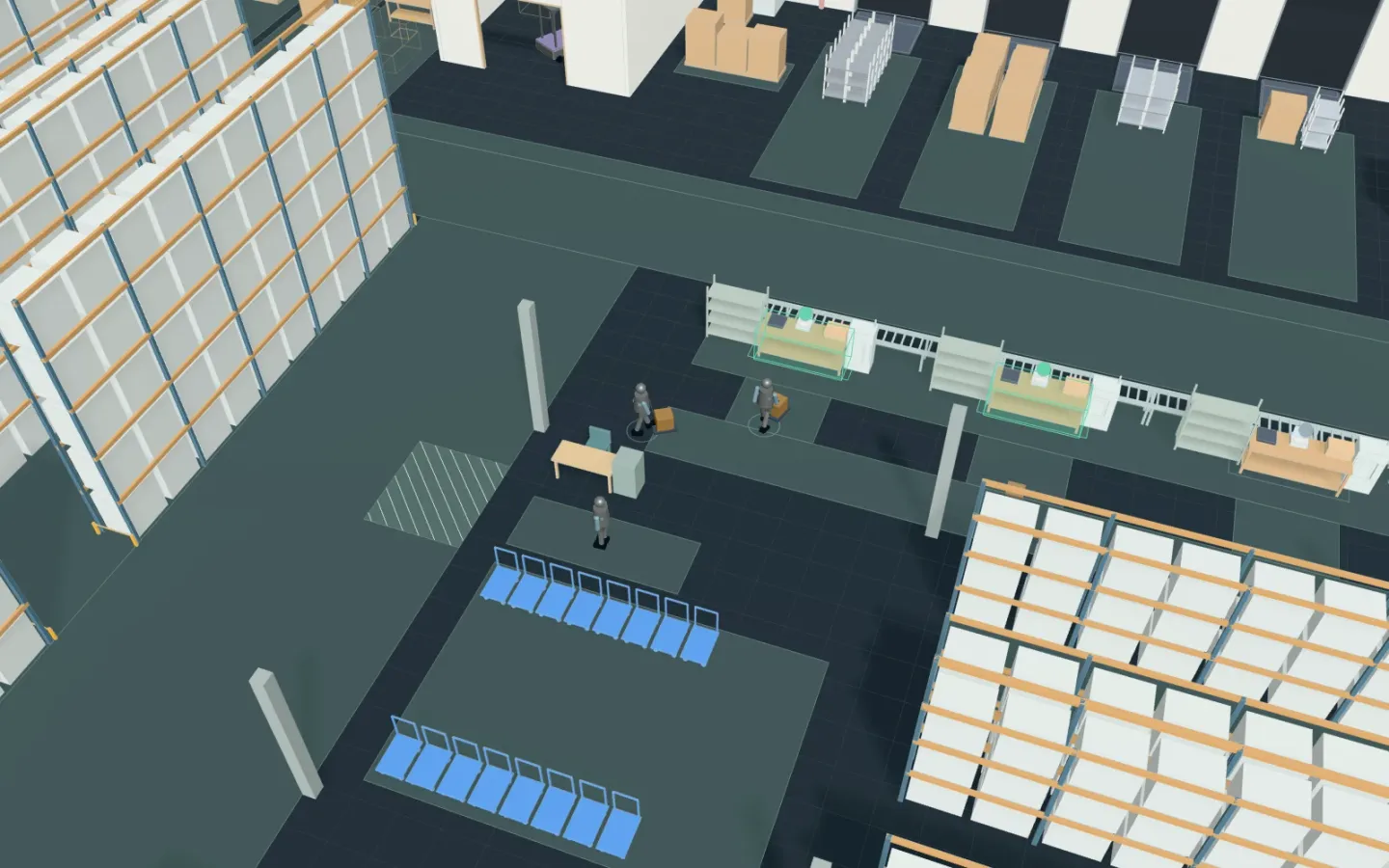
Open the warehouse (no account needed to open it; running simulations takes Pro). How many people does picking and packing need to get a new client’s orders out by the carrier’s cut-off? With the same orders, your AI changes the pickers and pack stations and compares them in a simulation. This article runs on a synthetic warehouse with the same tools your AI calls over MCP. Every number below comes from that run.
1. The warehouse and the afternoon wave
The synthetic warehouse is a 3PL’s, and the work is a new client’s afternoon wave (13:00 to 17:30).
- Orders arrive from 13:00 to 15:00 at random, 45 an hour (Poisson arrivals, 91.5 in the two hours on average).
- A free picker prints the pick list, takes a cart and picks 1 to 3 cases from the ground-level pallets. Three orders in four then ride the shared goods lift (two carts a car, 0.5 m/s) to pick 2 to 5 items from the mezzanine shelving, and ride back down.
- The picker leaves the cart at a free pack station (carts on their way count; else the shortest queue). The packer packs, weighs and labels it (about 200 s), and the carton runs on the conveyor to the dispatch sort.
- Orders packed and on the conveyor by the 15:45 cut-off go out with the carrier today; later ones go the next day. A reach truck replenishes the pick faces.
- Today there are 4 pickers and 2 pack stations. Not counted: batching several orders on a cart, aisle congestion, picking errors, breaks, labour cost, the carrier’s capacity.
2. Pickers and pack stations
Your AI ran the saved scenario’s parameters, the pickers and the pack stations, at each value with sweep_process_parameters, twenty runs each on the same random numbers. Orders that miss the cut-off (of 91.5, mean of the 20 runs):
| Pickers | 2 pack stations | 3 pack stations |
|---|---|---|
| 4 (today) | 25.2 | 25.2 |
| 5 | 16.7 | 10.0 |
| 6 | 15.9 | 1.1 |
| 7 | 15.9 | 0.0 |
- With today’s 4 pickers and 2 pack stations, 25.2 orders miss the cut-off. Orders wait 42.7 minutes for a picker on average.
- A third pack station changes nothing with 4 pickers (25.2): the pickers are what is short.
- With 6 pickers and 3 pack stations, 1.1 miss (95 % interval 0 to 2.2); with 7 and 3, none missed in any of the 20 runs.
3. Add only one, and the queue moves
With the 2 pack stations, as the pickers grow:
| Pickers | Wait for a picker | Wait at packing | Pack station queue (longest) |
|---|---|---|---|
| 4 | 42.7 min | 1.5 min | 2.0 carts |
| 5 | 23.4 min | 9.4 min | 5.3 carts |
| 6 | 11.8 min | 20.0 min | 10.9 carts |
| 7 | 5.0 min | 26.6 min | 14.3 carts |
- More pickers cut the wait for a picker, but carts queue in front of the pack stations (14.3 at the longest with 7). So from 6 pickers the missed orders stay at 15.9.
- Making the cut-off takes both picking and packing.
4. When the client’s orders grow
Your AI copied the scenario with 6 pickers and 3 pack stations (the saved one kept), and raised the orders an hour.
| Orders an hour | Orders (two hours) | Missing the cut-off |
|---|---|---|
| 45 (today) | 91.5 | 1.1 |
| 55 | 110.6 | 13.1 |
| 65 | 131.4 | 32.8 |
- With the same team, 13.1 orders miss once the client sends 55 an hour. When quoting, try how the client’s orders may grow too.
5. How to use these numbers
- The client’s orders by hour, the case and item lines per order and the share of small items on the mezzanine come from the client’s data. Give your AI the picking and packing times and the walking speed with a cart measured in your own warehouse, the goods lift’s cycle and each carrier’s cut-off.
- This is a labour plan, not a revenue forecast. Add your own allowances for breaks and absence, and your way of batching orders.
- Not counted: batching several orders on a cart, aisle congestion, picking errors, breaks, labour cost, the carrier’s capacity.