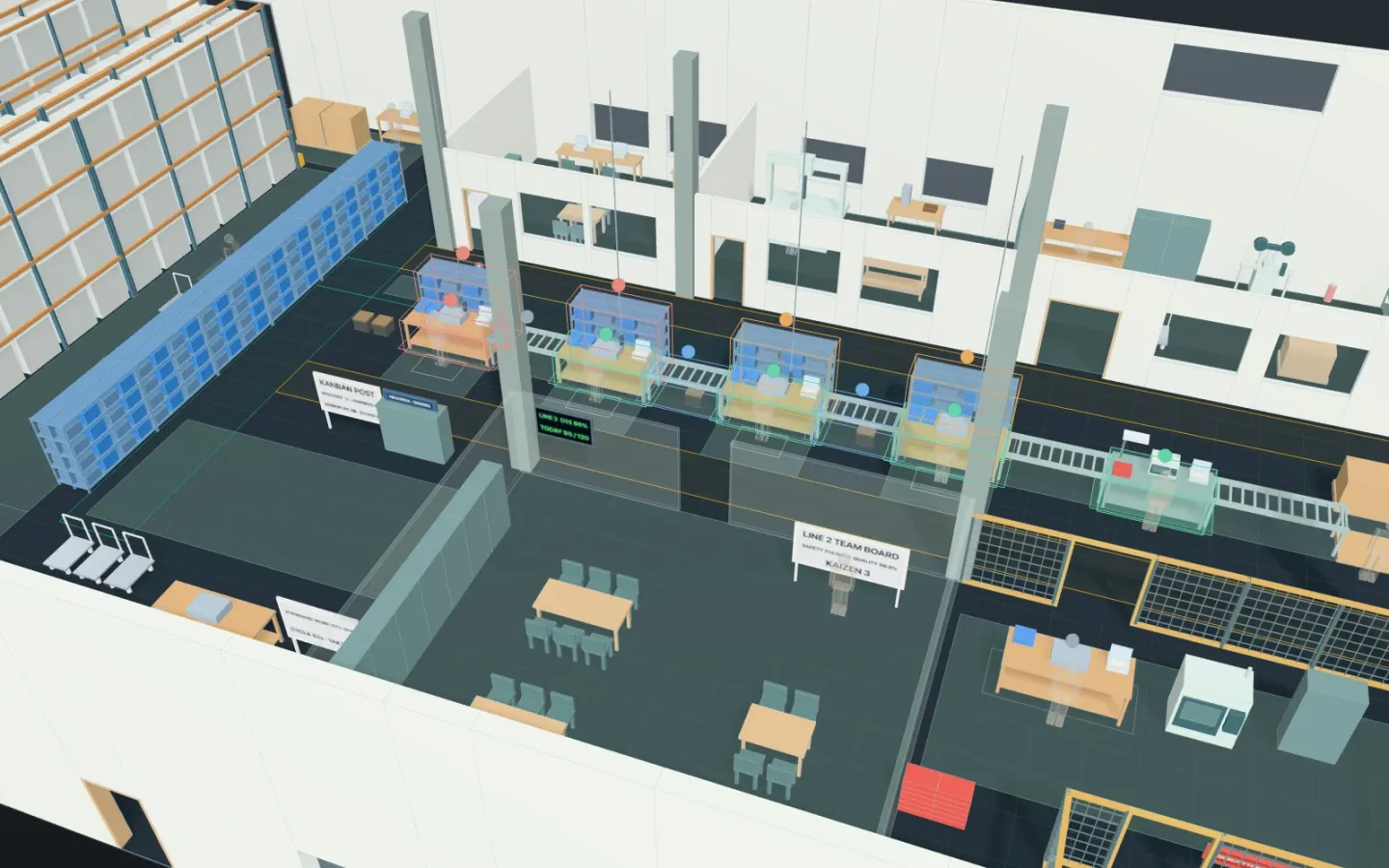
Open the assembly line kanban (no account needed to open it; running simulations takes Pro). When a line’s takt shortens, can one water spider (the person who brings parts to the stations) keep every station from running out? Or does the line need a second, more kanban cards or a faster supermarket pick? With the same 120 units, your AI changes them and compares them in a simulation. This article runs on a synthetic line with the same tools your AI calls over MCP. Every number below comes from that run.
1. The line and the water spider
The synthetic Line 2 runs at its new 60 s takt.
- 120 units pass four stations (42 to 66 s each), joined by roller conveyors holding 2 units each, and then inspection (40 s). 10 % are reworked (2 to 5 minutes) and inspected again.
- Each station takes its parts from the kanban flow rack behind it, two bins a part (brackets 12, harnesses 6, M5 screws 48, covers 6; a unit takes 2, 1, 8 and 1).
- An emptied bin sends its card to the kanban post and the water spider on a trip: collect the card (5 s), pick a full bin in the supermarket (45 s), set it into the rack (20 s), and walk back at 1 m/s.
- A station whose rack is empty stands starved, holding its unit, until the bin arrives. Every 4 good units make a pallet the forklift takes to shipping.
- Not counted: collecting several cards on one trip, breakdowns, breaks, congestion in the aisles, costs. The figures are assumed.
2. Water spiders and kanban cards
Your AI ran the saved scenario’s parameters, the water spiders and the kanban cards a part, at every combination with sweep_process_parameters, twenty runs each on the same random numbers.
| Water spiders | Cards a part | Times stations ran out | Time starved (in all) | Last pallet ships (from the start) | Spider busy |
|---|---|---|---|---|---|
| 1 (today) | 2 (today) | 56.6 | 60.8 min | 151.8 min | 82 % |
| 1 | 3 | 35.8 | 36.6 min | 151.8 min | 82 % |
| 2 | 2 | 0.0 | 0.0 min | 125.8 min | 41 % |
| 2 | 3 | 0.0 | 0.0 min | 125.8 min | 41 % |
- With one spider today, the stations stand starved for 60.8 minutes in all.
- A third card cuts that to 36.6 minutes, but the last pallet still ships at 151.8 (0.0 minutes apart, run by run): what is short is not stock at the line but the spider’s time.
- With two spiders the stations never run out, and the last pallet ships 26.0 minutes sooner (95 % interval 25.3 to 26.8 minutes sooner).
3. A faster supermarket pick
With one spider and two cards, your AI shortened the time to pick a bin in the supermarket.
| Pick a bin | Times stations ran out | Time starved (in all) | Last pallet ships | Spider busy |
|---|---|---|---|---|
| 45 s (today) | 56.6 | 60.8 min | 151.8 min | 82 % |
| 35 s | 42.0 | 32.1 min | 138.5 min | 74 % |
| 25 s | 0.0 | 0.0 min | 126.0 min | 67 % |
- At 25 s, one spider keeps every station supplied and the last pallet ships 25.8 minutes sooner: about the same as with a second spider (125.8 minutes).
4. A longer takt
With one spider, your AI lengthened the takt from 60 s.
| Takt | Times stations ran out | Time starved (in all) | Last pallet ships |
|---|---|---|---|
| 60 s | 56.6 | 60.8 min | 151.8 min |
| 65 s | 46.1 | 47.6 min | 152.2 min |
| 70 s | 10.1 | 6.1 min | 152.6 min |
- At a 70 s takt the stations hardly run out, but the last pallet ships at 152.6 minutes, no sooner than at 60 s (151.8): the 60 s line was already running at one spider’s pace.
5. How to use these numbers
- Give your AI the takt and shift plan, the parts per unit and bin quantities, a time study of the water spider (collecting cards, picking and setting bins), the route on your floor, the station times, the rework rate and the pallet quantities.
- Shorter trips save money only if overtime or staffing actually fall; more cards also take line-side space and stock.
- Not counted: collecting several cards on one trip, breakdowns, breaks, congestion in the aisles, costs.