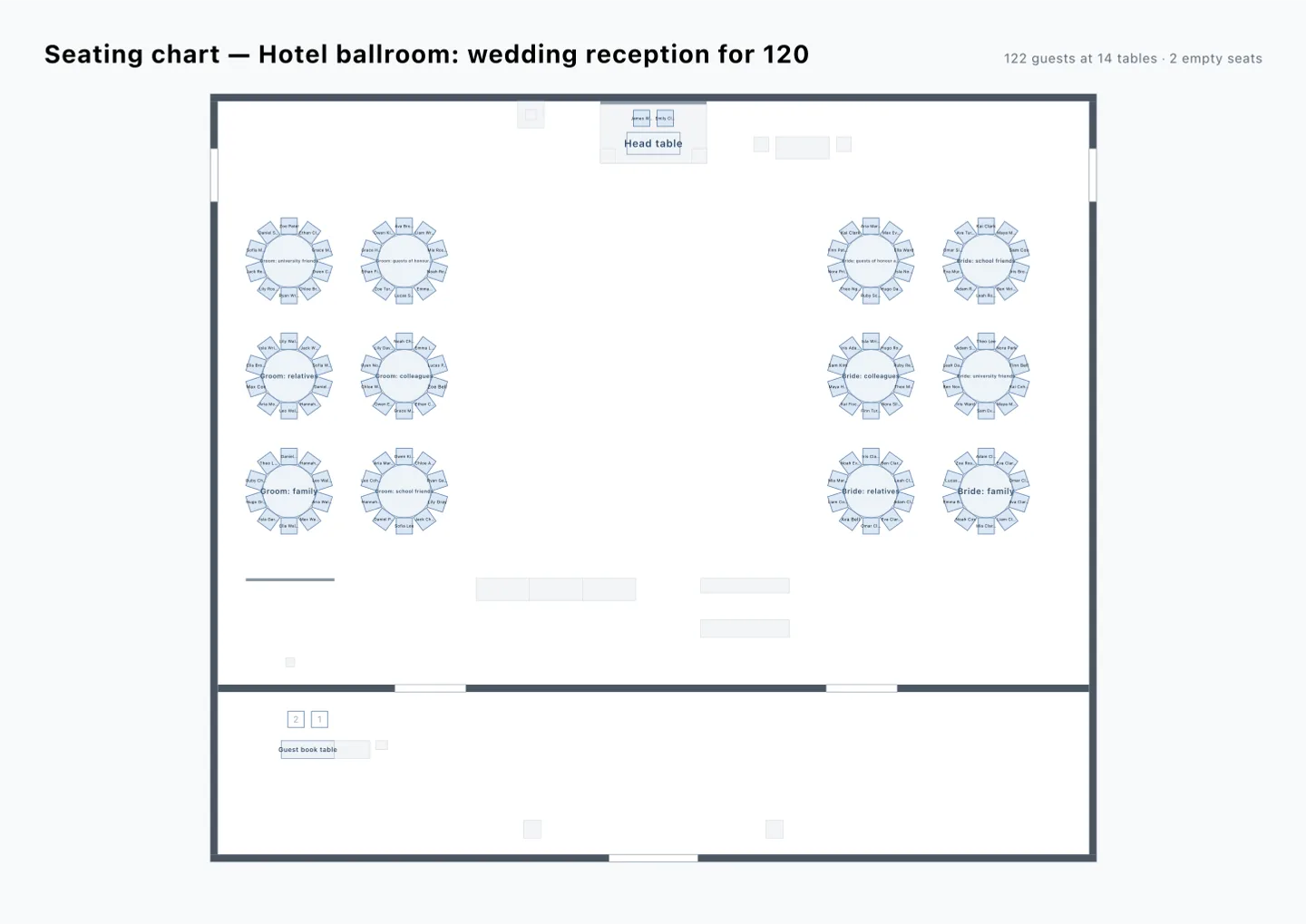
Start from the hotel ballroom (free account) or from your own venue. A seating chart is one piece of work from the guest list to the print: putting the guests into groups, choosing a table for each, and setting out the names. This article has your AI make the seating chart for a reception of 120. It runs on a synthetic venue with the same tools your AI calls over MCP. Every number and picture below comes from that run.
How the seats are often decided
- The tables nearest the head table are the places of honour. Guests of honour and bosses sit there, then colleagues, friends and relatives. The families sit farthest from the head table.
- The groom’s guests sit on his side (on the left as the guests see it), the bride’s on hers (the right). At the head table, too, the groom sits on the guests’ left and the bride on their right.
- At each table, the seat nearest the head table is the place of honour.
These rules differ by place, venue and family, so they are a starting point to change afterwards.
1. The order of the tables
The venue is a hotel ballroom of 30 × 26 m with the head table at the north and twelve round tables of ten to its south, six on each side. Your AI reads where the tables stand with get_space and puts each side’s six in order of their distance from the head table.
| Order | Groom’s side (left) | From the head table | Bride’s side (right) | From the head table |
|---|---|---|---|---|
| 1 | Table 2 | 9.33 m | Table 3 | 8.37 m |
| 2 | Table 6 | 11.54 m | Table 7 | 10.78 m |
| 3 | Table 1 | 12.96 m | Table 4 | 11.94 m |
| 4 | Table 10 | 14.49 m | Table 8 | 13.74 m |
| 5 | Table 5 | 14.64 m | Table 11 | 13.89 m |
| 6 | Table 9 | 17.05 m | Table 12 | 16.3 m |
2. Seating 120 guests at once
The guests are 60 on each side, in six groups of ten. Your AI calls assign_guests once: each group goes to the next nearest table, which takes the group’s name, and the couple sit at the head table. One Undo takes it back.
| Order | Groom’s side | Bride’s side |
|---|---|---|
| 1 | Guests of honour and bosses (Table 2) | Guests of honour and bosses (Table 3) |
| 2 | Colleagues (Table 6) | Colleagues (Table 7) |
| 3 | University friends (Table 1) | University friends (Table 4) |
| 4 | School friends (Table 10) | School friends (Table 8) |
| 5 | Relatives (Table 5) | Relatives (Table 11) |
| 6 | Family (Table 9) | Family (Table 12) |
Within a group, the first on the list takes the seat nearest the head table and the rest go round the table clockwise from it. Of the 124 seats, 122 are taken (the 120 guests and the couple); only the two at the guest book table are empty. check_space checked the aisles and the space in front of the doors: no findings.
3. The seating chart
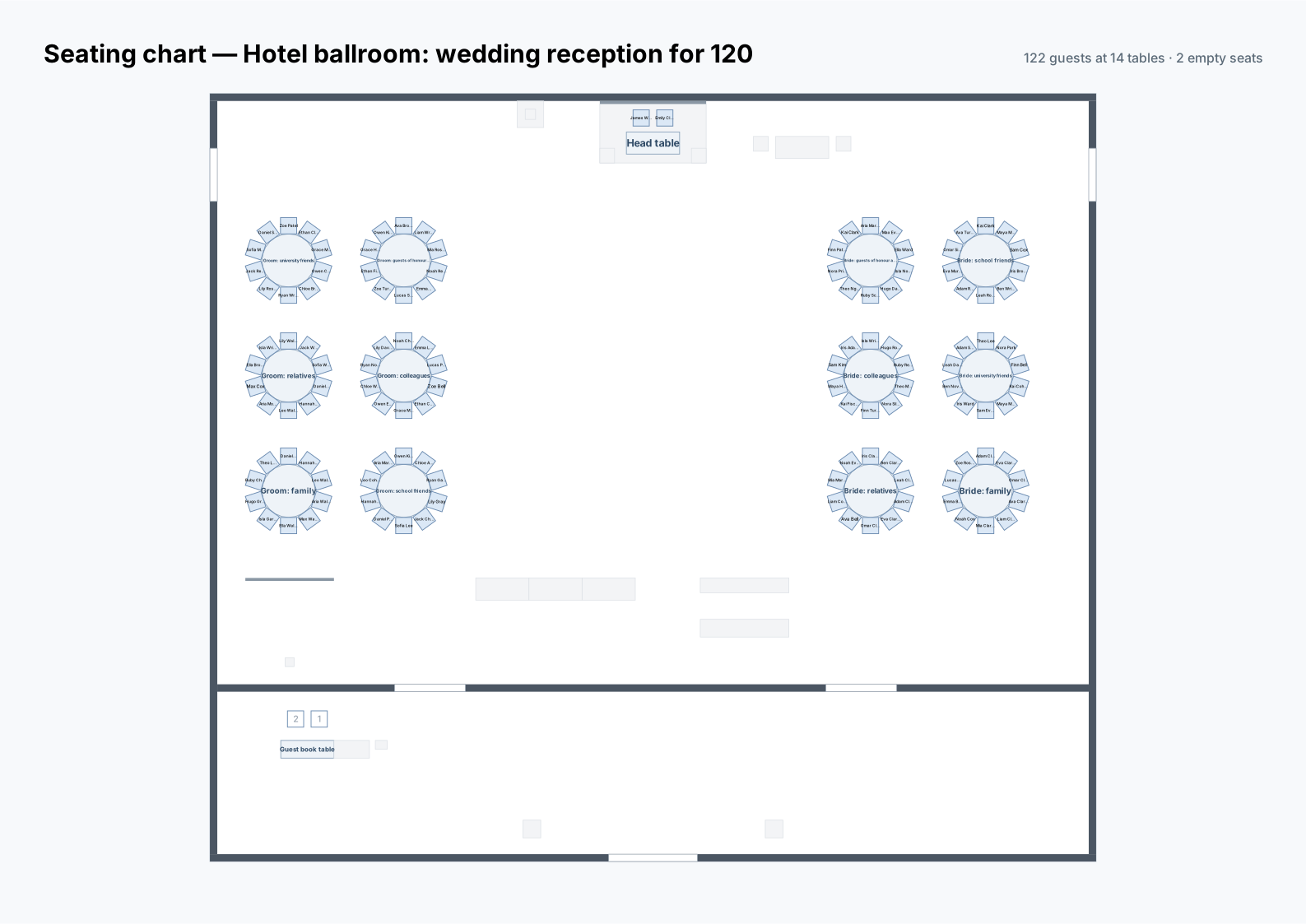
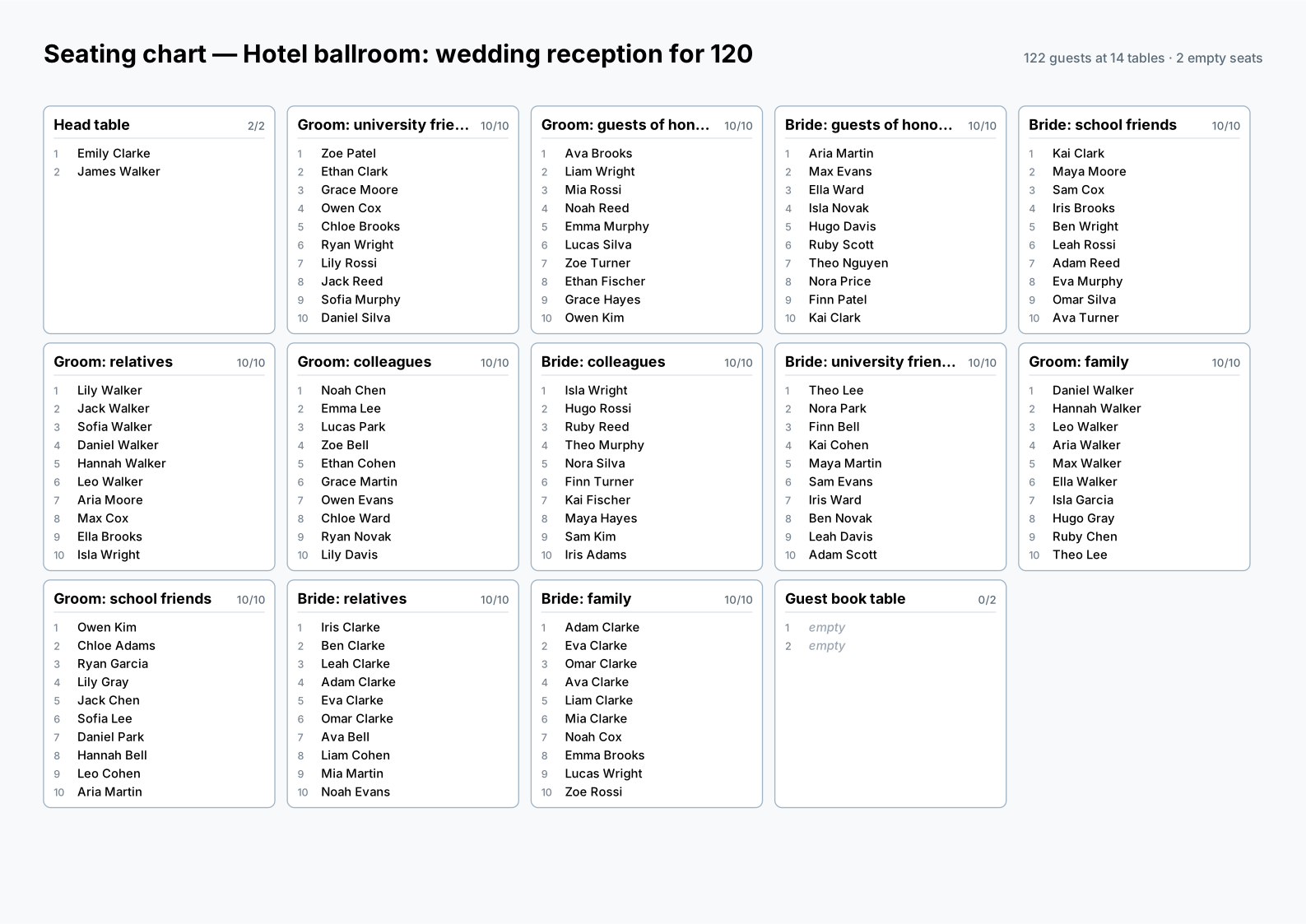
get_seating_chart gives three forms of the same seating:
- The chart on the plan (above): each table’s group and each seat’s guest on the venue’s plan, for the reception desk or the board at the door. Names are shortened to fit the seats.
- Table cards: one card for each table with its group and the names in seat order, the base for the place cards.
- The guest list by name (CSV): each guest’s table and seat, for showing guests to their tables or printing escort cards.
4. A late swap
One of the bride’s school friends gives the maid of honour’s speech, so they swap tables with her university friends, nearer the head table (Table 4). Your AI calls assign_guests once to swap the two tables’ names. The chart, the cards and the list are all made again from that seating: the picture above, the cards and the list are after the swap.
5. How to use this chart
- The rules above are customs, not laws. Ask your AI for what your families want (“this guest near the head table”, “these two apart”) and have it seat them again.
- Every venue’s tables differ. Draw your own venue’s plan and the same steps give its seating chart.
- Names and titles go in as the guest list has them. Check how each guest writes their name before printing.