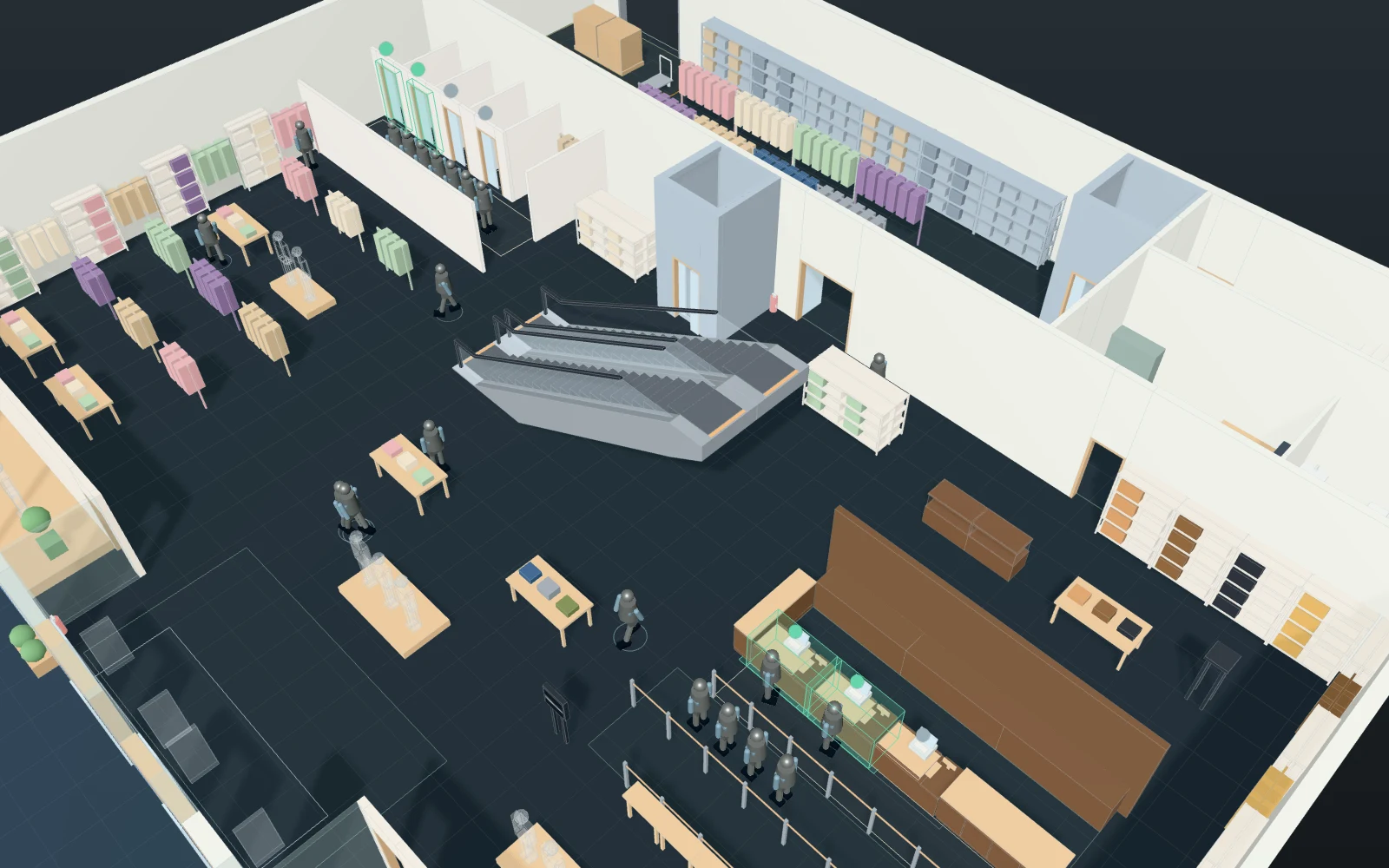
Open the apparel store model (no account needed; running the simulation needs Pro). Should the table of socks and small items, the things shoppers add on, stand beside the till queue or at the entrance? In this article, on a simulated two-storey apparel store, the AI puts the ground floor’s four “Socks & small gifts” tables in four places, runs the same Saturday scenario and compares how long and by how many shoppers the tables were in view. It used the same tools an AI calls over MCP; every figure and picture below is their result.
1. What was compared
The socks and small gifts tables are four tables, 0.9 m wide, 0.4 m deep and 0.9 m high, in a row (3.6 m long), now just south of the till queue’s barrier. The AI compared them like this:
- Move them: one change with
edit_spacemoves the row of four, as it is (the same arrangement), to each of three other places. At every placecheck_spacefound no issues (no aisle too narrow, no door blocked). - Run: the saved Saturday scenario (shoppers come in for the first hour at a rate of 170 an hour, three hours until all have left) is run as it is in the store with the tables moved (
run_process_scenario). - Count:
get_visibility’sattentioncounts the four tables, named. As in the fixtures article: every side at 0.7 m, shoppers only, every 3 seconds (the three hours in 3,600 samples). Each shopper is assumed to look where it walks (60° either side, 60° up or down, within 6 m). The result’stotalgives the shopper-seconds with any side of the four tables in view (once however many sides are in view at the time), and how many shoppers had any of the sides in view (each shopper once).
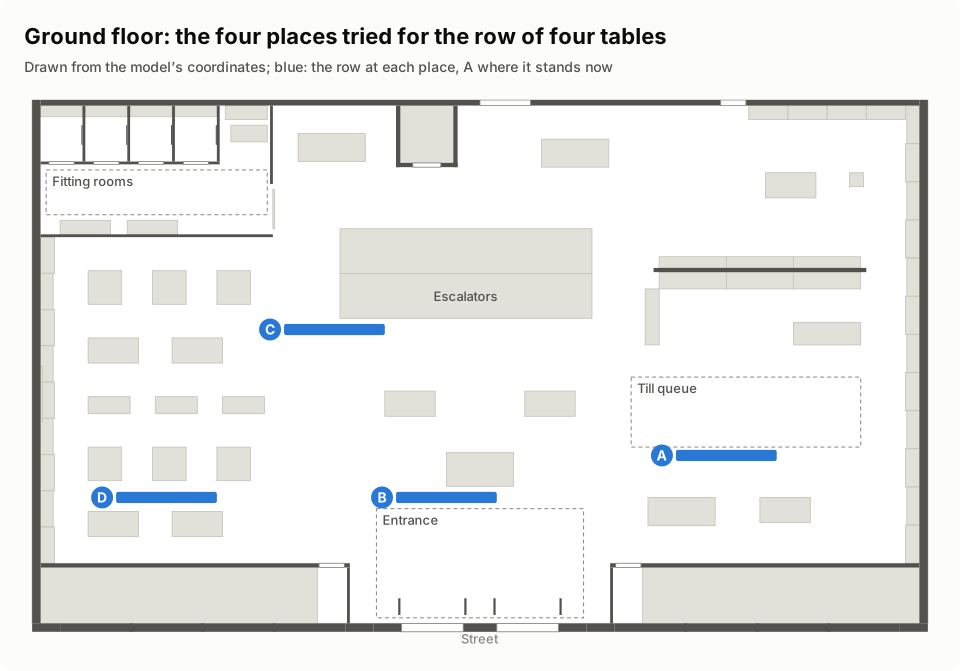
The four places compared:
- A. Now: beside the till queue. Just south of the till queue’s barrier.
- B. Just inside the entrance. 4.3 m in from the automatic doors, at the north end of the entrance area.
- C. At the foot of the up escalator. South of where shoppers step on, 0.2 m from the escalator.
- D. Among the women’s tables (west). Between the coat racks and the tops and knitwear tables.
2. The result
| Place | Shopper-seconds | Shoppers who had them in view (of 168) | Each |
|---|---|---|---|
| A. Now: beside the till queue | 6,615 | 117 (69.6%) | 57 s |
| B. Just inside the entrance | 3,780 | 168 (100%) | 23 s |
| C. At the foot of the up escalator | 3,306 | 162 (96.4%) | 20 s |
| D. Among the women’s tables (west) | 1,917 | 59 (35.1%) | 32 s |
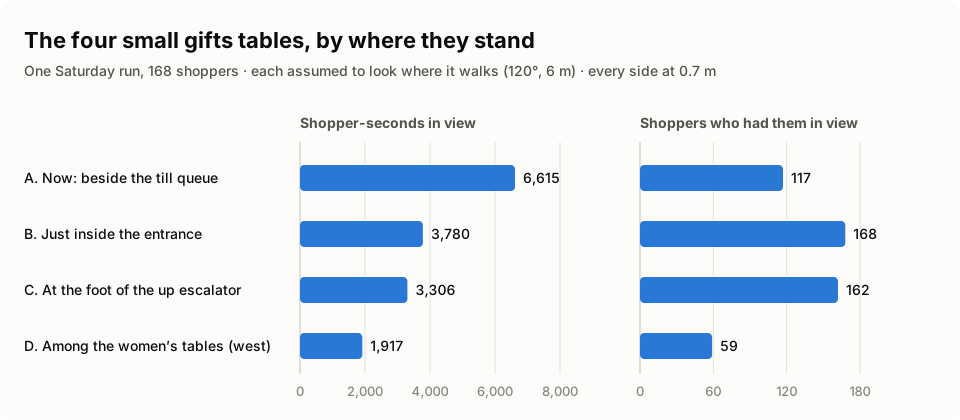
- A (now) is in view the longest. 57 seconds for each shopper, more than twice B and C: the tables are in front of the shoppers waiting in the till queue. But 117 shoppers had them in view, 7 in 10 of the 168. That day, 90 shoppers paid at the tills.
- B (the entrance) is in view of every shopper. All 168, but 23 seconds each: shoppers coming in through the entrance walk towards the tables.
- C (the escalator) is in view of almost all too (162), 20 seconds each.
- D (the back of the west sales floor) reaches few shoppers. About one shopper in three (59). Those who come that far have the tables in view for 32 seconds each, longer than at B or C.
3. The shoppers move almost the same
The tables are not where shoppers go, so moving them only changes how shoppers walk round them. At each of the four places, all 168 shoppers left, 90 paid at the tills, and shoppers spent 17.0 to 17.1 minutes in the store on average. The two new-in tables nearby were in view for 15,420 to 15,642 shopper-seconds, against 15,477 now: within 1.1%.
4. When the assumption changes
The same four runs, counted again with another assumed view:
| Place | 60°: shopper-seconds | 60°: shoppers | 3 m: shopper-seconds | 3 m: shoppers |
|---|---|---|---|---|
| A. Now: beside the till queue | 2,757 | 107 | 5,229 | 89 |
| B. Just inside the entrance | 2,181 | 167 | 1,113 | 156 |
| C. At the foot of the up escalator | 2,295 | 155 | 2,034 | 154 |
| D. Among the women’s tables (west) | 1,455 | 36 | 1,719 | 35 |
- Under every assumption, A is in view the longest and B by the most shoppers. The order by shoppers (B, C, A, D) does not change either.
- Below the first, the order by time changes with the assumption. With 60°, C overtakes B (2,295 against 2,181). With 3 m, B’s time falls to under a third (from 3,780 to 1,113) and becomes the shortest of the four: at the entrance, shoppers see the tables from afar as they walk in. At A, many shoppers wait close by, so 8 in 10 (5,229) remains even at 3 m.
- Counted with shoppers hiding the tables from each other (
crowd: the other shoppers stand in the way as upright prisms of their size), no place loses more than 1.3% of its time, and the orders by time and by shoppers stay the same: some side of the four tables is still in view. Added up side by side, the time falls by up to 3.3%.
The time changes much with how far shoppers are assumed to see. The order by shoppers held whatever the assumption.
5. How to use it, and what it does not tell
- Choose by what the table is for. A table for shoppers who are paying to add one more thing while they wait: A, beside the till queue. A table every shopper who comes in should see (seasonal small items, a campaign table): B, the entrance, or C, the escalator. D suits neither.
- Compare plans. The same way, run the same scenario on plans with tables or racks moved and count under the same assumption, to compare places against each other.
What it does not tell:
- It counts the time and the shoppers with the tables in view, not whether shoppers looked at them, picked something up or bought it.
- Where the tables stand does not change where shoppers go or what they buy: the scenario’s shoppers are not drawn to the tables.
- Shoppers are assumed to look where they walk, without turning their heads. Shoppers hiding the tables from each other are counted only in the last count of section 4 (prisms of their size); the tables and the figures leave them out.
- At each place it is one run (a fixed random seed).
Tools used
edit_space: moves the row of four tables to another place in one changecheck_space: checks the tables in their new place block no aisle or doorrun_process_scenario: runs the saved Saturday scenario as it isget_visibility(attention): adds up the four tables’ sides, for the time and the shoppers they were in view