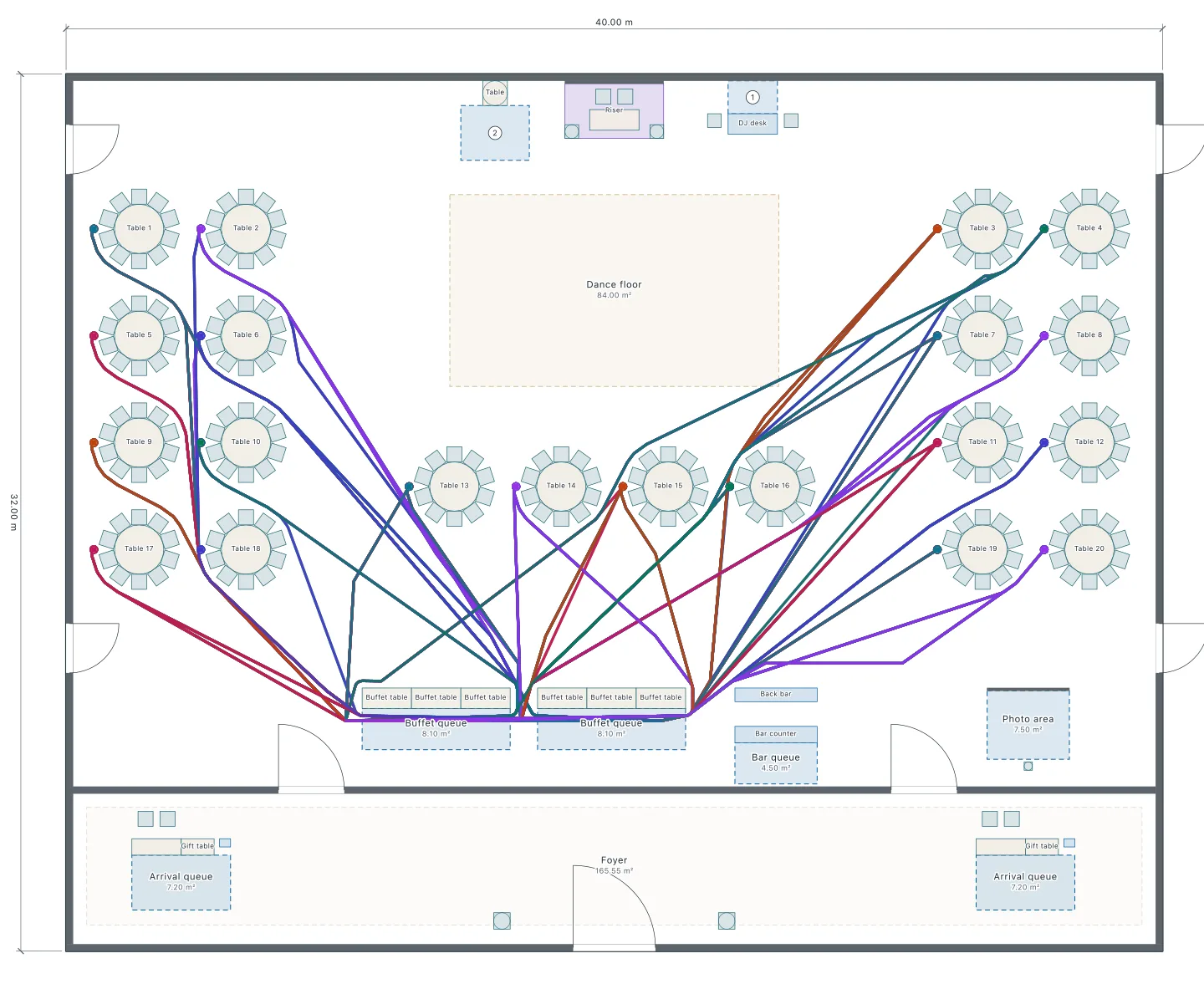
Start from the banquet hall model (free sign-up; running a simulation needs Pro). When the MC invites everyone to the buffet after the toast, a long queue forms in front of the buffet tables. How long it gets comes from how many guests the buffet serves a minute and how fast they come. In this article, your AI writes the buffet after the toast for a mock banquet hall for 200 and compares how the tables are called and how the buffet tables are used. It ran the same tools an AI calls over MCP. Every figure and number below comes from that run.
1. The hall and the buffet
The mock hall is 40 × 26 m, with the foyer to the south. There are 20 round tables of ten (200 guests), two buffet lines along the south wall (three buffet tables, 5.4 m long) and the bar counter east of them. Your AI reads the tables (Table 1 to 20) and the buffet tables and their queues with get_space, and writes this scenario (put_process_scenario):
- After the toast, the MC calls the tables in order from Table 1, a set number of seconds apart (0: everyone at once). A table’s ten guests stand up 6 seconds apart.
- Guests join the line with the fewest waiting (the nearest of equals), at its west end.
- At each buffet table two guests take food side by side (30 s a table on average, 15 to 45), and move on when there is room at the next. After the three tables they go back to their seats.
- The buffet tables are served from one side (the south, where the queue is: two lines) or from both (four lines).
- Twenty runs, with different random numbers.
Second helpings, drinks (the bar counter) and refilling the dishes are left out. The seconds between tables called, one side or both, and the time at each buffet table are the scenario’s parameters. With sweep_process_parameters, your AI runs the same twenty random runs at each combination.
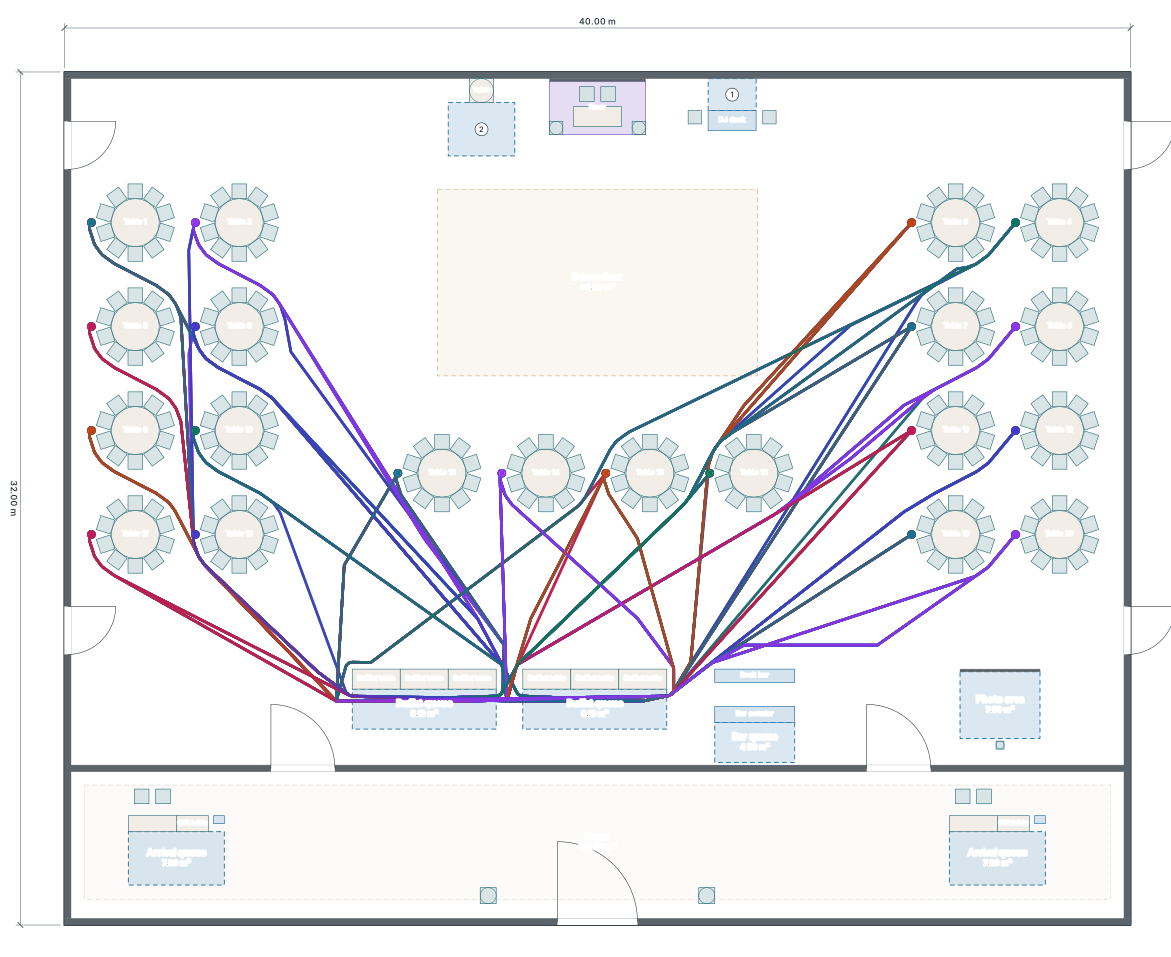
2. Everyone at once after the toast
When everyone stands up at once and the buffet tables are served from one side, a guest takes 17.1 min on average from standing up to sitting down again with a plate (taking the food itself is a minute and a half at three tables). Each line grows to about 95 guests at its longest, and the last guest is back 33.6 min after the toast.
3. Calling the tables in turn, and serving both sides
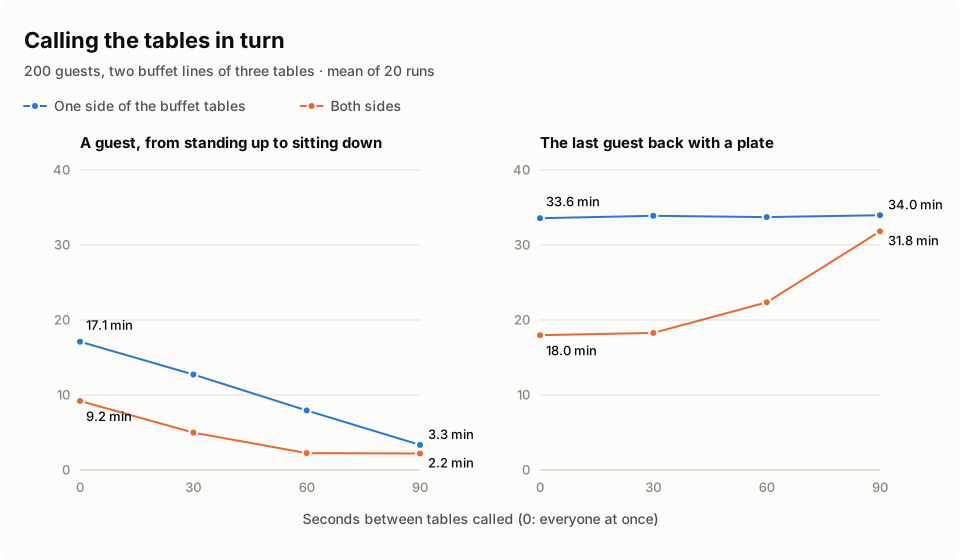
| Tables called | One side: a guest | One side: the last guest | Both sides: a guest | Both sides: the last guest |
|---|---|---|---|---|
| All at once | 17.1 min | 33.6 min | 9.2 min | 18.0 min |
| Every 30 s | 12.7 min | 33.9 min | 5.0 min | 18.3 min |
| Every 60 s | 7.9 min | 33.7 min | 2.3 min | 22.4 min |
| Every 90 s | 3.3 min | 34.0 min | 2.2 min | 31.8 min |
“A guest” is from standing up to sitting down again with a plate; “the last guest” is from the toast to the last guest back in their seat (mean of 20 runs).
- Served from one side, the last guest is back after about 34 minutes however the tables are called: the buffet’s pace sets it. Calling the tables in turn turns the wait in the queue into a wait at the table, and a guest’s time falls from 17.1 min to 7.9 min every 60 s and 3.3 min every 90 s (the lines at their longest about 36 and 7).
- Served from both sides, there are four lines, and even with everyone at once the last guest is back after 18.0 min (a guest 9.2 min, each line about 45 at its longest).
- Served from both sides with a table every 60 s, hardly anyone queues (a guest 2.3 min, the lines 1 at their longest), and the last guest is back after 22.4 min. Every 90 s, the buffet stands idle at times and the end slips to 31.8 min.
- A guide to the calls: the time for everyone at once to be back, divided by the tables. In this hall, from one side 33.6 min ÷ 20 tables is about 101 s, from both 18.0 min ÷ 20 tables about 54 s. Call faster and a queue forms; slower, and the buffet stands idle and the end comes later.
4. Time at each buffet table
| A buffet table (everyone at once) | One side: a guest | One side: the last guest | Both sides: a guest | Both sides: the last guest |
|---|---|---|---|---|
| 20 s | 11.7 min | 23.1 min | 6.3 min | 12.4 min |
| 30 s (today) | 17.1 min | 33.6 min | 9.2 min | 18.0 min |
| 40 s | 22.5 min | 44.1 min | 12.1 min | 23.5 min |
- When the dishes or how easily they are served change the time at each table, the end changes nearly in step. Even from one side, at 20 s a table the last guest is back after 23.1 min.
5. How to use these numbers
- The time at each buffet table depends on the number of dishes and how easily they are served. Time the guests at one buffet table at your last banquet or a rehearsal, and give it to your AI.
- Not calculated: second helpings, drinks, the buffet stopping while dishes are refilled, guests cutting in or leaving the line, guests who need help, standing receptions where nobody goes back to a seat.
- To add buffet tables, check the passages on the plan first, as in How many round tables fit in a banquet hall?.