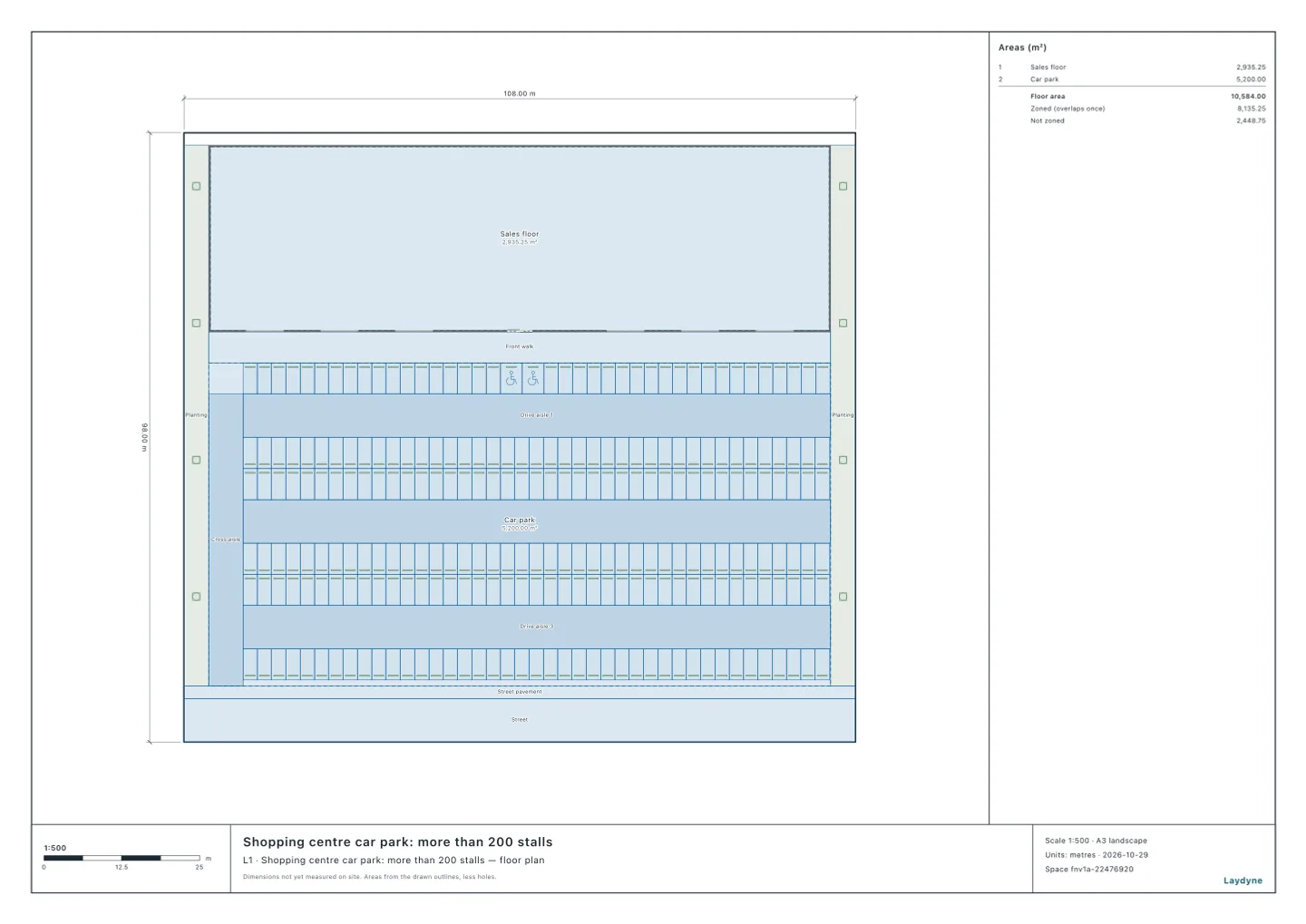
Start from the shopping centre car park model (free sign-up; running a simulation is Pro). Whether a car park fills depends not only on its stalls but on the cars that come and how long each stays. In this article, in the members’ shopping centre car park, your AI simulates a Saturday. It ran the same tools an AI calls over MCP. Every figure and number below comes from that run.
1. The car park and the Saturday
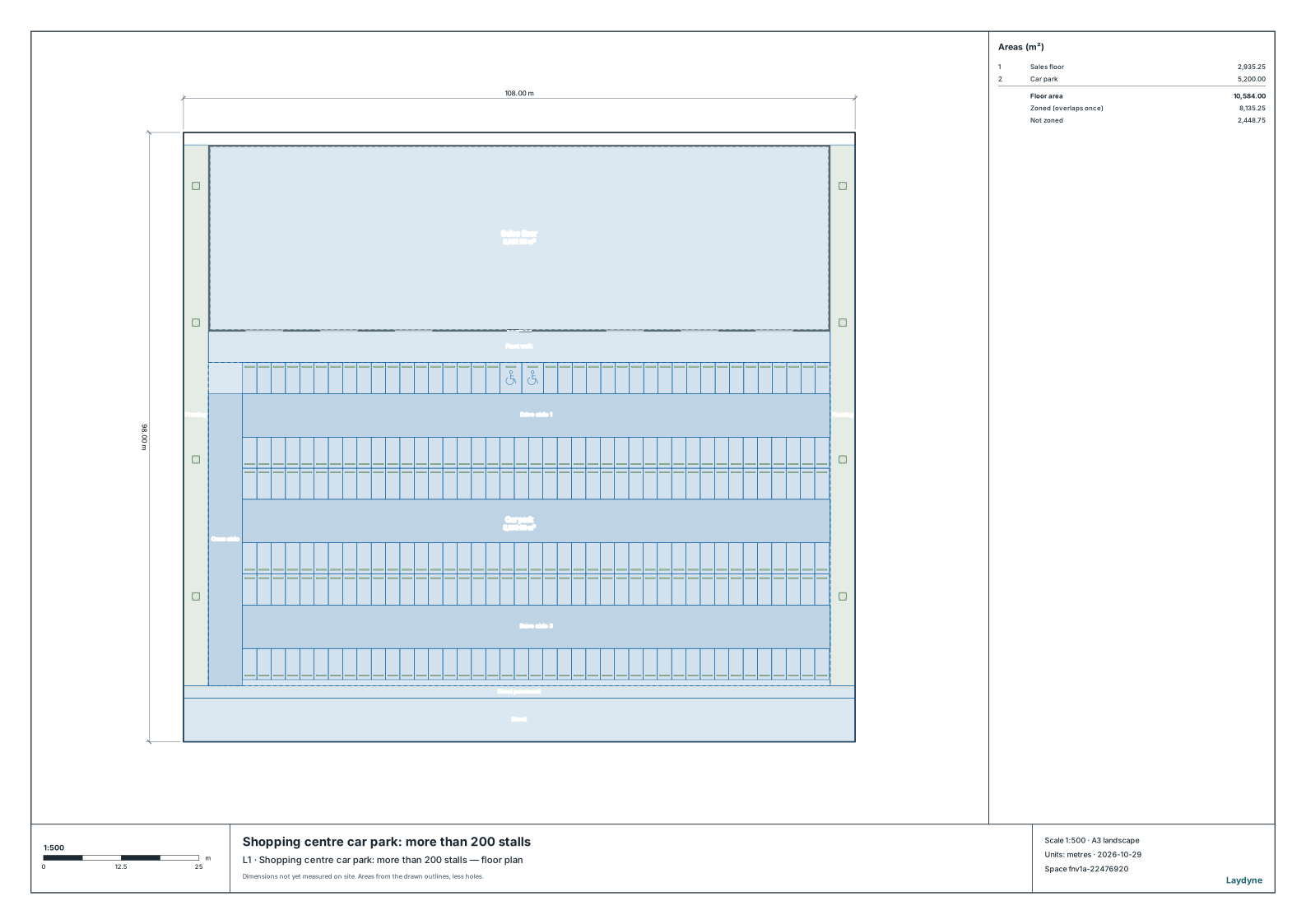
The AI counted the stalls with check_space: 245 stalls, 2 of them wheelchair stalls. The wheelchair stalls are kept for those who need them, so the simulation uses the 243 ordinary stalls (a car park of 245 stalls needs 5 wheelchair stalls in Japan: see the article on wheelchair stalls). The AI wrote this flow as a scenario (put_process_scenario).
- The centre is open 10:00 to 20:00. Cars come in at random, on a usual Saturday these many an hour (1,250 in the day):
| Hour | 10:00 | 11:00 | 12:00 | 13:00 | 14:00 | 15:00 | 16:00 | 17:00 | 18:00 | 19:00 |
|---|---|---|---|---|---|---|---|---|---|---|
| Cars | 60 | 110 | 150 | 170 | 180 | 170 | 150 | 120 | 90 | 50 |
- A car stays 75 minutes on average (22.5 to 142.5 minutes, most often 60).
- With no stall free, a car waits at the entrance. With 15 cars already waiting it drives on, and after 10 minutes without a stall it gives up.
- Every number and time is an assumption. Put in your own centre’s cars and times.
2. A Saturday through the day
The AI ran a usual Saturday and days of 20 % and 40 % more cars 20 times each (run_process_scenario), and read the stalls taken every 15 minutes (get_process_series).
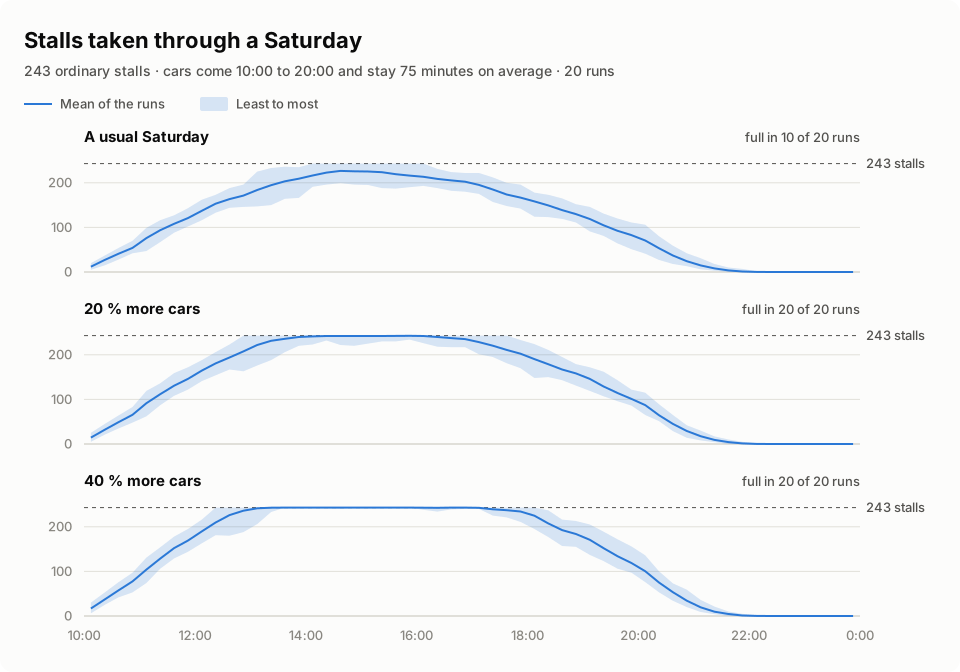
- Even on a usual Saturday, 226.6 stalls are taken on average around 14:30, and in 10 of the 20 runs the lot fills and cars wait at the entrance. It fills between 14:00 and 16:15.
- With 20 % and 40 % more cars, it fills in all 20 runs. With 40 % more, every 15 minutes from 13:30 to 16:00 has a moment when the lot is full, in all 20 runs.
3. The cars and how long they stay
The AI changed the cars that come (a usual Saturday, 20 % more, 40 % more) and the average stay (60, 75, 90 minutes) (sweep_process_parameters), 20 runs each.
| Cars | In the day | Stay (mean) | Drove on | Longest wait | Waiting at the entrance (most) |
|---|---|---|---|---|---|
| A usual Saturday | 1,252.9 | 60 min | 0.0 | 0.0 min | 0.0 |
| A usual Saturday | 1,252.9 | 75 min | 1.1 | 1.3 min | 4.2 |
| A usual Saturday | 1,252.9 | 90 min | 32.8 | 7.8 min | 15.0 |
| 20 % more | 1,505.9 | 60 min | 0.0 | 0.4 min | 1.6 |
| 20 % more | 1,505.9 | 75 min | 40.2 | 6.8 min | 15.0 |
| 20 % more | 1,505.9 | 90 min | 162.6 | 9.3 min | 15.0 |
| 40 % more | 1,759.7 | 60 min | 18.4 | 4.7 min | 13.6 |
| 40 % more | 1,759.7 | 75 min | 167.8 | 7.4 min | 15.0 |
| 40 % more | 1,759.7 | 90 min | 335.6 | 9.5 min | 15.0 |
- With stays 15 minutes longer, 90 minutes, 32.8 cars drive on without parking even on a usual Saturday: close to a day of 20 % more cars (40.2 at 75 minutes).
- With stays of 60 minutes, only 18.4 drive on even with 40 % more cars.
- The stalls taken are, roughly, the cars an hour times the stay (Little’s law). In planning a car park, look at how long a car stays as much as at how many come.
4. More stalls
At the average stay of 75 minutes, the AI changed the ordinary stalls (243, 270, 300, 330).
| Cars | 243 | 270 | 300 | 330 |
|---|---|---|---|---|
| A usual Saturday | 1.1 | 0.0 | 0.0 | 0.0 |
| 20 % more | 40.2 | 6.1 | 0.2 | 0.0 |
| 40 % more | 167.8 | 81.9 | 20.2 | 0.7 |
The numbers are the cars that drove on without parking (in the day, the mean of 20 runs).
- To take days of 20 % more cars, 300 stalls: 0.2 cars drive on.
- With 40 % more cars, 20.2 still drive on at 300 stalls, and 0.7 at 330.
5. How to use this
- Draw your car park (from a PDF of the drawings or photos too), and tell the AI the cars that come each hour and how long a car stays. The AI counts the stalls from the drawing.
- Not checked: cars driving in the car park and the aisles’ congestion, the time spent looking for a free stall, the traffic on the street, the pay stations at the exit, and sales.